
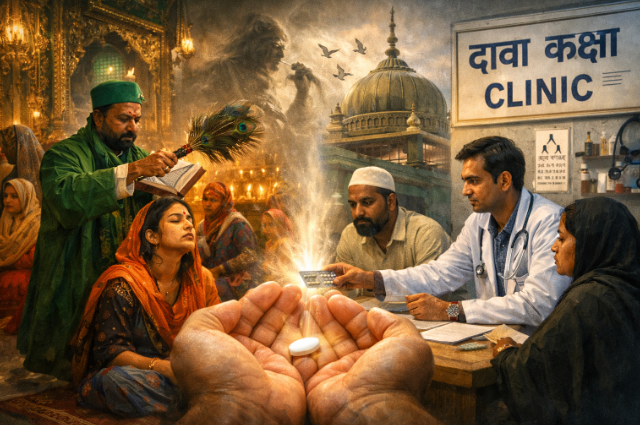
Cognitive dissonance is typically talked about in textbooks as an abstract psychological discomfort, a tension that occurs when cognitions (or thoughts/beliefs) and actions don't align. In Unava village of Mehsana district in Gujarat, however, cognitive dissonance is not merely a theory. Viewed through the lens of Leon Festinger’s Cognitive Dissonance Theory, the story of Mira Datar reveals how belief-aligned treatment can succeed where conventional psychiatric outreach has failed. It is a practical tool that has quietly transformed mental health care for tens of thousands of people. At the Mira Datar Dargah, a centuries-old shrine dedicated to the martyr Hazrat Saiyed Ali Mira Datar, a simple antipsychotic tablet is taken not as medicine, but as a “blessed pill,” believed to weaken spirits so that prayers may work faster. This reframing, subtle yet radical, lies at the heart of one of India’s most effective and least discussed mental health interventions.
Mira Datar Dargah is widely known across India as the “Supreme Court for spirit possession.” Families arrive from Gujarat, Rajasthan, Madhya Pradesh, and beyond, convinced that a loved one is possessed by a jinn. Clinical psychiatry, however, offers a markedly different diagnosis. Studies conducted at the shrine show that a large proportion of these patients meet diagnostic criteria for schizophrenia, bipolar disorder, or conversion disorder. The challenge for mental health professionals was never the absence of treatment, but access. Government psychiatrists sat in underused clinics while thousands sought help through faith. The gap was not logistical; it was cognitive.
This cognitive gap between medical knowledge and patient belief required a solution that addressed psychology rather than infrastructure. Hamlai’s motivation was deeply personal. His brother lived with schizophrenia, and his insight was sociological rather than clinical. He recognized that families were not ignorant of medicine; they simply interpreted illness through a spiritual framework that medicine refused to enter. Instead of attempting to replace belief with science, Altruist designed a system that embedded treatment inside belief. This system, now known as the “Divine Referral,” operates through cognitive dissonance reduction rather than confrontation. When a family brings a patient to the shrine, the Mujavir, or priest-healer, performs the ritual prayer. At the end, instead of declaring the work complete, the Mujavir issues a referral slip and instructs the family to visit the clinic within the dargah compound and take the prescribed “dava.” The explanation is critical: the spirit is strong, and the medicine will weaken it so the prayer can succeed. The patient swallows an antipsychotic tablet believing it is spiritually sanctioned. The belief system remains intact, but behavior changes.
Leon Festinger’s Cognitive Dissonance Theory explains why this works. People experience psychological discomfort when actions contradict deeply held beliefs, and they are motivated to reduce this discomfort. In rural Gujarat, instructing a patient to take psychiatric medication directly confronts a belief that the illness is spiritual, creating resistance. Reframing the medication as a spiritual aid eliminates dissonance. The patient is not betraying faith by taking medicine; they are strengthening it. Compliance increases not because beliefs are corrected, but because they are respected. Empirical data support this approach. A 2021 study analyzed patient records at Mira Datar from 2008 to 2018. It recorded treatment outcomes for more than 38,000 patients, many of them with histories of poor adherence to psychiatric care. The study identifies that financial incentive was not the deciding factor, but trust and symbolic authority were. Once Mujavirs endorsed treatment, stigma collapsed almost overnight. Medication compliance rates were significantly higher than in comparable rural outpatient clinics, and relapse rates dropped when patients continued follow-ups through the shrine-linked clinic. Importantly, interviews with 26 patients revealed that none described themselves as receiving “psychiatric treatment”; instead, they consistently attributed improvement to the combined power of prayer and medicine.
This is not an isolated observation. Another study documented the process through which Altruist negotiated with Mujavirs. Initially, priests saw doctors as competitors who would steal devotees. In time, they were won over by the belief that the clinic would deal with violent or severe cases that were beyond the shrine's capacity and would therefore ease their burden. As this study notes, what ultimately proved decisive was less the financial incentive than trust and symbolic authority.
While clinic-level outcomes proved to be successful, the larger importance of this model emerges when set against India's national mental health landscape. The National Mental Health Survey of India reported that roughly 83% of people with mental illness in rural areas receive no formal treatment at all. Stigma, supernatural explanations, and fear of social labeling are among the primary barriers. At Mira Datar, these barriers are inverted. The shrine provides anonymity, religious legitimacy, and community acceptance. Treatment is free under government programs, but the referral slip itself carries worth. To families, it is not charity; it is a sacred instruction.
Media documentation has further validated the model. The project was featured on Satyamev Jayate in the episode “Nurturing Mental Health,” where Hamlai explained how doctors intentionally allow priests to take public credit for recovery. If a patient improves, the doctor says it is the dargah’s blessing. This strategic surrender of credit is not incidental; it is essential. In community psychology, ownership of success determines sustainability. Ego, in this context, is a clinical risk factor.
International attention followed. The visuals are striking: patients waiting for prayer on one side and psychiatric consultation on the other, with no perceived contradiction between the two. For policymakers, the implication is profound. The question is no longer whether faith and psychiatry can coexist, but whether ignoring faith constitutes a failure of care. Critically, this model does not romanticize superstition or deny diagnosis. Schizophrenia remains schizophrenia, whether named or not. What changes is the treatment pathway. The Mira Datar model demonstrates that belief-congruent adherence may be more effective than belief-corrective education in certain contexts.
The economic impact is equally significant. Conventionally, families used to stay in Unava for weeks or even months, spending money on various rituals, accommodation, and food, often running into debt. Faster improvement of symptoms with the help of medication reduces this drain, thereby bringing mental health care in line with the core objectives of social work. The Supreme Court of India has cited the project as a best-practice model, recommending its replication in other states: a rare acknowledgment of a shrine-based intervention in formal healthcare discourse.
The “blessed pill” is not magic, nor is it deception. It is a case study in applied psychology, cultural humility, and systems design. By resolving cognitive dissonance instead of provoking it, Altruist transformed faith healers from obstacles into allies and shrines from sites of delay into gateways of care. It thus offers a lesson that is both timeless and timely for a country where millions go untreated, not because of any lack of medication, but because of a lack of meaning: healing begins where belief is recognized rather than suppressed.
. . .
Sources:
- Altruist. (n.d.). About the organization. https://www.thealtruist.org
- Festinger, L. (1957). A theory of cognitive dissonance. Stanford University Press.
- Government of India. (2016). National Mental Health Survey of India, 2015–16. Ministry of Health and Family Welfare. https://www.nimhans.ac.in
- Hamlai, M., Shah, A., & Patel, V. (2021). Unique collaboration of modern medicine and traditional faith-healing for the treatment of mental illness: Best practice from Gujarat. ResearchGate. https://www.researchgate.net
- Shields, L., Kirmayer, L. J., & Hamlai, M. (2016). How can mental health and faith-based practitioners work together? A case study of collaborative mental health in Gujarat, India. Transcultural Psychiatry, 53(6), 768–789. https://doi.org
- Satyamev Jayate. (2014). Nurturing mental health (Season 3, Episode 5) [Television series episode]. Star Plus. https://satyamevjayate.in
- PBS NewsHour. (2015). India mental health care [Video]. Public Broadcasting Service. https://www.pbs.org