
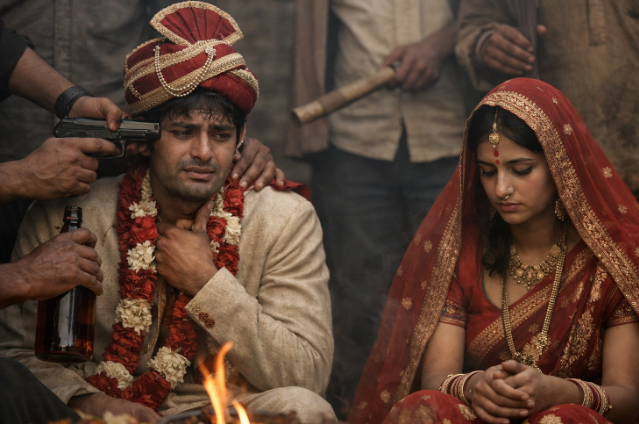
Dowry is generally presented as a social problem that weighs on families, degrades women, and commodifies marriage. However, there are regions of India where the aftereffects of the practice are more than just a debt or a social stigma. In a large area of Western Bihar and Uttar Pradesh, the practice of dowry has, over time, taken a turn for the worse, becoming an economy where ‘force replaces consent, where life takes precedence over morality. Groom kidnapping, or Pakadwa Vivah, is "not an exception to the practice of dowry, but one of its more extreme manifestations." Pakadwa Vivah is not merely a case of misinterpreted consent, but one in which survival instincts override consent altogether, a grim calculation historian Sharad Kohli describes as necessity eclipsing choice. Essentially, pakadwa vivah is less about improperly performed marriage customs and more about what happens when dowry demands reach economically unsustainable levels. Government servants such as teachers, railway employees, clerks, and engineers are viewed as scarce resources, as if they are precious commodities. The demand for dowry could be anywhere between ₹20 lakh and ₹1 crore. For families with daughters, particularly those owning less land and having less income, such amounts are not unreasonable; they are impossible. Being in debt, losing land, and living in debt—are these alternatives? The act of abducting a groom becomes a perverse protest against the system. Thus begins the violence that follows as ritual. Grooms are kidnapped, threatened with violence, beaten, and forced into marriage rituals. Videos on the Internet depict the terror-stricken men being forced into performing spiritual rituals at gunpoint with liquor bottles pushed against their backs to apply sindoor to their brides. The institution of marriage, which comes with the taint of commoditization, falls apart when subjected to the use of force. While this practice reached saturation points in the 1990s through the early years of the 2000s, there were reported cases every year; these would not be by any means exhaustive.
But the actual darkness in dowry systems is not just in the violence of the abduction but in the consequences that ensue. In a counterintuitive twist to common beliefs about such systems, the common practice among the abducting grooms is not to escape after the initial threat has abated but to stay in the marriages. This is generally taken as a symbol of compromise or submission, but actually symbolizes the violence that the dowry economy enforces. In essence, these marriages cannot be abandoned since the bride will be socially ruined in the process. She was probably given little choice in the matter to begin with. This type of activity is sometimes referred to in psychological terms in accordance with survival patterns in hostage situations—not a psychological diagnosis, of course, but a model of how people psychologically prepare for and cope with situations of ongoing threats. What looks like consent is actually a negotiation with risk. What looks like stability is actually endurance.
The dowry system, therefore, expands outwards in terms of the creation of harm, accomplishing a gendered sort of violence that permeates through the gender lines to encompass a wider generational violence. Women are the obvious sufferers here, but the pakadwa vivah reveals that men are also brutalized through the same mechanism. There is neither diminishment nor obscuring of patriarchy here, but a revealing of the profound rootedness of the economic valuation of marriage. When dignity is reduced to the price of lakhs, the use of violence ceases to be an aberration. This reality is not lost on communities. They are cognizant of the violence, but they facilitate it because it provides an opportunity for economic salvation. Thus, pakadwa vivah can be said to be a moral compromise in this sense, where the violence remains, albeit rearranged in different areas of people's lives. Where there had been a debt imposed upon a family through dowry, there is now the absence of autonomy, security, and choice for another family. For many years, the law reflected this silence and classified disputes simply as “family disputes,” and forced marriages were hardly ever annulled, despite completing the rituals of marriage.
Finally, there was a turning point in November 2023 when the Patna High Court held that marriages by force are null and void. Yet the law can only do so much. It can strike down a marriage, but it certainly can’t wash off the stigma that the bride has to bear. It can’t dispel the social notion that strength lies in endurance. And it definitely can’t dismantle the economic conditions that promote it—the unemployment, the fetishization of government jobs, and the normalization of the practice of dowries.
Pakadwa Vivah ultimately unmasks the most sinister fact about dowry. This fact reveals how, when marriage turns into a market, morality can become a bending notion. Consent will be conditional. Violence will be procedural. Survival, not choice, will become This is because societies do not normally support and perpetuate injustice due to ignorance of the same, but due to the willingness to tolerate certain injustices. Pakadwa Vivah may be a practice that not only survives because of a lack of moral awareness but also because of the effectiveness of the dowry system in training society to be content with damage control rather than seeking justice. It will not cease to be a reality until the transactional nature of marriage, the cost of dignity, becomes a thing of the past.
Sources:
- Tewary, A. (2023, December 11). Happily never after: bachelor blues in Bihar as the practice of pakadwa vivah persists. The Hindu. https://www.thehindu.com
- Singh, B., & Law, L. (2023, November 26). Patna High Court annuls Hindu marriage, noting man was forced to apply Sindur at gunpoint, emphasizes. . . Live Law. https://www.livelaw.in