
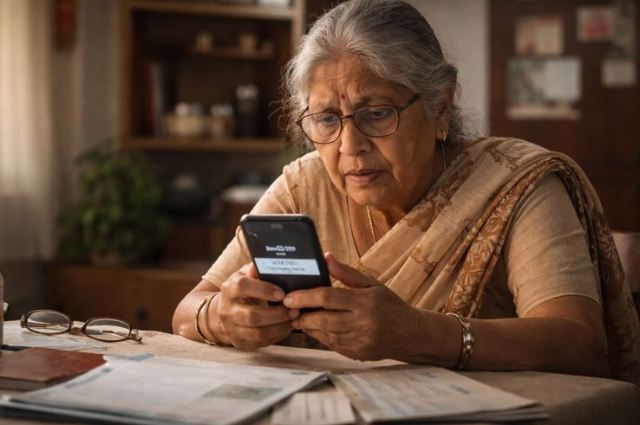
The internet was designed by designers as a slick and speedy technology, and it speaks volumes for their skill: for millions of older people, life is becoming a series of mini-rejections. OTPs expiring before they can be entered; fonts so small they wouldn't be an issue if the bleary eyes belonged to a mountain goat; layouts morphing to a new design in the middle of the night; interfaces that require lightning-quick switching between tasks without needing to remember any of the millionths-of-a-second password combinations. It's not just a few niggles; rather, it amounts to a new form of exclusion in the mould of the black staircase or the high curb: the grey digital divide, a genteel ageism in which the default user is automatically young, quick, and tech-savvy, and everyone else needs to “adapt.”
Are applications inherently designed to function independently of older bodies and minds? The data is telling. Despite the rising number of older adults in many parts of the world who are using applications, there is still a way to go to ensure full equality of access for older adults. For instance, in the U.S., there was an increase within the last decade in the number of Americans aged 65+ owning smartphones, though many lacked access to the internet and had difficulty with usability models for many smartphones. Currently, in India, some 15% of Indians aged 15 and older reported not using a phone in the three years leading up to 2023.
Such figures are important because the critical services that matter, like banking, pensioning, healthcare, and welfare, are quickly shifting to app-based interfaces. By requiring national services to migrate online via designs that are not senior-friendly, seniors are simply excluded. Why, then, does the responsibility to “learn to adapt” lie with seniors rather than the systems themselves? The beginning of this argument has to do with blind spots created by the free market. In reality, design organisations will naturally optimise systems for their greatest beneficiaries: younger, richer, and more urbanised people. “Bells and whistles” that detract from the smooth interface, such as senior-friendly interfaces, numerous linguistic voices, and simplified login processes, will naturally seldom be considered aspects that should be integrated since such elements appear esoteric and expensive. The implication, then, is that the inclusion of seniors has become the problem, not the lack. If seniors don’t work well with apps, then they should simply “get the help they need” rather than requiring apps to accommodate their requirements. However, this represents the reverse argument that accessibility represents that in the sense that ramps, accessibility lifts, and Braille signs needed to be integrated into buildings precisely since they were built with people like seniors in mind. Technology exclusion represents the same idea, since the bias represents the same exclusion based on the type of people that technology has in mind. Exclusion here doesn’t get fixed since the exclusion represents the natural choice rather than the natural flaw in the systems themselves.
This exclusion has severe impacts. There are growing cases of cyber fraud against the elderly, with disturbing amounts being lost to online fraud, which includes the misuse of OTP verification, misleading links, and social engineering manipulation driven by digital illiteracy. During the period 2023-2025, the various districts and the city's cybersecurity team have reported hundreds of incidents where the elderly have been cheated out of crores in online frauds constructed on WhatsApp or fake investment proposals.
In addition to fraudulent activity, going offline has a number of other psychological and civic implications, including feelings of loneliness, having to rely on family or agents to conduct simple transactions, and loss of telemedicine and welfare information, which can be particularly harmful to older adults’ health. National ageing studies point out links between lower levels of digital inclusion and symptoms of depression and vulnerability to mental decline in later life. Second, the problem has a language and culture component as well. Many public websites and private applications are biased towards English and minimalistic UI patterns, which are inaccessible to seniors, who are “verbally savvy but language-impaired,” meaning that while they are fluent and articulate in regional languages, those are poor substitutes for “tech-English.”
Organisations such as HelpAge India have set up digital empowerment centres to target seniors, both urban and rural, and provide training that has proven that a small outlay of effort and a “less is more” approach definitely leads to a higher sense of agency among seniors in digital spaces, but are clearly inadequate on a larger scale.
Digital accessibility architecture can be improved similarly with regulations to ensure basic usability for the over-65s as a means of making online access viable for people with visual or other impairments in their advanced years. This would also make apps accountable for use by the over-65s if a design puts users at risk. Solutions are already available in the technical space. Financial services can provide low-resistance alternatives to SMS OTPs (secured biometrics in branch and call-back). Methods of verification and extended OTP times, banks can provide assisted access solutions for elderly clients, and telemedicine services can enable “assisted” consultations with a trusted relative without compromising patient privacy. Design communities should begin and end with “elder personas” and conduct prototype testing with seniors in both rural and urban environments as a necessary step, rather than an afterthought.
The elders should not be seen as mere recipients of charity but rather as people who have the right to dignity and participation in the digital world. The fact that one will be left behind cannot be referred to as progress. The needs and voices of the elders should be embraced if a truly inclusive future is to be achieved.
References:
- Waghmare, A. (2025, November 18). Access to phones and the internet. Data for India. https://www.dataforindia.com
- Greenwood, S., & Greenwood, S. (2025, April 24). Mobile Technology and Home Broadband 2021. Pew Research Centre. https://www.pewresearch.org
- Cg.Sankar. (2025, October 17). 184 elderly lost 50cr in last 34 months: Data. The Times of India. https://timesofindia.indiatimes.com
- Kużelewska, E., Tomaszuk, M., & Malinowski, D. (2025). The Elderly Digital Divide: Digital Exclusion Versus the Right Not to Use the Internet. International Journal for the Semiotics of Law - Revue Internationale De Sémiotique Juridique. https://doi.org