
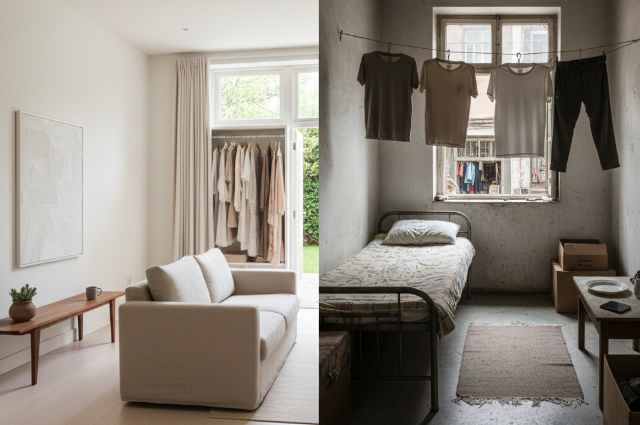
Minimalism, which started as a trend, has become one of modern living's most romanticized ideas: sleek, aesthetic, calming, and (at least on social media) shockingly easy. One clean white shelf with a single candle. A capsule wardrobe of fourteen pieces that somehow creates a hundred outfits. A life free from clutter, chaos, and the consumerist noise that defined the previous decades. The idea is like a siren’s whisper: that freedom comes from owning less, buying less, and detaching from material excess and leading a peaceful life. But beneath the soothing beige tones and perfectly curated spaces lies a truth that often goes unspoken—that minimalism, at least in its trendiest form, is a luxury accessible to only a few. The social divide embedded within the movement raises uncomfortable questions about who gets to choose "less," who is forced into it, and why society celebrates only the partial truth.
Popular minimalism has always been a product of privilege. For so many, the decision to live with fewer possessions is a philosophical choice driven by a need for clarity, mindfulness, and simplicity. These individuals clean out their closets not because they have to, but because they want to. They purge excess only once they have experienced excess. Their minimalism is a stylized aesthetic, bolstered by the financial safety net without fear. But a huge swathe of the population never had the luxury of clutter to begin with. Their minimalism is not intentional; it is circumstantial. It is the forced minimalism of those for whom owning "less" has always been the only option. The person who has lived with the same three shirts for years out of necessity is rarely part of the narrative.
This divide is widened still further by the commodification of minimalism. It is an ironic twist; the movement that started by rejecting consumer culture has, in turn, been co-opted by it. Brands have managed to make “less” into a premium product somehow. High-end labels market the idea of having fewer but “better” things, where “better” almost universally translates to expensive. Now, because it's “minimalist,” that plain white T-shirt just got more costly. And that simple lamp is a statement piece because of its bare design alone. Scarcity becomes sophistication, and consumers are taught that the path to simplicity is actually lined by curated purchases. The cycle is almost comical: buy more to look like someone who buys less. Decluttering has come to be an industry itself, with organizers, consultants, and full brands making good off the right to simplify. The absurdity of marketed minimalism was unwittingly exposed by Marie Kondo, who popularized the decluttering movement worldwide. Even the queen of decluttering relied on selling more things to encourage owning fewer as her brand expanded into books, Netflix series, organizing gadgets, and a full-fledged online store. And instead, minimalism is just another aspirational lifestyle being sold back to consumers. It has become about spending right. And “right” usually means “expensive.” According to a 2024 global consumer survey, households earning over ₹15 lakh per year were three times more likely to identify as “minimalists by choice” compared to households earning under ₹4 lakh. In India, urban professionals adopting minimalism often cite influencers or global trends as inspiration, while lower-income families label their lifestyle not as “minimalism” but simply “managing with what we have.” In one telling example, a Delhi-based family earning under ₹3 lakh said they owned only two sets of bedding and minimal cookware—not because of a curated aesthetic preference, but because replacing old items was financially difficult. The divide is quiet but important: when minimalism is a choice, it becomes commendable. When it is the result of financial strain, it becomes invisible.
While physical clutter takes center stage in the minimalist conversation, one form of clutter is rarely discussed: digital clutter. Modern minimalists may live in immaculate, spacious homes with neatly folded sheets and nothing out of place, yet their digital lives tell a different story. People may own fewer physical objects, but they accumulate millions of photos, thousands of unread emails, dozens of half-watched YouTube videos, and endless saved posts "for later." (Did you know that the average person stores 2,300+ digital photos they never revisit?) Cloud storage becomes a chaotic attic. There is a misconception that digital clutter is innocuous because it is invisible and weightless. Yet the psychological burden could be heavier than the weight of any closet. Digital overload has been associated with anxiety, distraction, and decision fatigue. Even those who take tremendous pride in their tidy layouts and clutter-free rooms can get sucked into digital spaces that are much messier than the houses they post online. In truth, minimalism usually ends at the screen.
But the cultural celebration of minimalism reveals more profound problems of unstable economies, increasing rent, tiny living spaces, precarious employment, and the imperative of fitting in. Young adults who are forced to live in small apartments may romanticize their meager possessions as a lifestyle decision. Aesthetics cushion the sting of frugality. In nearly every way, minimalism is a miniature socioeconomic landscape: some practice it to flee the din of plenty; others to discover honor within paucity. All the contradictions of minimalism lie more frankly in the digital age. Social media influencers are making their homes squeaky-clean oases, where color-coded bookshelves, linen bedding, and cleansed kitchen counters supply images of spotlessness. Their spaces function as a sort of visual benchmark, and minimalism becomes a performance for the camera backstage rather than an earthly event. Many influencers own much more than what appears on screen; they simply hide it. The "clean" lifestyle becomes another competition, another unrealistic standard, another source of discontent. Even environmental arguments—though well-intentioned—can double back into consumerism: sustainable products, eco-friendly replacements, and minimal-waste tools often cost significantly more. Minimalism in this way is less about reducing consumption and more about consuming differently. This is a nuance the conversation around minimalism needs to recognize: a minimal life is not inherently superior; owning less does not inherently make someone more mindful, conscious, or environmentally aware. And the ability to part with possessions without any financial fear is a privilege in itself. True minimalism—the kind that leads to mental clarity and intentional living—cannot be bought. It begins with self-awareness and needs to acknowledge that less is not freedom but a limitation not chosen by many. It's time for the minimalism movement to be more than the sum of its parts: an aesthetic choice, a visually pleasing space, and the envy of Instagram followers. It needs to recognize its socioeconomic blind spots, its digital contradictions, and the ways it has been co-opted by consumer culture. It is only through this that minimalism may yet become what it was originally meant to be: not a lifestyle to aspire to, but a mindset to practice. After all, the luxury of less is not about having fewer things; it is about the privilege of choosing what to keep. And for many, that choice is just what they don't have.