
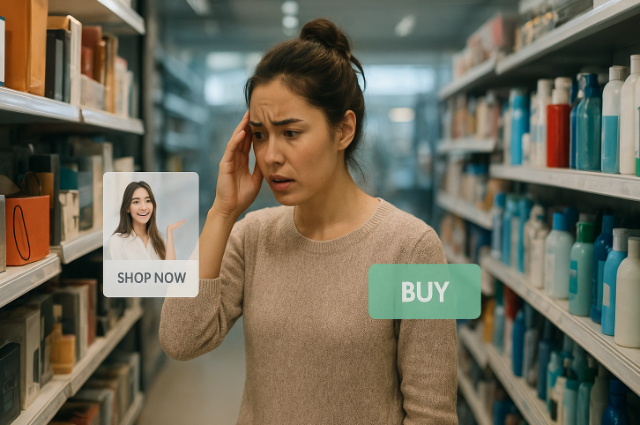
Imagine it's the 20th century; our grandparents have gone out to buy some home decor items. They go to their trusted shop, and within the next hour, they’re back, and everyone is happy and appreciative of the item they’ve bought. Now compare the same situation in 2025: you’ve explored hundreds of shops in real time, viewed another fifty on online shopping sites, and taken a few opinions of your trusted friends, and yet, are nowhere close to deciding what you want. Even when you have shortlisted a few items, you’re still unsure of the style you want—minimalist, traditional, or bohemian.
This is what the concept of “paradox of choice” is. What once was seen as having not a lot of options is now being turned into “decision fatigue” or, simply, decision anxiety. Similarly, the concept of what a need was earlier has evolved over time. Today, a human’s wants take precedence over his needs if he has enough resources. Every purchase today feels like a test of class status, prestige, and identity. What if there is a better deal in the sale? A newer model? A trendier version? Choosing has become a Catch-22 decision.
Consumerism, at its root, is no longer about meeting human needs but about creating new ones. Every product, commercial, and limited-edition drop is meant to remind us that what we have is no longer sufficient. The phone you purchased last year feels out of date. The fear of missing out, or FOMO, dictates our decisions more than the actual utility of the product.
This loop is subtle but unrelenting. It all starts with a trigger: a picture-perfect billboard, a well-lit influencer post, or a friend flaunting a new purchase. It leads us to alter the way our brain works so that happiness, confidence, and even self-worth can be bought. Consumerism sells feelings, not stuff. A sense of belonging, importance, and identity. The vocabulary of marketing has changed from "you need this" to "you deserve this." Furthermore, this desire keeps us distracted from certain factors like affordability within means and limited space. We are inclined to "treat ourselves," but we rarely think about why we need it in the first place. The truth is that consumerism thrives when we are somewhat dissatisfied, not entirely content.
In the process, we have blurred the distinction between who we are and what we own. Consumption has evolved into a type of identity building. From what we wear to the businesses we support, our purchases have become a reflection of ourselves. But behind the shadow of this manufactured self is exhaustion, the quiet understanding that we're chasing versions of bliss that were never ours to begin with. People who deeply value spirituality already understand the mirage of this illusion.
But the price we pay is not solely monetary. It is psychological, environmental, and fundamentally human. As consumers, we are conditioned to associate abundance with happiness. The more the merrier. However, the more we accumulate, the more fragmented our feeling of fulfillment is. Our desires grow faster than our satisfaction. This is the irony of modern life: we have everything, yet it never feels like enough. However, this is not an accident; it is intentional. Consumerism is an ideology that thrives on unhappiness. So the system ensures that we are never satisfied for long. Trends evolve faster, items are replaced more frequently, and algorithms understand our vulnerabilities better than we do. Even our perception of "choice," what we believe to be free will, is influenced by targeted ads and subtle persuasion. And what may seem like an idea that was ours to believe in, isn’t.
The environment also bears one of the greatest loads of our imagined needs. Landfills overflow with the remains of our fleeting aspirations: abandoned clothes, gadgets, packaging, and plastics, while industries compete to meet ever-increasing needs at the expense of sustainability. Every click, purchase, and delivery leaves a hidden ecological footprint. The earth is paying the price for our illusion of endless choice. Socially, too, the cost runs deep: consumerism has changed how we relate to one another. Friendships are often formed over shared brands, not values. Love itself has been marketed: dates, proposals, and weddings are all wrapped neatly in aesthetic expectations. Our lives have become commodities, polished for consumption. But maybe the most painful cost is the decline in satisfaction. We are constantly told that our next purchase will complete us, but each one leaves us feeling a little empty. The promise of satisfaction has evolved into a want treadmill, on which we run but never get anywhere.
Despite the noise, there is a silver lining: a growing realization that more isn't necessarily better. Minimalism, sustainability, and mindful consumption are gradually emerging as counter-movements, led primarily by those tired of pursuing the illusion of "enough." People are starting to wonder, "What do I really need?" Conscious consumption is becoming more than just a phrase; it is becoming a movement, a quiet resistance against luxury. It is not about giving up modern pleasures but about restoring balance. It also gives our earnings a purpose, something bigger than just mindless spending, maybe to save for experiences that matter. Between want and worth, satisfaction and greed. In a world that thrives on our self-doubt, conscious consumption is an act of self-respect. It is deciding to live thoughtfully, to spend purposefully, and to let meaning, not marketing, determine our wants.
In the end, the price of needs, perhaps, is that we’ve forgotten how to want less. But awareness is where the change begins. Slowing down, questioning, and making intentional choices allow us to retake control from the never-ending cycle of desire. The goal was not to stop wanting, but to begin wanting wisely. Because true fulfillment does not come from having too much stuff. It is found in peaceful satisfaction with enough and making the most of what we have.