
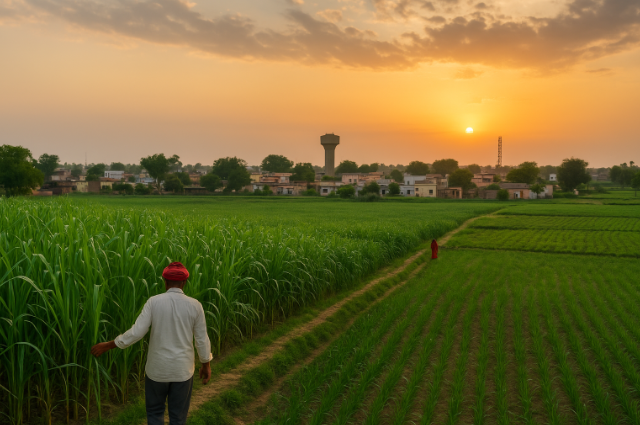
The small town of Indri in Haryana had lived, for many years, outside the national imagination, a quiet settlement not far from Karnal, with its fields and sugarcane crops, its rhythm of life determined by agriculture. It was best known to those who lived around it or to those who used the narrow roads that cut across it on the way to bigger cities. But over time, Indri found itself becoming synonymous with headlines it never asked for. Like so many small Indian towns, it briefly entered the public conversation because of a tragedy that cast a long shadow, one that became an unfair lens through which outsiders viewed it. That moment of history remained etched in its name, overshadowing the everyday reality of a town that could have been so much more than one incident.
Yet, communities do not remain hidden in the shadows of their past. Over the last decade, Indri has transitioned quietly, yet decisively, into a reshaping of identity via development, agriculture, education, and resilience. Today, the town is reclaiming its story, one painstaking step at a time, out of the shadows into a more hopeful and grounded future.
Growth in Indri is linked to broader economic changes sweeping through Haryana. Agriculture remains the backbone, but it has indeed become central to growth through diversification. According to data from the Haryana Department of Agriculture, the region recorded a 14% rise in vegetable output between 2018 and 2023, thanks to improved irrigation and farmer-training programs. Indri, lying along fertile belts, has benefited considerably from these changes. On a very local scale, farmers have been experimenting with micro-irrigation methods, higher-yielding seed varieties, and soil testing programs that are fully or partially supported by the government. These sources have raised household incomes not only by increasing harvests but also by paving the way for families to invest in education for both the male and female children of their households and lending aid for small businesses.
This education has further played a very important role in reshaping and prospering the identity of Indri. Over the past several years, the literacy rate in the Karnal district has grown steadily as well, reaching 75.4% as of the 2023 Haryana Statistical Abstract. The rise is not the global standard, but this has brought a much-needed change and a quiet revolution. Local schools have expanded infrastructure, digital learning programs under state initiatives have been introduced, and more children, especially girls, are pursuing secondary education.
One of the most surprising developments is its modest but growing entrepreneurial landscape.
Increased local manufacturing, particularly in agro-processing and packaging, has been a function of the support through the Micro, Small & Medium Enterprises Development Scheme. Indri observes the emergence of new businesses that employ young people, such as rice mills, seed processing facilities, dairy cooperatives, and small logistics services. Under the regional mobility plans, the town's infrastructure and public areas have been improved, with more public transportation routes and connectivity.
However, the emotional transformation Indri has undergone cannot be quantified. Places of tragedy often have a double burden: the suffering felt within and what is imposed long after by outsiders. The residents of Indri keep talking about how the most difficult thing was not what had occurred but how their home was reduced to a single narrative. And, over time, the community moved from denial into determination—a need to signal the reality of their town: fields at the break of dawn, festivals, minor triumphs of everyday living, and the hope that a place's story can be rewritten.
To be sure, look at the growing environmental effort by Indri: the area around Karnal recorded the planting of over 3 lakh saplings between 2021 and 2024 under state-led green initiatives, part of large-scale afforestation and micro-forest projects. The passionate involvement of schools and local youth groups in these projects has signaled a new era of environmental responsibility in Indri. These projects have generated a growing interest in ecotourism and rural experiences due to the proximity to historical and cultural monuments, as well as the stunning natural surroundings of Karnal.
It would be very easy to idealize this transformation, but the truth is far more matter-of-fact. Indri is still a developing town that faces challenges like infrastructure, youth migration, dependence on seasonal agriculture, and the long-term task of changing public perception, which is something time can attest to eventually. But progress does not need perfection; it requires direction. And Indri most definitely has one. Most importantly, this journey depicts something universal: no place deserves to be defined solely by its darkest moments. Communities grow, heal, evolve, and move forward even when history and people with rigid mindsets try to anchor them to one chapter. It's not a story about tragedy, but one about resilience, development, and the quiet determination of everyday people who continue to build a future one step at a time while living with the whispers. The shadow over Indri does not go away completely; shadows rarely do. But they have shrunk in size, not because the memory has been erased, but because the town has grown larger than the memory. And maybe that is the most honest kind of healing: a community laying claim to its name not by denial but through progress speaking for itself.
. . .
Sources:
- Ministry of Agriculture – Agriculture Statistics at a Glance 2023
- Government of Haryana – Economic Survey of Haryana 2024
- Ministry of Rural Development – PMGSY Progress Report 2024