
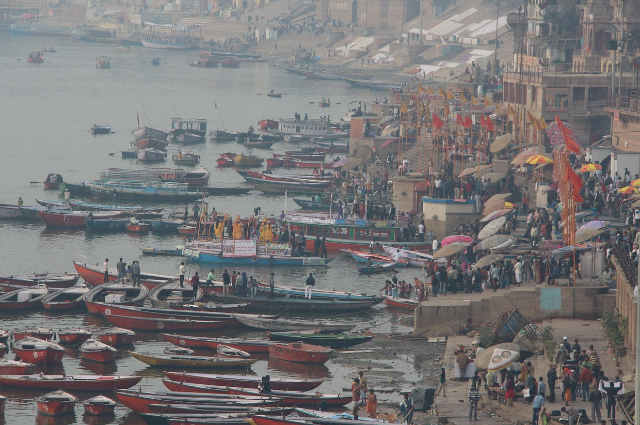
The first rule is not written anywhere, but everybody who comes learns it quickly, almost like a rumour blown from one breath into another: This is not a place for suicide. This is only for natural death. In a city dripping with propaganda about liberation and eternity, Kashi Labh Mukti Bhavan in Varanasi deals with something far more fragile: the last fifteen days of a human life and the ethics of how those days unfurl. From the outside, it looks like just any other old guesthouse tucked behind a narrow lane: peeling paint, a quiet courtyard, and a staircase mellowed with use. But the air inside carries a different quality altogether. People check in not to recuperate, not to rest, but to die. They get a simple room, a priest, minimal facilities, and a deadline. If they don’t die within roughly fifteen days, they are asked (courteously) to go home and “live a little more.” Over the decades, between 12,000 and 15,000 people have died within the walls, making it one of India’s most condensed spaces of conscious dying.
The staff never allow the place to be romanticised as a spiritual shortcut. They insist on drawing a strict line: Mukti Bhavan is not a refuge for despair, not a destination for those contemplating suicide, and not a sanctified space for euthanasia. Journalists observing the place have noted how often the caretaker repeats the same words: We are not here to kill anyone. We are here so people may die with dignity, not by choice, but by nature. Entry itself becomes an ethical judgment. The manager quietly assesses whether a person is close enough to the end or whether they are simply searching for an experience or an escape. The dying are admitted; the merely tired are sent away. This gatekeeping may appear harsh, but it protects the very soul of the place. In a country where an estimated 7–10 million people need palliative care and fewer than 4% receive it, Mukti Bhavan occupies an ambiguous intersection of hospice, hostel, and spiritual home. It does not accelerate death. It only refuses to let death be a lonely, bureaucratic afterthought.
Every day life inside the Bhavan is a set of rituals, like the ringing of temple bells at dawn and priests chanting verses. At dusk, tulsi leaves are placed near the chapped lips of oncoming death, and a few drops of Ganga water are offered. When someone dies, there is nothing but a quiet acceptance: eyes are shut, the body cleaned and wrapped, incense burned, and then, the room readied for the next person. These are not just acts of religious observance; they are ethical pledges. They say: you will not die unattended, unspoken for, or unacknowledged. In a country where people often die on crowded wards or on stretchers in corridors, the simple dignity of these gestures is almost radical.
One of the most striking real stories from Mukti Bhavan is that of Ram Sagar Mishra, a Sanskrit scholar who arrived certain he would die on the sixteenth day. For forty years, he had not spoken to his younger brother because of a quarrel that literally split their home into two. As his predicted day approached, Mishra asked the manager to summon his estranged brother. The man arrived, hesitantly, and for the first time in decades, the two men held hands. Mishra asked him to tear down the wall between their homes when he returned. In the middle of this reconciliation, Mishra’s voice faded. He died while making peace. Stories like this are not rare here. Mukti Bhavan functions not only as a place to die but also as a container for last acts: apologies, blessings, redistributions of property, and last words murmured between breaths. The ethics of the place are shaped not by policy but by these daily human negotiations. The most hotly debated feature is the fifteen-day rule. On paper, it sounds clinical that you either die within two weeks or vacate the room. But in reality, it is more compassionate than it sounds. With just about a dozen rooms and upwards of 20,000 ailing pilgrims arriving in Varanasi each year seeking salvation, the staff has to choose who gets to spend their final days here. Those who do begin to stabilise—who start eating better, moving more, and regaining some strength—are told, often with a half-smile, "It appears God wants you to live longer." They are sent home not as failures but as survivors, while someone more fragile takes their place. The rule is not to limit life but to make sure death does not become a matter of competition for beds. And it is precisely for this reason that the staff deny people contemplating suicide: to admit them would reduce this house of natural passing into a sanctuary for self-chosen death. A violation of the very promise that governs the Bhavan.
None of this is happening in a country remotely prepared for the moral onus of dying. Studies indicate, repeatedly, that India provides some of the worst access to end-of-life care in the world. Millions require palliative support; a sliver gets it. Families cope with emotional grief and impossible medical bills. Hospitals extend life on machines but rarely comfort the person slipping away. Mukti Bhavan, in this landscape, is both a haven and a symptom for those who make it and a reminder of how little support there is elsewhere. Behind its walls, ethical questions arise every day: How much truth should families speak to someone dying? At what point does hope become cruelty? Is it moral to pursue painful treatments when death is certain? Should someone be allowed to stop medication if they so wish? No handbook exists to answer these questions. The staff fall back upon accrued wisdom, on men like Bhairav Nath Shukla, the longtime manager who has seen over 12,000 deaths and can summarise his lessons in lines of startling simplicity: Resolve your conflicts early. Live simply. Don't wait till your last day to be honest and kind.
If Mukti Bhavan has a single unspoken rule, it is this: death will not be rushed, but it will not be hidden either. In a world that medicalises dying in ICUs and romanticises it in film scripts, this small guesthouse in Varanasi treats death as daily work—beds to clean, lamps to light, rituals to perform, and families to console. It does not offer beauty or spectacle. It offers presence. And in doing so, it offers something that India often fails to give its dying citizens: company, dignity, and moral clarity. In a society that often treats death as failure and grief as an inconvenience, Mukti Bhavan's promise stands out like a flame in a dark corridor. It refuses despair, refuses spectacle, and refuses to speed up the end. Instead, it delivers a quiet, almost defiant truth—one that cuts through the noise of the city, through the smoke of the ghats, through the illusions we build around mortality: the way we let people die is the truest measure of who we are.
. . .
References:
- Desk, T. L. (2025, February 24). Mukti Bhawan: A house in Kashi where only the dying people are allowed. The Times of India. https://timesofindia.indiatimes.com
- The Indian Panorama. (2015, October 30). A Hotel where people check in to die. https://www.theindianpanorama.news
- Dutta, T. (2022, September 30). Inside India’s “death hotel”: where believers come not for hospitality but for salvation. The National. https://www.thenationalnews.com
- Varkey BPA, Ghoshal A, Salins N, Mayland CR. Mapping end-of-life care in India: a scoping review to identify gaps in policy, practice, and psychosocial support. BMC Palliat Care. 2025 Jul 7;24(1):189. Doi: 10.1186/s12904-025-01825-z.