
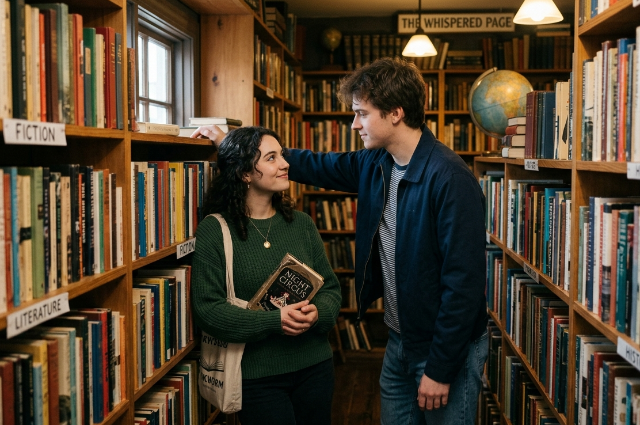
In a quiet corner of a bookstore, where the scent of paper lingers like a memory and time seems to slow its restless pace, a fleeting moment unfolds—soft, intimate, almost whispered into existence. Amid rows of neatly arranged books, two young individuals find themselves suspended between curiosity and connection, as though the world beyond those shelves has gently faded away.
The setting is unassuming, almost ordinary. Wooden racks stacked with stories, knowledge, and countless untold emotions create a backdrop that feels both grounding and surreal. Yet, what transforms this space is not the books themselves, but the pause between them—the silence that allows something unspoken to bloom.
The young man leans slightly closer, one hand resting above, creating a cocoon of privacy in a public place. His posture suggests hesitation, but also a quiet certainty, as though he has found something worth lingering for. The young woman, in response, meets his gaze with a softness that speaks volumes. Her expression is not hurried, not uncertain—it is calm, knowing, almost as if she has been waiting for this very moment to arrive.
What makes this scene particularly striking is its simplicity. There are no grand gestures, no dramatic declarations. Instead, it is built on the subtle language of proximity—the closeness of two people navigating a delicate emotional space. Their connection seems to exist in the pauses: in the way eyes meet, in the gentle tilt of a head, in the quiet understanding that doesn’t require words.
In a world that often celebrates loud expressions of love and connection, moments like these remind us of the beauty of restraint. There is a certain power in stillness, in allowing emotions to unfold at their own pace. The bookstore, filled with countless narratives, becomes a silent witness to a story that is just beginning—one that may never be written down, yet remains deeply felt.
Interestingly, the environment amplifies the emotion rather than distracting from it. Books, often seen as companions to solitude, now frame a moment of togetherness. Each spine on the shelf holds a different story, yet here, between them, a new narrative quietly takes shape—one that belongs entirely to the present.
Such moments resonate because they are universally relatable. Almost everyone has experienced a pause like this—a glance that lingered a second longer, a conversation that didn’t need to happen to be understood, a space where words felt unnecessary. It is in these fragments of time that connections often feel most real, unfiltered by expectation or performance.
The photograph captures more than just two individuals, it captures a feeling. It reminds us that amidst the rush of daily life, there are still pockets of stillness where emotions can breathe. It is a gentle nudge to notice the in-between moments—the ones that don’t demand attention but quietly shape our experiences.
As the world continues to move at an unrelenting pace, perhaps it is scenes like these that hold the most meaning. Not because they are extraordinary, but precisely because they are not. They are simple, fleeting, and deeply human—like a page turned softly, leaving behind a story that lingers long after.