
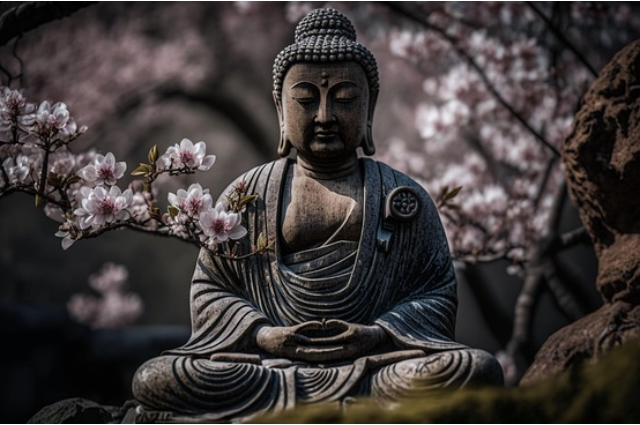
Image by Medusa_Print_Art from Pixabay
In a world that races forward with relentless urgency, the ancient idea of Nirvana has begun to find an unexpected resonance in modern lives. Across cities humming with noise, homes burdened with pressures, and minds stretched thin by ceaseless expectations, the quest for a state of inner quiet has quietly moved into everyday conversations. But Nirvana, as described for centuries in spiritual traditions, is not merely an escape from noise; it is a profound shift in the way one experiences existence itself.
The essence of Nirvana lies in liberation — not from the world, but from the restless movements within the mind. While the term is often associated with final enlightenment or the cessation of desire, its deeper significance becomes clear only when we see it through lived human experience. To seek Nirvana is to seek a freedom that surfaces not in isolation, but in conscious awareness — a freedom born from understanding the nature of suffering and the impermanence of all things.
Long before modern psychology articulated ideas of emotional regulation or cognitive patterns, ancient seekers had mapped the intimate landscape of the human mind with astonishing accuracy. They observed how desires arise, how fears shape perception, how attachments kindle both joy and sorrow. They saw how the mind creates its own storms and how it can, through insight and discipline, dissolve them. Nirvana became the word for the extinguishing of these inner fires — the fires of craving, aversion, and delusion.
What makes Nirvana extraordinary is that it is not presented as a place or an achievement, but as a shift in understanding. The external world remains unchanged, yet the one who sees it becomes transformed. A simple act such as watching the breath, walking in silence, or reflecting on impermanence becomes the doorway to a deeper clarity. For thousands of years, monks, philosophers, wanderers, and contemplatives have described Nirvana as an awakening that unfolds quietly — a revelation that the mind, once freed from its own illusions, naturally rests in peace.
In contemporary life, this teaching feels surprisingly relevant. Modern anxieties are crafted not only by circumstances but by the relentless inner churn that magnifies every worry. A small setback becomes a narrative of failure, a moment of loneliness turns into a belief of unworthiness, and fleeting desires grow into compulsions. In such a world, the wisdom of Nirvana invites a reconsideration: what if suffering is not imposed by the world, but generated by the stories we continue to believe about ourselves and our lives?
Meditation has become one of the most accessible pathways to this understanding. Yet its purpose is often misunderstood as a technique for relaxation. In truth, meditation is a mirror — a quiet, honest mirror that reflects the mind’s habits without judgment. It reveals how thoughts loop endlessly, how emotions surge and subside, and how identity itself is woven from fragile threads of memory and expectation. When one observes these movements long enough, something remarkable begins to shift. The grip loosens. The narrative weakens. A space opens up inside the mind where there is no pressure to become anything, fix anything, or control anything.
That space — clean, untethered, and silent — is often described as the first taste of Nirvana.
Traditionally, Nirvana is associated with the end of the cycle of rebirth, a liberation from all worldly bonds. But its experiential dimension is available even within an ordinary life. A mother sitting quietly after putting her children to sleep might feel a moment of profound stillness. A student walking alone after a stressful exam may suddenly sense the impermanence of worry. Someone grieving a loss might have a moment where the pain softens into understanding, realising that love and sorrow arise from the same tender place. These glimpses — tiny yet transformative — echo the essence of Nirvana: awareness without clinging.
Modern neuroscience has inadvertently reaffirmed these ancient insights. Studies on mindfulness reveal that awareness changes neural pathways, reducing reactivity and enhancing emotional balance. This scientific validation, however, addresses only the surface. The deeper significance of Nirvana is not merely calmness but clarity — a clarity that sees through illusions of permanence and control. It reveals that life is fluid, that emotions are waves, and that the self we defend so fiercely is not a solid entity but a shifting constellation of thoughts and experiences.
When this clarity deepens, suffering loosens its roots. Not because life becomes easier, but because the mind becomes more spacious. Anxiety still visits, but it does not imprison. Grief still arrives, but it does not drown. Desires still arise, but they do not dictate every choice. This is why the ancient texts described Nirvana not as joy but as freedom — a state where one is no longer compelled, no longer bound.
In today’s world, where relationships, careers, and aspirations pull us in different directions, Nirvana offers a gentle reminder: the world’s demands may be endless, but inner freedom remains possible. It asks us to look inward with honesty, to sit with discomfort without resisting, to embrace impermanence without fear. It invites a tenderness toward ourselves — a compassion that softens the mind and prepares it for transformation.
Interestingly, Nirvana is not achieved through force or ambition. It arrives with surrender — not a surrender of effort, but a surrender of struggle. When one stops fighting the nature of life, insight emerges naturally. When one stops grasping at certainty, experience becomes more vivid. When one stops clinging to identity, a deeper sense of belonging arises — not to a person, place, or belief, but to existence itself.
This quiet liberation is not a rejection of the world but a more intimate engagement with it. Someone who begins to glimpse the truth of Nirvana does not retreat from responsibilities; instead, they approach them with balance. They listen more deeply, speak more carefully, and act with greater gentleness. Relationships that once felt strained become easier when expectations loosen. Work that once felt suffocating becomes lighter when identity is no longer tied to performance.
The spiritual masters often said that the world does not need more enlightened teachers; it needs more peaceful hearts. A heart that has tasted even a drop of inner stillness becomes a source of comfort to others. Its presence softens rooms. Its silence reassures. Its clarity inspires.
As India steps into 2026 — a year of hopes, uncertainties, ambitions, and transitions — the teachings of Nirvana feel especially meaningful. In a society constantly in motion, the idea of stepping inward and understanding oneself has never been more essential. The path may be ancient, but its relevance is timeless.
Nirvana ultimately reminds us that peace is not found by withdrawing from life but by awakening within it. It is the gentle flame that continues to burn even as the winds of change sweep across the world. It is the quiet centre that remains steady while everything around shifts. It is the freedom of a mind that has finally learned to rest in truth.
And perhaps the most comforting thing is this: Nirvana is not distant. It is not reserved for monks or mystics. It exists as potential in every breath, every moment, every human being who dares to pause and look inward with honesty.