
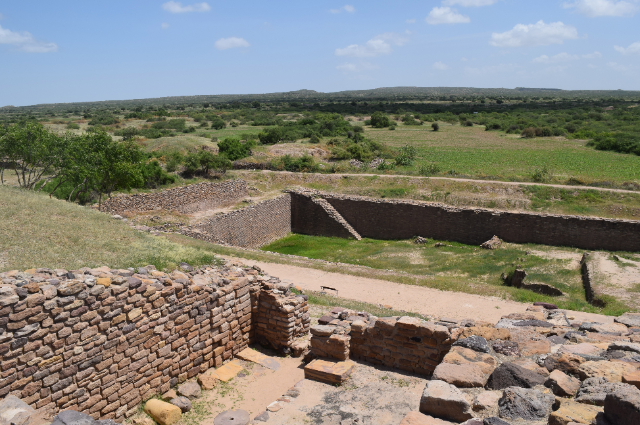
For most of the nineteenth century, scholars believed that the history of urban life in India began in the middle of the first millennium BCE, with the cities of the Ganges plain and the age of the Buddha. That assumption collapsed in the 1920s, when excavations in the Indus basin revealed brick-built cities with planned streets, drainage systems, and standardised weights, all dating to the third millennium BCE (Marshall 1931). A civilisation as sophisticated as those of Egypt and Mesopotamia had been forgotten for nearly four thousand years, and its rediscovery pushed the story of Indian urbanism back by more than two thousand years.
The question in the title, who were the people of ancient India, is both simple and difficult. It is simple because we know a great deal about how these people lived: what they ate, how they built, what they made, and with whom they traded. It is difficult because we cannot read their writing, we do not know what language they spoke, and we have no names, genealogies, or histories in their own words. Everything we know comes from material remains, and material remains must always be interpreted.
The Discovery of a Lost Civilisation
The first hint came from the British engineers who built the Lahore–Multan railway in the 1850s. They used baked bricks from the ruined mounds near Harappa as ballast, unaware that they were destroying a Bronze Age city. Alexander Cunningham, the first Director-General of the Archaeological Survey of India, visited Harappa and published a seal showing an unknown script and a bull-like animal, but he assigned it a much later date (Cunningham 1875).
Systematic excavation began after Sir John Marshall took charge of the Survey. In 1921, Daya Ram Sahni began digging at Harappa, and in 1922 R. D. Banerji identified a similar site at Mohenjo-daro in Sindh. When Marshall announced the discovery in 1924, a comparison with seals found in Mesopotamia showed that the new culture belonged to the third millennium BCE.
After partition in 1947, excavation continued on both sides of the new border, and sites such as Kalibangan, Lothal, Dholavira, and Rakhigarhi in India showed that the civilisation reached deep into Rajasthan, Gujarat, and Haryana (Lal 1997; Chakrabarti 1999). More than a thousand Harappan sites are now known (Possehl 2002).
Chronology and Geography
Scholars generally divide the Indus tradition into three broad phases: an Early phase, a Mature phase, and a Late phase. The dates vary somewhat between regions, but the overall scheme is widely accepted (Possehl 2002; Wright 2010). The story begins long before the cities. At Mehrgarh, on the Kachi plain in Balochistan, the transition from hunting and gathering to farming and herding can be seen as early as about 7000 BCE, with wheat, barley, sheep, goats, and cattle appearing in a settled village setting (Jarrige 1984; Jarrige et al. 1995).
Regional farming communities then spread across the plains between about 5500 and 2600 BCE, and the Mature Harappan period, from about 2600 to 1900 BCE, saw standardised weights, a shared script, and large planned cities. The sequence from Mehrgarh through the Early Harappan sites to the Mature phase is central to the question of identity. It indicates that the civilisation grew out of local roots rather than being introduced from elsewhere (Jarrige et al. 1995; Kenoyer 1998). At its height the civilisation covered perhaps one to one and a half million square kilometres, from the Makran coast and Shortugai in northern Afghanistan to Alamgirpur near Delhi, and from the Indus plains to Gujarat (Possehl 2002; Wright 2010). No other Bronze Age civilisation covered so wide a territory.
Cities and Urban Planning
Five sites are generally regarded as the largest urban centres: Mohenjo-daro and Harappa in Sindh and Punjab, Ganweriwala in Cholistan, and Rakhigarhi and Dholavira in India (Possehl 1999; Kenoyer 1998). Mohenjo-daro may have covered more than 200 hectares, and estimates for the larger cities range from tens of thousands to perhaps 40,000 people, although such figures are uncertain (Possehl 2002).
The most striking feature of Harappan cities is their order. Mohenjo-daro and Harappa each consist of a raised, partly fortified section, often called the citadel, and a larger lower town laid out in a rough grid. Streets ran along the cardinal directions, and houses were built of s baked or mud bricks in a consistent ratio of about 1:2:4 (Marshall 1931; Kenoyer 1998). The uniformity of brick sizes across such a vast area implies a shared system of measurement and a high degree of cultural integration.
The cities also had remarkable sanitation. Many houses had their own bathing areas and latrines, connected to covered brick drains running beneath the streets, and wells were common (Jansen 1993). At Mohenjo-daro, the so-called Great Bath, a large waterproofed brick tank on the citadel, has often been interpreted as a space for ritual ablution, although this is an inference rather than a demonstrated fact (Marshall 1931; Kenoyer 1998). Dholavira in Kutch shows how the Harappans adapted to a harsh environment. The city was divided into a citadel, a middle town, and a lower town, and it contained an elaborate system of reservoirs and channels for conserving seasonal rainwater (Bisht 1991).
Harappan cities contain no obvious royal palaces, large temples, or monumental tombs comparable to the ziggurats of Mesopotamia or the pyramids of Egypt, and this raises a real question about how power was organised. Some scholars propose a priest-king or centralised state, others a collective of merchant and landowning elites, and still others a heterarchical arrangement in which authority was shared among several groups (Possehl 2002; Green 2021). The evidence suggests that the Harappans invested in civic order rather than in the display of rulers.
Economy, Craft, and Trade
The Harappan economy rested on a diverse agricultural base. Wheat and barley were staples in the winter-crop zone of the Indus plains, while in Gujarat and parts of the east, summer crops such as millets and rice were more important. Cattle, sheep, and goats were herded, and zebu cattle appear frequently in representations (Fuller 2006; Madella and Fuller 2006). This multi-cropping strategy, which took advantage of both winter and summer rainfall systems, helped to protect communities against the failure of any single monsoon, and it is increasingly seen as a key to the civilisation's resilience (Petrie et al. 2017).
Harappan craftspeople worked with remarkable skill. They produced fine carnelian beads, drilled with long stone drills that were among the most advanced of their age, together with faience, shell bangles, copper and bronze tools and vessels, and distinctive wheel-made pottery (Kenoyer 1998; Kenoyer and Miller 1999). Stone seals, usually of steatite, bear animal motifs and short inscriptions, while terracotta figurines, toy carts, and game pieces attest to a lively domestic culture. Workshops at Chanhudaro, Lothal, Harappa, and Mohenjo-daro point to organised manufacture for local use and export (Kenoyer 1998; Rao 1973). Standard cubical weights and a shell scale found at Lothal and Mohenjo-daro suggest that exchange was regulated.
The Harappans were also active participants in a wide network of exchange. Seals of Indus type have been found in Mesopotamia, the Persian Gulf, and Oman, and Mesopotamian cuneiform records from the Akkadian period refer to a distant land called Meluhha, which most scholars identify with the Indus region (Possehl 1996; Ratnagar 1981). In return, Indus communities obtained lapis lazuli from Afghanistan, copper from Oman and Rajasthan, and tin and silver from the Iranian and Central Asian highlands (Ratnagar 1981; Wright 2010).
Society, Belief, and Daily Life
Because there are no readable records, social organisation must be inferred from settlement patterns and burials. Differences in house size and in access to prestigious goods suggest social stratification, but the contrasts appear less extreme than in many contemporary societies. Cemeteries at Harappa and elsewhere show modest burials, often accompanied by pottery and ornaments, with relatively little evidence of dramatic inequality (Kenoyer 1998; Wright 2010). Studies of skeletal remains at Harappa indicate that people from different parts of the city had somewhat different health profiles, a pattern consistent with social differentiation (Lovell and Kennedy 1989).
Harappan religion is poorly understood. Seals depict horned figures, sometimes in a seated posture, along with animals such as the bull, a unicorn-like creature, and the tiger. Marshall saw in one seated figure a prototype of the later Hindu god Shiva, and some later scholars have supported the idea of continuity with later Indian traditions (Marshall 1931; Possehl 2002). Others stress the danger of reading Vedic or Hindu concepts back into a culture that left no texts (Ratnagar 2001). The safest view is that the Harappans had a religious life of their own, some elements of which may have contributed to later South Asian traditions.
The Indus Script and the Question of Language
More than 4,000 inscribed objects, mostly seals and sealings, bear short sequences of signs, usually five or six characters long, drawn from an inventory of roughly 400 signs (Parpola 1994). The script is usually written from right to left. Despite more than a century of attempts, it remains undeciphered, and the reasons are well understood: the inscriptions are very short, no bilingual text has been found, and the underlying language is unknown.
Some researchers have proposed that the language was an early form of Dravidian, a view championed by Asko Parpola and by Iravatham Mahadevan, who compiled the standard concordance of the signs (Parpola 1994; Mahadevan 1977). Others have argued for an Indo-Aryan, Munda, or unknown language family. A provocative minority has even claimed that the signs do not encode language at all, but this position has been contested by researchers who point to the statistical regularities in sign sequences (Farmer, Sproat, and Witzel 2004; Rao et al. 2009). The honest conclusion is that no proposed decipherment has gained general acceptance.
Who Were the Harappans? The Evidence from Genetics. The identity of the Harappans was for generations entangled with theories about the origins of Indo-European languages and the so-called Aryan problem. Wheeler (1968) famously suggested that Indra, the Vedic war god, “stands accused” of destroying the Harappan cities, an idea that seemed to fit the discovery of skeletons at Mohenjo-daro. Later re-examination showed that these remains are not a single massacre, and most archaeologists have abandoned the invasion hypothesis (Kenoyer 1998; Possehl 2002).
A major step forward came in 2019, when Shinde and colleagues published an ancient genome from a skeleton at Rakhigarhi in Haryana, dated to roughly 2500 BCE. The individual, a woman, had no detectable ancestry from Steppe pastoralists or from the Neolithic farmers of the Iranian Zagros (Shinde et al. 2019). Her ancestry came mainly from a population related to ancient Iranian hunter-gatherers and from South Asian hunter-gatherers. This result matters for two reasons. First, it indicates that the spread of farming into South Asia was not the product of a large migration of Iranian farmers, as it was in Europe, but was rooted in local populations. Second, because Steppe ancestry is absent, it shows that this population predates the arrival of Steppe-related people in South Asia, which other studies place in the second millennium BCE (Narasimhan et al. 2019).
These findings must be handled with care. Only a single genome from within the core Harappan area has so far been published in detail, and one individual cannot represent a civilisation of perhaps a million people spread over a vast region. Genetic ancestry also does not map neatly onto language, culture, or modern national identity (Narasimhan et al. 2019). Even so, the weight of present evidence supports several conclusions. The Harappans were predominantly a South Asian population whose roots lay in the region’s Neolithic and earlier communities, with some connection to groups on the Iranian plateau. They were neither the product of a sudden foreign invasion nor a single, genetically uniform people.
The Decline of the Civilisation
By about 1900 BCE, the large cities were in decline. Writing disappeared, st weights and seals became rare, long-distance trade contracted, and settlement shifted eastward and southward toward the Ganges plain and Gujarat (Possehl 2002; Wright 2010). The process was gradual and uneven, and the word collapse is misleading, since many communities continued to live in the region for centuries in a different form.
Several factors are now thought to have contributed. Palaeoclimatic evidence indicates a weakening of the summer monsoon beginning around 4,200 years ago, which reduced rainfall across northwestern India (Dixit, Hodell, and Petrie 2014). Giosan and colleagues (2012) argued that the rivers of the northwest, including the Ghaggar–Hakra system, were fed by monsoon rain rather than by glaciers, so that a weaker monsoon reduced their flow and undermined agriculture in the areas that depended on them. Yet the Harappans were not passive victims. Petrie and colleagues (2017) show that they responded to environmental stress by diversifying crops and dispersing into smaller settlements, which suggests resilience rather than simple failure. There is no evidence for a single catastrophe, but increasingly strong evidence for a long process of environmental and social adjustment.
Legacy and Continuing Debates
At the same time, scholars warn against using the Harappans to support nationalist or sectarian narratives. The civilisation belongs to all of South Asia and to the history of humankind as a whole. The scholarly task is to follow the evidence and to acknowledge uncertainty where it exists, rather than to enlist the past in the service of present identities. Three questions remain especially important: the decipherment or at least the classification of the script, the recovery of more ancient DNA from different sites and social strata, and a fuller understanding of how so large a civilisation was governed without visible palaces or royal monuments.
The people of the Indus Valley Civilisation were farmers, herders, craftspeople, traders, and city-dwellers who built one of the great societies of the Bronze Age. They planned their cities with care, managed water with skill, standardised their measures, and traded across thousands of kilometres. They also wrote, though what they wrote we cannot yet read, and they believed and worshipped, though what they believed we can only partly guess.
The best current evidence indicates that they were an indigenous South Asian population with deep local roots and connections to the wider Iranian plateau, not the victims of a sudden invasion. Their civilisation declined slowly as monsoon patterns shifted, rivers changed, and trade networks contracted, and many of their descendants moved to new regions and new ways of living. The Harappans remind us that the history of ancient India did not begin with the Vedas or the Buddha, but reaches back at least to the third millennium BCE and, through its antecedents at Mehrgarh, to the seventh. Much remains to be learned, and each new excavation and each new genome has the potential to revise what we think we know.
References:
- Bisht, R. S. (1991). Dholavira: A new horizon of the Indus civilisation. Puratattva, 20, 71–82.
- Chakrabarti, D. K. (1999). India: An Archaeological History. Palaeolithic Beginnings to Early Historic Foundations. Oxford University Press.
- Cunningham, A. (1875). Archaeological Survey of India: Report for the Years 1872–73, Volume 5. Government Central Press.
- Dixit, Y., Hodell, D. A., and Petrie, C. A. (2014). Abrupt weakening of the summer monsoon in northwest India approximately 4100 yr ago. Geology, 42(4), 339–342.
- Farmer, S., Sproat, R., and Witzel, M. (2004). The collapse of the Indus-script thesis: The myth of a literate Harappan civilisation. Electronic Journal of Vedic Studies, 11(2), 19–57.
- Fuller, D. Q. (2006). Agricultural origins and frontiers in South Asia: A working synthesis. Journal of World Prehistory, 20(1), 1–86.
- Giosan, L., Clift, P. D., Macklin, M. G., Fuller, D. Q., et al. (2012). Fluvial landscapes of the Harappan civilisation. Proceedings of the National Academy of Sciences, 109(26), E1688–E1694.
- Green, A. S. (2021). Killing the priest-king: Addressing egalitarianism in the Indus C. Journal of Archaeological Research, 29, 153–202.
- Jansen, M. (1993). Mohenjo-Daro: City of Wells and Drains. Water Splendour 4500 Years Ago. Frontinus-Gesellschaft.
- Jarrige, J.-F. (1984). Towards an understanding of the Neolithic and Chalcolithic of the Indo-Pakistani borderlands. South Asian Archaeology 1981, 101–112.
- Jarrige, C., Jarrige, J.-F., Meadow, R. H., and Quivron, G. (Eds.) (1995). Mehrgarh: Field Reports 1974–1985, from Neolithic Times to the Indus Ci. Department of Culture and Tourism, Government of Sindh.
- Kenoyer, J. M. (1998). Ancient Cities of the Indus Valley Civilisation. Oxford University Press and American Institute of Pakistan Studies.
- Kenoyer, J. M., and Miller, H. M.-L. (1999). Metal technologies of the Indus Valley tradition in Pakistan and western India. In V. C. Pigott (Ed.), The Archaeometallurgy of the Asian Old World (pp. 107–151). University of Pennsylvania Museum.
- Lal, B. B. (1997). The Earliest Civilisation of South Asia: Rise, Maturity and Decline. Aryan Books International.
- Lovell, N. C., and Kennedy, K. A. (1989). Society and disease in prehistoric South Asia. In K. A. R. Kennedy and G. L. Possehl (Eds.), Ecological Backgrounds of South Asian Prehistory. Cornell University South Asia Program.
- Madella, M., and Fuller, D. Q. (2006). Palaeoecology and the Harappan Civilisation of South Asia: A reconsideration. Quaternary Science Reviews, 25(11–12), 1283–1301.
- Mahadevan, I. (1977). The Indus Script: Texts, Concordance and Tables. Archaeological Survey of India.
- Marshall, J. (Ed.) (1931). Mohenjo-daro and the Indus Ci (3 vols.). Arthur Probsthain.
- Narasimhan, V. M., Patterson, N., Moorjani, P., Rohland, N., et al. (2019). The formation of human populations in South and Central Asia. Science, 365(6457), eaat7487.
- Parpola, A. (1994). Deciphering the Indus Script. Cambridge University Press.
- Petrie, C. A., Singh, R. N., Bates, J., Dixit, Y., et al. (2017). Adaptation to variable environments, resilience to climate change: Investigating land, water and settlement in Indus Northwest India. Current Anthropology, 58(1), 1–30.
- Possehl, G. L. (1996). Meluhha. In J. Reade (Ed.), The Indian Ocean in Antiquity (pp. 133–208). Kegan Paul International.
- Possehl, G. L. (1999). Indus Age: The Beginnings. University of Pennsylvania Press. Possehl, G. L. (2002). The Indus Civilisation: A Contemporary Perspective. AltaMira Press.
- Rao, R. P. N., Yadav, N., Vahia, M. N., Joglekar, H., et al. (2009). Entropic evidence for linguistic structure in the Indus script. Science, 324(5931), 1165.
- Rao, S. R. (1973). Lothal and the Indus Civilisation. Asia Publishing House.
- Ratnagar, S. (1981). Encounters: The Westerly Trade of the Harappa Civilisation. Oxford University Press.
- Ratnagar, S. (2001). Understanding Harappa: Civilisation in the Greater Indus Valley. Tulika.
- Shinde, V., Narasimhan, V. M., Rohland, N., Mallick, S., et al. (2019). An ancient Harappan genome lacks ancestry from Steppe pastoralists or Iranian farmers. Cell, 179(3), 729–735.
- Wheeler, M. (1968). The Indus Civilisation (3rd ed.). Cambridge University Press. Wright, R. P. (2010). The Ancient Indus: Urbanism, Economy, and Society. Cambridge University Press.