
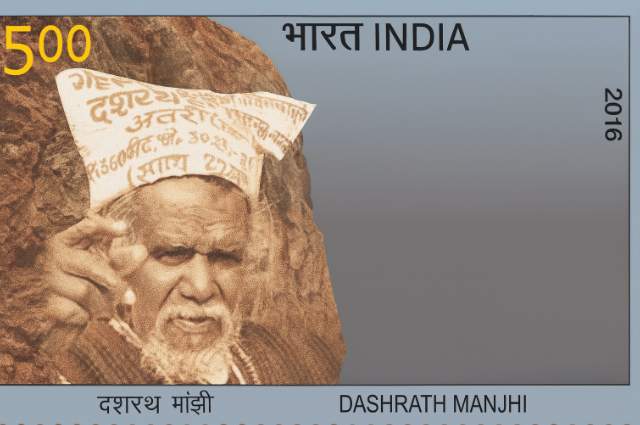
This story is based on a true event and a real-life example of love. A man for his women, he creates a history in India by doing so great work. Yes, we are talking about Dashrath Manjhi, the man from Bihar. He is known as THE MOUNTAIN MAN of India. Dashrath Manjhi’s story is one of the most extraordinary tales of human courage and determination, born in the dust of poverty and polished through the fire of relentless struggle. He was born on 14 January 1934 as an Indian labourer from Gehlaur village, near Gaya in the eastern state of Bihar. He is also known across India as “The Mountain Man.” Manjhi carved a 360-foot-long road through a massive mountain using nothing but a hammer, chisel, and unwavering resolve.
In an age when governments, machines, and modern engineering shape the world, the idea that a single man could cut a mountain seems unbelievable. Yet, Dashrath Manjhi, an impoverished labourer from Bihar, proved that the strength of a human will can be stronger than stone. Born in 1934 in the remote and impoverished village of Gahlour in Bihar’s Gaya district, Dashrath came from the Mushahar community, one of the most marginalized Dalit groups in India.
His lifestyle, the second Shah Jahan
His early life was shaped by extreme poverty, hunger, and social discrimination. The Mushahars, historically treated as “untouchables,” had little access to education, land, or social dignity. The harshness of this social reality meant Dashrath grew up without formal schooling, learning instead the lessons of survival in a society where poverty, caste, and lack of opportunity formed a seemingly unbreakable cage. He worked in fields, collected firewood, and performed odd labour jobs from a young age. Yet, despite this difficult upbringing, Dashrath grew into a man who possessed immense inner strength, patience, and a fierce love for the people around him.
The geography of his village added another layer of hardship. Gahlour was surrounded by a rugged mountain range that separated it from Wazirganj and the district headquarters in Gaya. The shortest route available required a treacherous journey across narrow, slippery paths carved by nature that were dangerous for women, children, and the elderly. The alternative was a 55–60-kilometre walk around the entire mountain to reach hospitals, schools, or markets. Pregnant women could not reach medical help in time; farmers lost productivity; and children rarely attended school. The mountain stood like a wall that divided villagers from development, services, and basic human necessities. For generations, people had accepted this harsh barrier as an unchangeable part of life until tragedy struck Dashrath Manjhi’s family.
Dashrath fell in love with and married a woman named Falguni Devi, who became the emotional center of his world. Their relationship, built in the simplicity of rural life, was filled with mutual support and affection. Despite their poverty, they shared a bond rooted in understanding and resilience. But one day, as Falguni was crossing the mountain to deliver food to Dashrath, she slipped on the rocky terrain, falling from the steep path and sustaining severe injuries. In desperation, Dashrath carried her across the dangerous mountain route and then walked the long distance around it to reach a hospital. But the long journey proved fatal; she died before receiving medical help. Her death left Dashrath devastated, but it also ignited a fire in him stronger than anything he had ever felt.
Standing in grief, Dashrath vowed that no one in his village would suffer the same fate. He decided to cut a road through the mountain alone. People laughed at him, calling him insane. How could a single man break a massive mountain? But Dashrath, fueled by love for his wife and compassion for his community, was not swayed by ridicule. He sold his goats to buy a hammer, a chisel, and some rope. In 1960, he walked to the base of the mountain, lifted the hammer, and struck the first blow. He had no wealth, no education, no support—only an unbreakable will.
Road Construction, Men in Love
Dashrath Manjhi decided to carve a road through the mountain because his wife, Falguni Devi, died after being severely injured and not receiving timely medical care. The nearest town with a doctor was 70 km away, and the narrow, dangerous mountain path delayed help for the next twenty-two years. Dashrath Manjhi committed his life to a task considered impossible. His daily routine was grueling. Early in the morning, he worked in the fields or took up any small job he could find just to earn enough survival food. After returning, he spent the rest of the day chipping away at the mountain. He worked under the scorching heat of Bihar summers, where temperatures often crossed 45°C. He endured the monsoon rains that turned the rocky slopes slippery and dangerous. He hammered through cold winters with bleeding hands, sore muscles, and little rest. Many days he worked with an empty stomach. When he ran out of money, he travelled to nearby villages to find labor work but always returned to continue carving the mountain. His hands became rough and wounded, his body carried scars, yet his determination only grew stronger.
Villagers Reaction To Mountain Man
Initially, villagers mocked him. They believed his efforts were foolish. How could one man accomplish a task that even the government had ignored? Often, he was told, “Pagal ho gaya hai!” (He has gone crazy.) But Dashrath continued silently, driven by a personal loss that the world could not understand. As the years passed, people began noticing the transformation. After a decade of persistent effort, a narrow passage had begun to emerge, and slowly, ridicule turned into admiration. Villagers started bringing him food and water, supporting his mission in small ways. As the path widened year by year, people realized that he was not just carving a road; he was carving hope into the heart of a forgotten village.
It took Dashrath twenty-two years of unwavering effort, without machines or assistance, to complete the path. By 1982, the mountain had been split by the strength of one man’s hands. The road he carved was 360 feet long, 25 feet deep, and 30 feet wide, reducing the distance between Gahlour and Wazirganj from nearly 55 kilometres to just about 15 kilometres. What had once required hours and danger could now be crossed in minutes. For the first time, children could reach school, pregnant women could reach hospitals, and villagers could access markets and job opportunities. The isolation that had shaped the village’s suffering for generations had finally been broken by one man’s love and determination.
Government action on this road
Despite his monumental achievement, recognition did not come immediately. For years, Dashrath approached government offices in Patna, barefoot, carrying petitions asking for support, road paving, a hospital, and development for his village. Many officials ignored him or dismissed him as just another poor man with unrealistic demands. But he persisted. Eventually, media attention helped bring his achievement to light, and his story spread across Bihar, then across India. He was celebrated as “The Mountain Man,” admired for his perseverance. His dedication finally caught the attention of the Bihar government, which honored him and later paved the road he had carved by hand. He was also given land for a house and offered support in his old age.
In his final years, Dashrath Manjhi continued to advocate for his village, urging the government to build schools, medical facilities, and proper roads. Even after achieving the impossible, he remained humble and dedicated to the welfare of others. In 2007, he was diagnosed with gall bladder cancer. The Bihar government arranged for his treatment at AIIMS, New Delhi, but despite medical care, he passed away on August 17, 2007. In recognition of his extraordinary contribution, he was given a state funeral, an honor usually reserved for national leaders and celebrated figures. For a man who had once been ignored and underestimated, this final tribute was a powerful symbol of how far he had risen through sheer determination.
Lesson for today’s world
Today, the legacy of Dashrath Manjhi lives on not only in the road he carved but also in the hearts of millions across the world. His journey from an impoverished laborer to a symbol of resilience has inspired documentaries, books, international media coverage, and the popular Bollywood film Manjhi: The Mountain Man. More importantly, his story serves as a living reminder that greatness is not defined by background but by vision, effort, and perseverance. His message, “Jab tak todoge nahi, tab tak chhodoge nahi,” continues to echo across classrooms, motivational talks, and social movements. It means: Do not stop until you break the obstacle.
Dashrath Manjhi’s story is not just a biography; it is a lesson in humanity. It teaches us that love can drive unimaginable strength. It shows that even the poorest, most marginalized person can challenge the systems and circumstances that confine them. It proves that one person’s persistence can transform an entire community. Above all, it reminds us that no mountain is too big, not in nature, not in society, and not in life. His journey demonstrates that every human being carries within themselves the power to spark change, even if the world doubts them.
In a world filled with challenges, frustrations, and inequalities, the life of Dashrath Manjhi stands as a bright, undeniable example of what a determined human spirit can accomplish. His road through the mountain is more than a physical path; it is a symbol of hope, courage, and the unstoppable force of human will. Generations to come will continue to walk on that road, literally and metaphorically, inspired by the man who dared to break a mountain with his bare hands.
The life of Dashrath Manjhi, The Mountain Man, stands as a timeless reminder that true strength is born not from wealth, education, or social status, but from purpose, love, and unshakable determination. What began as a husband’s grief transformed into one of the most extraordinary examples of human resilience in history. Through twenty-two years of relentless labour, armed only with a hammer, chisel, and a promise made to his beloved wife, Manjhi proved that even the most impossible barriers can be broken.
His achievement not only brought development, healthcare, and opportunity to his village but also inspired millions across India and the world. Manjhi’s journey teaches us that one individual’s courage can uplift an entire community, and that change does not always come from governments or institutions; sometimes, it comes from the hands of a single determined soul.
Today, the road he carved is more than just a path through stone; it is a symbol of hope and a testament to what human will can accomplish. Dashrath Manjhi showed that love can move mountains, and perseverance can rebuild destinies. His legacy continues to guide us, reminding us that no mountain, literal or metaphorical, is too big when faced with unwavering resolve.