
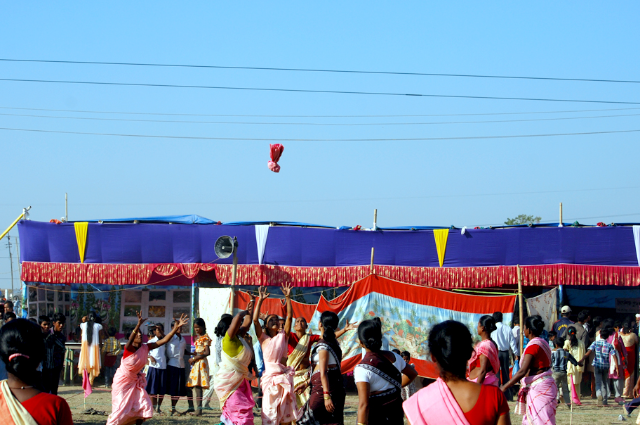
Dhop Khel is a traditional ball game of Assam. is a cultural game of Assam it is counted to Bhartiya Khel. The main theme of those who are affected by this game becomes part of it. It reproduces the cultural memory among youth, the communal values of Assamese society. It played through Rongali Bihu, its mergers collaboration, and diffident honour within the Assamese people. And show that Dhop Khel was not only a festival sport but also a platform for youth to begin love and cooperation, and the Ahom king during that period, as a public wish to be cultural unity. The game simple players to attack opponents through a ball and consume the opponent safely without being touched by someone else, it's an amazing game ever played in Assam. These skills communicate cultural individuality of courageousness, unity and communal accountability among others.
Bhartiya Khel, the traditional sports of India, Dhop Khel represents the Assamese contribution. But, unlike other aboriginal sports that achieved formal position and have institutionalisation, its growth has remained regional in local area, where the other not just a pitch but it makes the way to the forwarding to upper level and is established as a traditional game. Making it a important situation for educational safety. Though recent revitalisation activities by cultural managements, schools, and festival groups have helped resuscitate the game, especially during Bihu celebrations, mostly as part of Assam’s intangible cultural heritage in Assam.
Dhop Khel works as a cultural identity, joining Assamese people to their culture and spiritual conversion, engaging it within Bhartiya Khel supports India’s plural, generous culture while encouraging provincial pride of Assam of tradition, so that Dhop Khel remains a living tradition rather than just a historical heritage in Assam.
Dhop Khel, Assamese Culture, Bhartiya Khel, Indigenous Sports of India, Cultural Heritage, Bihu Festival, Intangible Cultural Traditions
Dhop khel, also converted dhop khel and dhoop khel, is a traditional ball game of Assam played in the Indian state of Assam. The game is played between two teams of having each team 11 players each on a 125 m × 80 m field circumscribed by four flags. The rule of the playing methods the players take turns throwing the ball at the opponent to knock them out of the game, while seeking to catch the ball and sidestep being touched by other players. It is a test of speed, stamina, and acrobatic skills; both men and women play this game. Matches of the game were traditionally made to observe the spring and the new year festival of Bihu. This game was introduced by Ahom royalty, at later it became a traditional game for unity and welcoming the spring.
The rules of the game:
The field is divided into two shares, with a player of one squad trying to throw the ball so that it hits the designated opponent underneath the stomach. If the hit is positive, the designated opponent must try to catch the ball after its reverberations off them, then run back to their own half of the field without being touched by any of the players on the first team, in order to be successful.
As it starts like this at the end of the game, the team with the greater number of successful players wins the game.it was played in the session of Rongali Bihu, this game emphasizes agility, strategy, and teamwork and is often played during festive occasions such as Rongali Bihu. so, they need to judge the direction and force of the throw. It requires swiftness and acrobatic agility.
The Play
Both, two teams of 11 members each, play this game with the measurement of the ground is 125 m × 80 m field bounded by four red flags. Players throw the ball at the opposing team members to tag them out, while the opposing team seeks to catch the ball and throw it back to the first team. The objective is the same, to tag one of the players. Tagging players standing near a corner is easier as they do not have much open space to run to. The player who is tagged out has to go to the opponent’s side and prevent the opponent’s team from catching the ball thrown by his or her native team. That player catches the ball and brings it back to the native team without being touched by the opponents. There would be multiple players from both teams on both sides on the court. The game is a test of speed, strength and motor skills.
Players
Two teams, each consisting of 7–12 players. The field is rectangular, typically 125 meters long and 80 meters wide, divided into two halves. Equipment: A lightweight ball, traditionally made of cloth or other soft materials.
Equipment Needed
A chalk powder or white powder to draw the baselines, a whistle, a stopwatch and score sheets are needed.
There is no dress code for informal games. The game is played barefoot for both informal and official matches. The players wear shorts and numbered t-shirts, having different colours for each team in official matches.
Playing Method
The primary aim is for players to throw the ball into the opposing team’s territory and then return safely to their own side without getting tagged.
The game begins with one team throwing the ball into the other team’s half. The opposing team must try to catch the ball or retrieve it and counterattack.
- Players from the attacking team throw the ball into the defending team’s side and must cross into the defending side to retrieve it.
- Defenders attempt to tag the attackers while they are retrieving the ball or crossing back to their own side.
- Attackers who successfully retrieve the ball and return without being tagged earn points for their team.
- Defensive Actions:
- The defending team can try to stop the attackers by tagging them before they cross back into their own side.
- Tagged players are considered “out” and must sit out of the game until the next round or until revived by a specific game rule.
- Winning:
- The team with great points at the end of the game wins.
- Points are awarded based on successful ball retrievals and safe returns.
History of Dhop Khel
Dhop khel in an indigenous traditional ball game of Assam, deeply connected to Assamese culture, folk tradition and basically festival activities.
Traditionally t was played during Rongali Bihu. In the era of 13 the -14th century at that time, The first Ahom king in the 13th century was Chaolung Sukaphaa, who founded the Ahom kingdom in Assam in 1228. he introduced this game and also encouraged many physical games, including wrestling, archery, and ball games such as Dhop Khel.
This game was associated with physical fitness, entertainment, and Bihu celebrations. That why Hemicram Borbourah write his article about this Dhop in his notable works like “Assamese sports and Games” published in 1981 by Rajshri Prakashan.
This is the brief story of Dhop khel in Assam. According to Nalinidhar Bhattacharya in the Sports culture of Assam in 1986, Dhop khel was one of the most popular folk games played during the spring festival of Rongali Bihu. Basically, young men from the different villages gathered on an open field, basically near madams, Rivershore, riverbank, to participate on this game.
Bhattacharya explains that, its strength the community engagement through unity and make a well social structure. He also introduces like other games at that time like Koni-juj, it combines the youth for teamwork’s and it’s related to fine well culture and also to believing thins and faith over this is most important. thus, Dhop Khel was deeply and openly woven into Bihu traditions as well great, both as entertainment, youth participation, and cultural expression of Assamese’ s identity, it was recognised in Bhartiya Khel.
Cultural connection of Dhop Khel with Rongali Bihu
Dhop khel holds a central place in the traditional festival of Rongali Bihu where mostly young men even women, participate, The Assamese people celebrate the new year and that marks the for arrival of spring. According to the prominent writer Nalinnidhar Bhattacharaya in his notal Val works “The Sport culture of Assam in 1986, the game was traditionally and historically played by groups of young where gather in field and make them self by playing Dhop.
The writer analyses that this game connecting people towards cultural identity and also
social chosen. The game shows strength, growth, agility, courage, and teamwork. The game counted to the people most on the occasion of Bihu festival and where we gathered to improve society and going for development towards cultural and social unity.
Mostly it makes cultural identity and makes people aware about the youth engagement and cooperation, extended to the Assamese’s people for a faith in arrival of spring and make us aware about the main thought of being in the youth unity and makes people believing things and understand the socio-economic cultural unity and diversity within the nation. Where Assam most famous Bihu and people get engagement towards the nation and the festival with big autonomous feeling among all Indian people towards Assam.
The identity of the Assamese’s people and they preserve that merciful guidance and make people towards heritage and engage them for development and to speared all over the nation.
It shows the people towards unity, cooperation, reflection and justice among them in the sense of the festival and celebrations.
Contribution to Bharatiya Khel
The late 20th century where the Assamese’s people wanted to make more important to this game and they started to spread all over the nation and finally it was to in Bhartiya Khel in 75 among other games, as Bharatiya Khel.
And also known as national game of Assam is Dhop khel, which is played during Bihu festival. Its official state sports. To promote this game the journal like “the Assam Sahitya Sabha Journal” reflecting the main important of this game. Reports of some valuable newspaper where it was published worldwide in “the sentinel” and “the Assam Tribune”.
Dhop khel is a traditional game of assam not just a game, but it connected to heart of Assamese people and it provide physical and emotional stable through fitness and physical, mental, teamwork works and also provide unity among the people and guides them towards national supplication and well-being physical health.
This played during the Rongali Bihu and in the court of our Ahom royal. The structure of the game shows the player’s speed, concentration, teamwork’s and move to application. Preserving the identify and cultural heritage of Assam it provides the unity within them, historical memory and India’s heritage of Bharatiya Khel. Reviving this for upcoming generation is most important for us and will be a responsible for this. Cultural festival will ensure the future generation it value not as a game but as a living legacy of Assam.
. . .
References:
- Das, Gaurav (20 April 2012). "Kids, adults now game for traditional Assamese sports". The Times of India. Archived from the original on 11 April 2013. Retrieved 28 February 2013
- Bharatiya Khel Program- An initiative by Indian Knowledge System
- Hemicram Borboruah, "Assamese Sports and Games" (Rajshri Prakashan, 1981)
- Bhattacharya, Nalinidhar. The Sports Culture of Assam. Guwahati: Assam Publication Board, 1986
- Assam Sahitya Sabha Journal, Annual Editions (1970–present) – publishes research on indigenous sports.
- Cultural Heritage of Assam – S. N. Sharma
- Upen Rabha Hakacham – Folk Games of Assam (1992) [page no: 123 to 126]
- Edward Gait – A History of Assam (1905)