
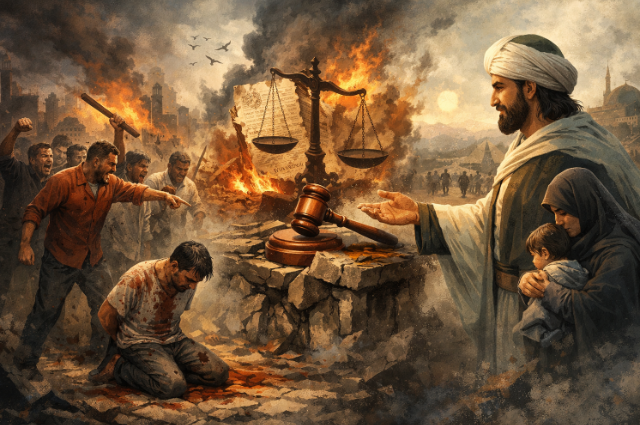
Liberation Without Moral Renewal
A troubling paradox of post-authoritarian societies is revealed by the events in Bangladesh following the civil revolt on August 5, 2024: the end of tyranny does not always imply the emergence of justice. A moral renaissance characterised by accountability, dignity, and constitutional order ought to have begun with the fall of a fascist administration. Rather than institutional justice, the aftermath has been characterised by extrajudicial penalties, vigilantism, and mob violence.
This change presents a basic moral conundrum: After tyranny has ended, who has the right to judge and punish? Justice is no longer justice at all when it is shifted from courts to mobs. Unchecked by morality or the law, collective rage turns emancipation into anarchy. Instead of freedom, revenge masquerading as responsibility emerges.
These events are more than just unplanned emotional outbursts. They reflect the systematic devaluation of human worth, a deeper moral dilemma. When people are treated more like labels than like human beings, dehumanisation starts. Violence is reframed as a duty after humanity is ignored, making brutality acceptable. Therefore, the very civilisation that opposed cruelty runs the risk of replicating it under a different name.
History shows that when justice gives way to retaliation, revolutions lose their validity. The true test of a society is not how hard it resists tyranny, but rather how morally it acts once tyranny is overthrown.
The Moral Cost of Progress Without Humanity
We take great pride in being progressive, educated, and modern, yet beneath the surface, something fundamental is deteriorating. Our technologies advance and our cities grow, but our moral awareness wanes. Once frightening, violence is now commonplace. These days, killings take place in public areas, where they are seen by large crowds who watch, document, and go on rather than being concealed in shame.
There has been a serious ethical collapse in this transition from intervention to indifference. Human suffering has become a spectacle. The desire to document now takes precedence over the need to protect. Because of their silence, apathy, and digital amplification, onlookers are no longer objective and are now morally responsible.
Without humanity, progress corrodes rather than civilises. The preservation of human dignity is a better indicator of true growth than infrastructure or innovation alone. Society regresses ethically when technology advances faster than morality.
Mob Mentality and the Politics of Dehumanisation
Mob behaviour does not develop in a vacuum; rather, it is fostered in settings where difference is militarized and violence is accepted. The intricate religious, ethnic, and ideological makeup of Bangladesh's society should promote diversity. However, long-term authoritarianism has institutionalised fear and repression, training people to view disagreement as treason and dissent as peril.
Political identity was weaponised by the previous government. Labels like BNP, Jamaat, or Shibir became moral death sentences rather than connections. After being assigned a label, people lost their complexity and became adversaries. Evidence was substituted by identity, and due process was replaced by allegation.
This is dehumanising politics. Mobs feel empowered to punish without evidence when individuals become symbols. Violence becomes a civic obligation. Conscience turns into a choice.
Democracy is destroyed from within by such dynamics. When power takes the place of justice and fear takes the place of law, society reproduces authoritarianism rather than escaping it.
The Collapse of Ethical Education and Critical Thought
Education should act as society's conscience during moral crises. Rather, education was hollowed out under protracted tyranny. Institutions were undermined, curricula were politicised, and challenging authority was made illegal.
Classrooms that were supposed to foster independent thought were turned into obedience factories. Reflection was replaced by memorisation. Integrity was replaced by loyalty.
As a result, generations are now unable to discern between truth and propaganda or between justice and retaliation. Citizens who lack ethical literacy follow the herd rather than their conscience. Education failed on a moral level rather than an intellectual one.
Case Study I: The Lynching of Ramnarayan Baghel (Kerala, 2024)
In December 2024, Ramnarayan Baghel, a 31-year-old migrant worker, was lynched in Kerala’s Palakkad district after being asked a single question: “Tum Bangladeshi?” That suspicion—without evidence—was enough. His body bore over 80 injuries. No stolen goods were found.
He was not seen as a person but as a stereotype—an outsider, a threat. Kerala’s high literacy rates did not prevent brutality. This case proves a crucial truth: education without empathy is powerless.
Mob violence thrives wherever dehumanisation is normalised.
Case Study II: The Madhu Lynching (Attappady, Kerala, 2018)
A young tribal man named Madhu was beaten to death for allegedly stealing food. Poverty and indigenousness were his true "crimes." Justice is still delayed years later. Witnesses became antagonistic. The investigations became weaker.
His death did not put an end to the violence because of institutional indifference. Mobs are empowered by impunity. Cruelty turns into a strategy when the law fails victims.
A Moral Counterexample: The Prophet Muhammad (ﷺ) and the Conquest of Makkah
The Prophet Muhammad (ﷺ) triumphantly entered Makkah following years of persecution. Retaliation was predicted by tribal norms. Rather, he said:
"Lā tathrība ʿalaykumu al-yawm... You're free.
This was moral authority, not weakness. With mercy, he broke cycles of retaliation. Justice was restraint, not a show.
True strength is found in deliberate forgiveness rather than harsh punishment.
Living Humanity: The Nimisha Priya Case
Muslim scholar A. P. Abubakar Musliyar intervened as a human being rather than a partisan when Christian Indian nurse Nimisha Priya was about to be executed in Yemen. To protect a life, he transcended religious and political boundaries.
Unconditional compassion turns into resistance.
Global Dehumanization: Sudan’s Humanitarian Catastrophe
Since 2023, there have been over 25 million people in need of help, hunger in Darfur, and approximately 13 million displaced people in Sudan. However, attention wanes worldwide.
Humanity becomes optional when suffering is rendered invisible. The principle of dehumanisation is the same whether there is a single victim on the street or millions during a conflict.
Conclusion: Reclaiming Justice Through Humanity
Where justice erodes, education loses morality, and humanity becomes conditional, mob mentality thrives. The process is the same in Sudan, Bangladesh, and India: cruelty becomes the norm when people are reduced to labels. Stronger conscience, not more rage, is the answer. We need to rebuild justice based on the law, education based on morality, and leadership based on moderation. Reason, faith, and history all concur that kindness is justice's completeness rather than its antithesis. We must decide whether to create a society ruled by dignity or give it over to rage and terror.
The response will determine our moral legacy.