
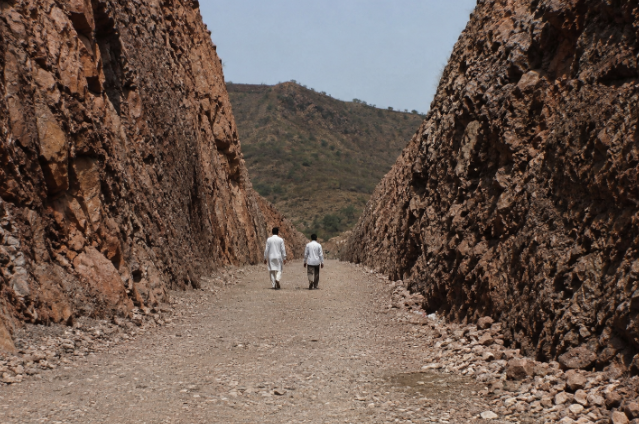
Whenever I hear people say that one person cannot make a difference, I remember the story of Dashrath Manjhi. Before reading about him, I never imagined that an ordinary labourer with no money, no machinery, and no formal education could achieve something that even governments might find difficult. His story is one of the most powerful examples of determination that I have ever come across.
Dashrath Manjhi was born in Gehlaur, a small village in Bihar. Life in the village was not easy. The villagers had to travel long distances to reach schools, hospitals, and markets because a huge mountain stood between their village and the nearest town. For most people, this was simply a part of life. They accepted the difficulty because they had no other option.
However, everything changed after a tragic incident in Dashrath Manjhi's life. His wife, Falguni Devi, was seriously injured while crossing the mountain path. Due to the lack of quick access to medical care, she could not receive timely treatment. This incident deeply affected him. Losing a loved one is painful for anyone, but what made it even more heartbreaking was knowing that the situation might have been different if proper access to healthcare had existed.
Many people experience tragedy, but very few decide to fight the cause of that tragedy. Dashrath Manjhi did exactly that.
Instead of blaming fate or accepting the situation, he made a decision that sounded impossible. He decided to carve a path through the mountain so that people in his village would not face the same difficulties in the future.
When I first read this part of the story, I honestly thought it was unbelievable. How could one person cut through an entire mountain? It sounded more like a legend than a real event. But what happened next makes his story truly remarkable.
Armed with only a hammer and a chisel, Dashrath Manjhi began working on the mountain. He did not have engineers to guide him. He did not have machines to help him. Most importantly, he did not have people encouraging him in the beginning. In fact, many villagers laughed at him. Some thought he had lost his mind. Others believed he would quit after a few days.
Imagine waking up every morning and working toward a goal that everyone else believes is impossible. Most people would lose confidence. Most would stop. But Dashrath Manjhi continued.
Day after day, month after month, and year after year, he kept breaking rocks. The work was physically exhausting. The weather was often harsh. Progress must have seemed painfully slow. Yet he continued because he believed that what he was doing would help future generations.
What inspires me most is not the mountain he cut through but the patience he showed. Today, we live in a world where people expect quick results. We want success quickly, promotions quickly, and solutions quickly. If things do not work out within a few weeks or months, many of us become frustrated.
Dashrath Manjhi spent 22 years working on a single goal.
Just thinking about that number amazes me. Twenty-two years is longer than many people's entire careers. Maintaining the same level of commitment for such a long time requires extraordinary mental strength.
Eventually, his efforts paid off. After 22 years of relentless work, he successfully carved a road through the mountain. The path was approximately 110 meters long, 9 meters wide, and about 7.5 meters deep. More importantly, it significantly reduced the distance villagers had to travel to reach nearby towns.
For the people of Gehlaur, this was not just a road. It was access to hospitals, education, employment opportunities, and a better quality of life. One man's determination improved the lives of thousands of people.
What I find particularly meaningful about this story is that Dashrath Manjhi never started this journey to become famous. He did not seek awards or recognition. His goal was simple: he wanted to solve a problem that was causing suffering in his community.
In today's world, success is often measured by money, status, or popularity. Dashrath Manjhi's life reminds us that true success can also be measured by the positive impact we have on others.
Eventually, people across India learned about his achievement. The same determination that was once mocked became a source of admiration. News channels, journalists, and social organisations shared his story. He came to be known as the "Mountain Man of India."
Even years after his passing, his legacy continues to inspire people. His story has been featured in books, documentaries, and films. More importantly, it continues to motivate ordinary individuals who face difficult challenges in their own lives.
After reading about Dashrath Manjhi, I realised that obstacles are often not as powerful as they appear. Sometimes the biggest challenge is not the problem itself but our willingness to keep trying. His story teaches us that determination, patience, and purpose can help us achieve things that seem impossible.
There may not be mountains standing in front of us physically, but everyone faces their own mountains in life. They may be financial difficulties, career challenges, personal struggles, or social barriers. The lesson from Dashrath Manjhi's life is that no obstacle is too large when we are committed to overcoming it.
In conclusion, Dashrath Manjhi was an ordinary man who achieved something extraordinary. Without wealth, influence, or modern technology, he transformed the lives of an entire community through sheer determination. His story is a reminder that meaningful change does not always require power or resources. Sometimes, it simply requires the courage to begin and the patience to continue.
For me, Dashrath Manjhi's journey is not just a story about cutting through a mountain. It is a story about hope, resilience, and the incredible power of human determination. That is why his story continues to inspire people across generations and why it deserves to be remembered.