
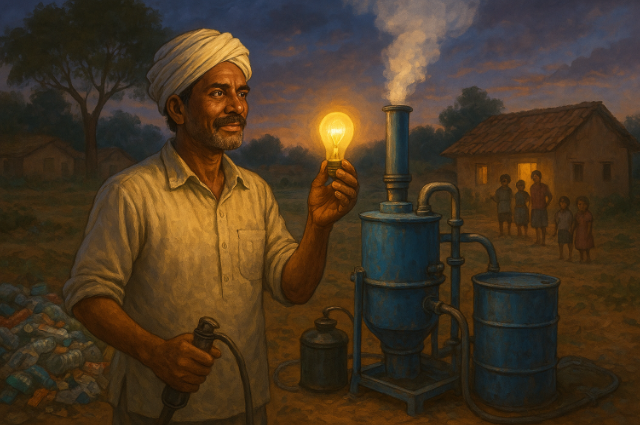
It was in a small village, between the dusty roads and the withering fields, where the nights tended to disappear into darkness, and the days were preoccupied with anxiety, that a quiet revolution was about to begin with a man who never thought he could initiate one. Ramesh Kumar was a man of tradition and an instinctive dreamer who lived in a world where the plastic waste crisis had turned into an unspoken tragedy. Mounts of garbage wrappers, bottles, and packets had choked the soil and the river, and apparently grew faster than the crops. Children used single-use plastic littered paths to walk to school. Cows chewed on desperate pieces to swell up their stomachs. Once fertile land, it was now struggling to breathe. Right next to this environmental degradation was another day-to-day ordeal, the lack of power that could be trusted. As the sun set, the entire village plunged into a darkness that was more oppressive than night itself. Students were working hard to brighten their eyes with the dim kerosene lamps, shopkeepers closed down early and even hope appeared only by flashes. The majority of the population accepted this as destiny. But Ramesh did not.
He did not begin his journey out of privilege, but out of pain, out of an ache, an ache of seeing his community disintegrate due to a series of problems that no one knew how to resolve. On one afternoon, when Ramesh was assisting his son with a school project on renewable energy, he came across an easy-to-understand explanation of pyrolysis, a process by which plastic waste can be transformed into usable fuel. To the majority of readers, this was a scientific term. But to Ramesh, it was an eye-opener. The idea that the very thing ruining their village could turn out to be its saviour excited his heart. He would wake up at night, wondering about it, and draw crude diagrams on the reverse of the old sacks of fertilisers, picturing what no one around him had pictured: that a farmer with no formal scientific training could turn plastic into electricity.
However, some big ideas usually arrive in impossible form. The villagers laughed at him first. Some warned him about danger. Others had rejected him as a person who had lost touch with reality. But Ramesh was aware that the first step towards progress is a question that no one might want to ask. His workshop was his backyard, as he had no laboratory. His scavenging of scrap metal, abandoned machine parts, old pipes, and rusted barrels was carried out with no equipment. Each failure was followed by an increased mockery; however, his determination was becoming increasingly forceful. He burned his hands, breathed fumes that made him sick, and at other times, he could sit and watch burnt plastic or melted parts, wondering whether hope could be a source of power in the dream. Yet he never stopped. A failure told a secret, each failure, and gradually it became a little easier to adjust the temperature, fasten the chamber, use another type of plastic, or change the pressure. Gradually, the pieces did start to fit together.
It was with the light he managed to create that he could feel his village glowing on the day when his small bulb flicked to life through the fuel he created. It was more than electricity. It was evidence that the unthinkable had broken. Rather than joyfully celebrating with the kids of his own home, he summoned the village council and the children to watch the shaking bulb. They were in dumb amazement. Some applauded, some wept, and everybody was aware that they were experiencing history, not the kind written in books, but the kind created in backyards through dogged desire. Ramesh inspired and perfected his system. He created a more efficient, safer and stronger pyrolysis unit with tools that most would have disposed of. The machine had the potential to convert plastic waste to oil, which was used to run a generator that was powerful enough to light homes. Where there had always been darkness, where one could be depended upon, this new light was as a second sunrise.
The electric or electric transformation did not stop at electricity. Ramesh has embarked on a village-wide campaign to gather plastic waste, in which everyone, from old farmers to young kids, is taught that the trash they used to pass by without care is their treasure and will not go to waste. The competitions were initiated in which children were required to collect the most plastic. Women formed associations to maintain street cleanliness. The farmers gathered plastic at their farms just as they harvested their crops. What was considered a symbol of neglect has been transformed into a symbol of empowerment. Slowly, the village was becoming purer, the river purer, the air fresher. Individuals ceased disposing of plastic; they began hoarding it. Others also made meagre incomes by collecting large volumes of rubbish. Innovation by Ramesh had not only resolved an environmental crisis, but it had also given rise to a new economy.
But all revolutions have their trials. On some days, the machine also failed to operate for no reason. It was months when the funds were insufficient, months when government officials doubted safety measures, months when his opponents reappeared to say his idea was unrealistic. However, Ramesh did not stop because he was not motivated by ego, but rather by a sense of responsibility. And he continually improved his model, learning technical principles on his own through reading old textbooks, watching videos, and consulting with anyone who was willing to explain. He recorded his observations, tried variations, and continued until he came up with a complete, working system that was sustainable, meaning it required minimal maintenance and could be run by trained villagers. What started as an isolated experiment turned out to be a societal invention.
Houses in his village today shine with clean energy, which is made from plastic that once threatened the environment. Children learn without necessarily straining their eyes. Small firms thrive when working hours are long. The electricity is used to operate water pumps by farmers.
The pyrolysis unit is a sign of pride in the village school, which trains children in the use of science to transform the world with the aid of daring. Even other nearby villages come to learn under Ramesh, to imitate his success. What used to appear as lunacy is now being glorified as an example of rural innovation that meets the world's sustainability objectives.
Yet, it is not just about technology, nor is it just about the effect on the environment. Through Ramesh and his story, we are reminded that inspiration has nothing to do with degrees, fancy laboratories, or high status. In some cases, the big change is achieved by people with minimal resources and a heart full of passion. Ramesh lacked investment, yet he had a mission. He was an uneducated man with a vivid imagination. He did not have a support system that would sustain him immediately, yet he had unshakable faith that an individual would be enough to spark a change. His quest confirms that great tales are not exclusive to superheroes but also to average individuals who are bold enough to rise up against common issues.
In an era where the world is choking on pollution and frantically trying to find a way out, one farmer living in a small village in India has demonstrated that all is not a privilege but an option, which could lead to innovation. It is not merely about plastic or electricity as far as his story is concerned. It is about resilience. It is the daringness to dream the unlimited. It is essential to remind society that genius is likely to emerge in places where the world does not typically look. His village is not just bright today because there is electricity, but because there is belief: the belief that change is not an extreme, closed-off thing in the minds of experts, but a living element, created through brave actions, imagination, and unswerving hope.
Ramesh Kumar might never refer to himself as a hero, but his village does. And maybe that is what impact really is - not awards, not recognition, but the faint light that shines in the houses, the power of a man who did not want his people to be in the dark. His story is not only an invitation to the world but also a call to remake what is possible when a mere individual chooses to rewrite his fate with nothing more than desire and a dream in his heart.