
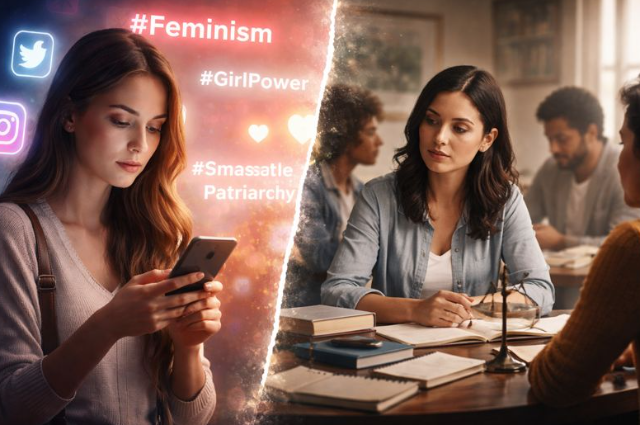
In India, over 60% of young women report learning about feminism primarily through social media platforms such as Instagram, TikTok, and YouTube (Pew Research Centre, 2023). Yet, surveys show rising anxiety, delayed marriages, and relational instability among the same demographic. This paradox raises a pressing question: Has a movement rooted in justice turned into a performance of identity rather than genuine empowerment?
Feminism is one of the most influential social movements in modern history. Born from women’s struggles against discrimination, exclusion, and violence, it sought to ensure dignity, equality, and justice. From securing voting rights to challenging workplace discrimination, feminism has reshaped societies worldwide and expanded opportunities for millions of women.
Yet, in the twenty-first century—particularly among sections of the younger generation—feminism seems to be standing at a crossroads. While its language is louder and more visible than ever, its meaning is increasingly fragmented. What was once a rights-based movement grounded in social reform is now often reduced to lifestyle symbols, social media performances, and ideological extremes, where empowerment is sometimes measured by appearance or rebellion rather than choice and responsibility.
This raises a critical question: Has contemporary interpretation of feminism begun to undermine moral balance and social harmony, rather than strengthen justice and equality?
This article argues that feminism itself is not the problem. The real concern lies in how it is interpreted, consumed, and practised by parts of the present generation, especially under the influence of digital culture, hyper-individualism, and commercialisation. By examining data, scholarship, and real-world impacts, this article seeks to distinguish genuine feminism from its distorted versions and explain why interpretation matters—not only for women, but for society as a whole. It focuses particularly on how digital platforms and pop culture have reshaped perceptions of empowerment, morality, and gender balance in contemporary society.
The Original Vision of Feminism: Equality with Responsibility
At its core, feminism has always been about ending injustice and promoting dignity, not rejecting morality or dismantling families. Scholar bell hooks famously defined it as “a movement to end sexist oppression,” framing feminism as a corrective and inclusive force rather than a destructive or adversarial ideology.
Historically, feminist movements tackled concrete inequalities: denial of education, lack of political representation, economic dependence, legal vulnerability, and gender-based violence. According to UN Women (2023), nations that invested in women’s education and workforce participation saw measurable gains in economic growth, public health, and democratic engagement. Feminism, therefore, was never merely a women’s issue—it was a project of societal transformation.
Early feminist thinkers did not reject family, marriage, or moral values. Simone de Beauvoir, often misquoted in popular discourse, did not oppose relationships or motherhood; she opposed forced roles without choice. Choice, dignity, and responsibility were the ethical pillars of feminism, empowering women within society rather than isolating them from it.
By grounding empowerment in responsibility and societal contribution, early feminism sought to create a balance between freedom and ethics, a balance that is increasingly overlooked in modern interpretations.
While the original vision of feminism emphasised ethical empowerment, responsibility, and societal reform, today’s engagement with feminism often looks very different. The rise of digital platforms has transformed how young people perceive and practice feminist ideals. Complex principles of choice, dignity, and responsibility are frequently condensed into viral slogans, visual symbolism, and performative acts, creating a version of feminism that is far removed from its foundational goals. This shift raises a crucial question: how has the digital age reshaped feminism, and what are the consequences of this “shortcut” approach?
The Digital Generation and the Rise of “Shortcut” and “Pop” Feminism
In the twenty-first century, feminism has taken on new forms, largely shaped by the habits and priorities of younger generations. Digital platforms now serve as the primary lens through which many young people encounter feminist ideas, reshaping both understanding and practice. The following subsections explore how this transformation has unfolded.
Digital Platforms and Compressed Ideas
The present generation’s engagement with feminism is shaped less by books, debates, or grassroots movements and more by digital platforms. According to the Pew Research Centre (2023), more than sixty per cent of Gen Z and young millennials report learning about social justice concepts primarily through social media platforms such as Instagram, TikTok, and YouTube. While digital access has democratised information, it has also compressed complex feminist ideas into viral slogans, trendy aesthetics, and performative gestures.
Pop Feminism and Performative Acts
Feminism is increasingly packaged as “pop feminism”—a commercialised, media-friendly version that prioritises visibility, style, and personal branding over historical understanding or ethical responsibility. Instead of sustained activism or structural reform, empowerment is often represented through symbols and spectacle. Common examples include trendy slogans such as “smash the patriarchy” circulating widely as hashtags without historical, social, or ethical context, as well as influencer-led campaigns that celebrate rebellion—party culture, excessive drinking, or provocative dressing—as inherently “feminist acts.”
This reduction of feminism into digestible visuals and attitudes has given rise to what scholars describe as performative feminism or slacktivism, where publicly claiming a feminist identity replaces meaningful engagement with real issues such as education, safety, legal reform, or economic justice. In many cases, empowerment is measured not by agency or responsibility, but by visibility, shock value, and online validation.
Algorithmic Amplification and Misinterpretation
A UNESCO Media Literacy Report (2021) warns that algorithm-driven platforms amplify sensational or extreme interpretations because they generate higher engagement. As a result, feminism is frequently perceived as a rejection of tradition, a badge of rebellion, or a lifestyle identity rather than a serious ethical and social movement. Many young users come to equate viral posts, slogans, or aesthetic rebellion with liberation, rarely engaging with the historical struggles, moral frameworks, or responsibilities that originally defined feminist thought.
From Grassroots to Symbolism
In contrast, earlier feminist movements relied on grassroots organising, legal advocacy, intellectual debate, and sustained collective effort. Empowerment was achieved through patience, sacrifice, and structural reform—not through trends or online performance. The rise of shortcut and pop feminism, therefore, marks a shift from substance to symbolism, with long-term implications for personal ethics, family stability, and social cohesion.
While digital and pop feminism have made the movement visible, visibility has also brought distortion. Personal choices are now often mistaken for universal principles, leading to widespread misinterpretation.
Key Misinterpretations: When Meaning Gets Distorted
One of the most concerning trends in contemporary discourse is the re-labelling of personal lifestyle choices as universal feminist principles. This distortion creates confusion, moral inconsistency, and social friction.
Contemporary narratives often equate empowerment exclusively with sexual expression or nudity. While bodily autonomy is undeniably important, scholars such as Martha Nussbaum caution against confusing autonomy with objectification. Movements like the No-Bra campaign are frequently cited as feminist symbols. While intended to promote freedom of choice, when such actions are presented as the sole marker of empowerment, they risk reducing feminism to appearance and rebellion rather than meaningful social reform.
Similarly, acts freely chosen—such as homemaking, caregiving, or prioritising family life—are frequently dismissed as “internalised patriarchy.” Ironically, this attitude denies women the very freedom feminism promised: the freedom to choose differently. True empowerment respects all choices; feminism that invalidates traditional decisions replaces liberation with another form of societal pressure.
Casual or premarital relationships are often framed as markers of ideological superiority, while commitment and responsibility are portrayed as weakness. However, psychological studies published in the Journal of Adolescent Health (2018) link casual sexual cultures with higher rates of anxiety, emotional distress, and relational instability among young adults, particularly women.
Another troubling trend is the rise of adversarial gender narratives. Some online interpretations promote hostility towards men as a feminist stance or encourage the demand of privileges simply because men have them—ignoring that equality is about fairness, not imitation. Bell hooks strongly criticised this approach, warning that feminism that seeks domination rather than liberation betrays its own purpose.
These misinterpretations do not strengthen feminism; they reduce it to a selective, performative ideology, accessible only to those who conform to a particular lifestyle. They distort the movement’s core, weaken family bonds, and create societal friction, undermining the real goal of equality, dignity, and shared responsibility.
Is Demanding What Men Have True Empowerment?
A growing trend in contemporary feminist discourse is equating empowerment with acquiring what men traditionally possess—be it lifestyle freedoms, casual relationships, or publicised behaviours. While striving for equality in opportunity, pay, and legal rights is central to feminism, copying male privilege without responsibility does not constitute empowerment.
A striking example is the “No-Bra” or “Free the Nipple” movement, which is often presented as an act of feminist resistance against objectification and social control. While the intention may be framed as bodily autonomy, such gestures frequently reduce empowerment to visibility and defiance rather than addressing deeper structural inequalities faced by women. When symbolic acts are elevated as ideological milestones, they risk diverting attention from pressing concerns such as education, safety, healthcare, and economic justice. This recurring example highlights how performative symbolism often overshadows ethical and structural feminist goals.
Some online narratives further suggest that women asserting independence must engage in partying, drinking, or provocative dressing to “break patriarchal chains.” While personal freedom is valid, framing such acts as inherently feminist reduces empowerment to imitation rather than ethical agency. This approach can inadvertently erode moral standards, destabilise family dynamics, and create social friction, affecting relationships, marriages, and emotional well-being.
Research from the Journal of Adolescent Health (2018) links cultures that glorify casual lifestyles with higher anxiety and relational instability among young women. Sociological studies in South Asia also show that framing empowerment purely as rebellion against men leads to strained family relationships, delayed marriages, and emotional disconnection between partners.
True feminism is about choice, dignity, and responsibility, not merely performing acts associated with men. Equality is achieved through structural, ethical, and moral reform—not by replicating behaviours divorced from context, consequence, or societal balance.
Moral Balance and Social Impact: Why Interpretation Matters
The way feminism is interpreted does not remain confined to ideology; it directly shapes social relationships, family structures, and ethical norms. When interpretations drift away from moral balance, the consequences are felt not only at an individual level but across communities and generations. Understanding this impact is essential to evaluating whether contemporary feminism strengthens or destabilises social harmony.
Ethics Is Not Oppression
One of the most misunderstood aspects of contemporary feminism is its relationship with morality. Morality does not signify control or suppression; rather, it represents the shared ethical framework that sustains trust, responsibility, and social harmony. Feminism originally worked within this framework, seeking justice without dismantling ethical foundations. When morality is misrepresented as oppression, freedom loses its ethical compass and becomes detached from accountability.
Equality vs. Sameness: A Fundamental Misreading
A significant source of confusion in contemporary feminist discourse arises from the assumption that equality must imply sameness. Questions such as why men and women follow different cultural expectations, why biological roles differ, or why family structures evolve asymmetrically are often framed as evidence of oppression rather than difference. Feminism, however, never sought to erase biological or social realities; it sought justice within them. When equality is reduced to identical roles, responsibilities, or appearances, the ethical goal of fairness is replaced by unrealistic comparison, leading to resentment rather than empowerment.
Media Narratives and the Illusion of Empowerment
Modern media and digital platforms play a decisive role in reinforcing this misreading. Popular narratives frequently portray empowerment as rebellion, visibility, and sexual expression, while modesty, caregiving, or family-oriented choices are framed as submission. This binary representation creates a narrow definition of freedom, validating only those choices that align with dominant cultural trends. As a result, empowerment becomes performative rather than substantive, prioritising symbolism over structural change and diverting attention from urgent issues such as safety, education, and economic justice.
Gender Relations and the Crisis of Trust
A visible social consequence of this distortion is the growing mistrust between young men and women. Pew Research Centre (2022) reports increasing fear of long-term commitment, with relationships often viewed through the lens of power struggle rather than partnership. When feminism is framed as opposition instead of cooperation, equality gives way to emotional distance, suspicion, and relational instability. Sustainable empowerment flourishes through mutual respect, not antagonism.
Family, Care, and Social Stability
Family institutions are increasingly portrayed as inherently patriarchal, yet empirical evidence suggests otherwise. UNICEF (2021) shows that stable and cooperative family environments significantly enhance women’s mental health, economic security, and child wellbeing. Feminism that devalues caregiving, homemaking, or shared responsibility risks weakening social cohesion rather than strengthening autonomy. True empowerment expands choices—it does not stigmatise those rooted in care and commitment.
Parenting and the Next Generation
The impact of distorted interpretations extends beyond adults to the next generation. UNICEF (2021) highlights that shared responsibility in parenting positively influences children’s emotional, cognitive, and social development. When extreme individualism prioritises personal freedom over collective responsibility, children may experience insecurity and weakened emotional bonds. A feminism that neglects its intergenerational impact risks undermining the very future it seeks to empower.
Real Data, Real Consequences
While earlier sections explored cultural and ethical shifts, the following data reveal their measurable social and psychological consequences.
While ideological debates dominate online spaces, the real impact of distorted feminist interpretations is best understood through data and lived outcomes. Statistics, health reports, and sociological studies reveal a widening gap between the rhetoric of empowerment and the realities faced by women in terms of mental health, economic security, safety, and relationships. These figures remind us that empowerment must be measured by well-being and stability, not symbolism alone.
Mental Health and Emotional Well-Being
Empirical evidence highlights a growing mental health crisis among young women. The World Health Organisation (2022) reports rising levels of anxiety, depression, and social isolation, particularly in hyper-competitive and appearance-driven cultures. When empowerment is reduced to constant self-presentation and validation, psychological pressure intensifies rather than diminishes.
A Harvard Study on Adult Development (2023) further links extreme individualism with long-term dissatisfaction, noting that meaningful relationships and emotional security—not performative freedom—are the strongest predictors of happiness and resilience.
Economic Reality vs Online Empowerment
Despite the popularity of digital empowerment narratives, structural inequality remains largely unchanged. The World Economic Forum’s Global Gender Gap Report (2023) estimates that at the current pace, global gender parity will take more than a century to achieve.
In India, official Labour Bureau data (2022) shows that women’s workforce participation remains below 25 per cent, with persistent wage gaps exceeding 20 per cent in urban sectors. These figures expose the limits of symbolic feminism that celebrates visibility while neglecting economic reform, workplace safety, and policy intervention.
Relationships, Commitment, and Social Stability
Data also reveals growing relational instability. Pew Research Centre (2022) reports increasing mistrust between young men and women, with many expressing fear of long-term commitment. Narratives that frame independence as detachment and cooperation as weakness contribute to delayed marriages, unstable partnerships, and emotional insecurity.
While personal choice must be respected, a culture that discourages responsibility and long-term planning risks weakening social bonds rather than strengthening autonomy.
Safety and Public Spaces
The contrast between symbolic empowerment and real safety is particularly stark. According to NCRB India (2022), incidents of harassment and assault against women continue to rise, especially in urban and nightlife settings often promoted as spaces of modern independence. Without structural safeguards, legal enforcement, and social accountability, performative rebellion exposes women to increased risk rather than genuine protection.
Reclaiming Feminism: A Balanced Way Forward
For feminism to remain relevant and truly empowering, this generation must return to its ethical core. Real empowerment respects all choices—whether a woman pursues a corporate career, embraces domestic life, dresses modestly, or expresses herself boldly. Freedom without responsibility, however, risks chaos rather than justice, creating a society where rights are claimed but consequences are ignored.
Education must replace imitation. Engaging with the works of Simone de Beauvoir, bell hooks, Judith Butler, and Martha Nussbaum equips women with the tools to critically analyse society and make informed choices, rather than merely replicating social media trends or performative activism.
True feminism fosters cooperation between genders, not adversarial relationships. Equality is not achieved by replacing one form of dominance with another; it thrives when men and women collaborate, respect boundaries, and share responsibilities.
Moreover, moral values are not the enemy of feminism. Ethics, culture, and empowerment can coexist. Upholding social and familial responsibilities, respecting community norms, and practising empathy ensure that freedom is sustainable, meaningful, and constructive. Feminism anchored in morality does not constrain—it strengthens dignity, choice, and social harmony.
By reclaiming this balance, feminism can evolve from a performative identity to a transformative force, shaping a society where empowerment is both authentic and socially responsible.
Interpretation Is the Real Battleground
The greatest threat to feminism today is not opposition—it is misinterpretation. When feminism is reduced to a performative identity, stripped of responsibility, and detached from moral reasoning, it loses its transformative power and risks fostering confusion rather than empowerment.
Real feminism does not shame tradition, glorify excess, or promote division. It builds dignity, ensures equality, and protects choice. It empowers women without weakening families, communities, or ethical foundations.
For this generation, the challenge is clear: to move beyond slogans, reject extremes, and embrace genuine empowerment, one that balances rights with responsibility, freedom with morality, and individuality with social harmony. In the end, feminism itself does not fail society. Misinterpretation does.
Feminism is not failing; our interpretation of it is, and restoring its moral compass is the only path to genuine empowerment.
. . .
References:
- Beauvoir, Simone de. The Second Sex. Paris: Gallimard, 1949.
- Butler, Judith. Gender Trouble: Feminism and the Subversion of Identity. New York: Routledge, 1990.
- Hooks, bell. Feminism Is for Everybody: Passionate Politics. Cambridge, MA: South End Press, 2000.
- Nussbaum, Martha. Creating Capabilities: The Human Development Approach. Cambridge, MA: Belknap Press of Harvard University Press, 2011.
- Pew Research Centre. “Gen Z and Young Millennials on Social Justice and Feminism.” Washington, DC: Pew Research Centre, 2023. https://www.pewresearch.org/
- Pew Research Centre. “Relationships, Commitment, and Social Stability Among Young Adults.” Washington, DC: Pew Research Centre, 2022. https://www.pewresearch.org/
- UNESCO. Media Literacy Report: Understanding Digital Influence and Algorithmic Amplification. Paris: United Nations Educational, Scientific and Cultural Organisation, 2021. https://www.unesco.org/
- UNICEF. The State of the World’s Children: Child Wellbeing and Family Structures. New York: UNICEF, 2021. https://www.unicef.org/
- UN Women. Women’s Education, Workforce Participation, and Social Progress. New York: United Nations Entity for Gender Equality and the Empowerment of Women, 2023. https://www.unwomen.org/
- World Economic Forum. Global Gender Gap Report 2023. Geneva: World Economic Forum, 2023. https://www.weforum.org/
- World Health Organisation. Mental Health Trends Among Young Women: Global Report. Geneva: WHO, 2022. https://www.who.int/
- Labour Bureau India. Women’s Workforce Participation and Wage Gaps in India. New Delhi: Ministry of Labour and Employment, Government of India, 2022. https://labourbureau.gov.in/
- National Crime Records Bureau (NCRB) India. Crime in India Report 2022. New Delhi: NCRB, 2022. https://ncrb.gov.in/
- Journal of Adolescent Health. “Casual Sexual Cultures and Emotional Well-being in Young Adults.” Journal of Adolescent Health 62, no. 4 (2018): 456–467.
- Harvard Study on Adult Development. Harvard University Study on Adult Development. Cambridge, MA: Harvard University, 2023.