
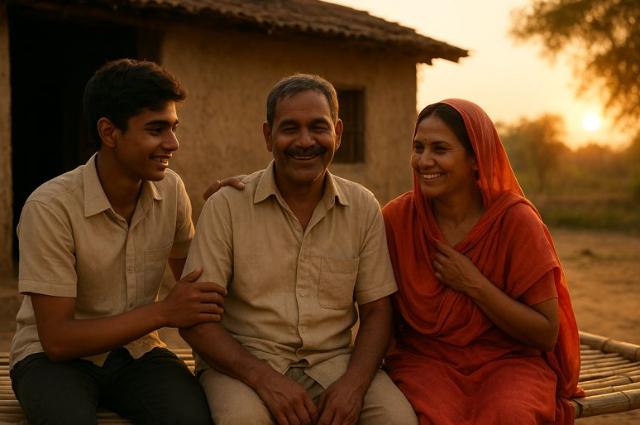
The day Junaid almost lost his father didn’t begin with thunder or warning. It began in a silence heavier than fear. COVID-19 had locked the world inside its homes, and in their small village, life felt frozen in time. Empty roads, shuttered shops, and the thick, unmoving air made it seem as if the whole world was holding its breath, waiting for something to break the stillness.
For months, Junaid’s family survived only because they cultivated vegetables. Food was manageable; income wasn’t. His father, once known across the village as an honest daily-wage labourer, lost all work as soon as the lockdown began. Before Covid, he returned every evening with dust on his hands and sweat on his forehead—but always carrying something small for the children. A packet of biscuits. A jalebi. A samosa. And when nothing else was possible, a smile that worked harder than any gift.
He believed in kindness even when life was unkind.
But the lockdown was a storm that uprooted jobs, dignity, and peace. Inside their small home, worry coiled through the air like smoke. Yet Junaid’s mother held the family together with faith. Whenever her fears grew too heavy, she tightened her dupatta, a gesture she never consciously noticed, but one that revealed every tremor of her heart.
After weeks of quietly observing her husband’s discomfort, she tightened that dupatta again and said, with courage trembling in her voice:
“No matter what it costs, we will go for your father’s kidney operation.”
The dupatta became her symbol of strength, wrinkled, knotted, clutched, and released with every rise and fall of hope.
Junaid’s father had lived with small kidney stones for years. The attacks came rarely and briefly, so he treated them as an inconvenience rather than a threat. “It’s nothing,” he would laugh. “Small things don’t trouble big men.” But something small was growing silently into something dangerous.
When the Covishield vaccination drive began, the family went together to the local school. Many villagers felt sick afterward, including them. But life settled back to an uneasy normal until one cold February morning.
Junaid was preparing for his metric examinations when the wind pushed his door open. Through the gap, he saw his father sitting stiffly on the bamboo platform outside. The bamboo, sun-warmed, cracked with age, had always been his refuge after long days of labour. But today, he didn’t look relaxed. He looked defeated.
Before Junaid could move, his mother’s voice broke into panic.
“Junaid! Your father is feeling pain in his chest, something heavy is pressing him!”
His books fell. He ran.
His father leaned forward, hand pressed against his chest, breathing shallowly as if each breath carried a stone inside it.
“Papa, what happened?” Junaid cried.
His father managed a faint whisper. “Maybe… the stones… maybe it came back stronger.”
Junaid rubbed his chest and back in slow circles, hoping for relief. But the pain clung stubbornly. His mother stood beside them, twisting the end of her dupatta so tightly that the cloth looked like it might tear.
“We need to go for a check-up,” she said.
Even then, his father’s instinct was to protect the family’s money rather than his own body.
“It will pass. Don’t waste money…”
His mother cut him off. “No. A mother’s heart knows. Take him.”
At the government hospital, the doctor examined him briefly. His tone softened as he handed them some tablets.
“You must go to a better hospital. We have done all we can here.”
That sentence followed them home like a shadow.
Junaid’s mother barely slept that night. She sat near the window, whispering prayers into the dark, her forehead sometimes pressed against the metal grill, tears slipping down silently, tears she hid from her children. At dawn, she took a breath strong enough to steady her trembling voice.
“We’re going tomorrow. Allah will make a way.”
The next morning, she took her husband for an ultrasound while Junaid stayed home with his two younger siblings. At seventeen, he felt his childhood end in a single day. He walked around the house mechanically, heart beating with a mix of fear and responsibility too heavy for his age.
When his parents returned at 3 p.m., sorrow entered with them.
Junaid rushed forward. “Ammi? What happened?”
Her hands shook as she held the medical envelope. It was crumpled at the edges, softened by the heat of her palms and the weight of her fear.
“The stones…” she whispered. “They’ve grown. From 2 mm to 19 and 22 mm.”
For a moment, the world around him blurred. His breath stilled. He felt as though those stones had lodged themselves inside his own chest.
A memory flashed before him, being five years old, feverish, and crying. His father had walked barefoot all the way to the market in the rain, just to buy him medicine before the shop closed. He had carried him home on his shoulders despite being exhausted from work.
Today, that same man could barely stand.
“I’ll find a good hospital today,” Junaid said, voice steadying with determination.
His mother nodded. “Even if we must sell property, we will go.”
His father shook his head weakly. “Your mother speaks like a child… How will you all live? I have no job. Two sons in private school. The youngest is still small. You all depend on me.”
Junaid knelt beside him.
“Papa, you once carried me everywhere. Now let me carry your worries. We can survive without money. We cannot survive without you.”
His father lowered his eyes, tears gathering.
“I’m not afraid of pain. I’m afraid of leaving you all alone.”
“There will be a way,” his mother whispered. “Allah never abandons the poor.”
They borrowed money, sold their stored betel nuts, and gathered enough for travel and admission.
After days of searching, they chose Al-Salam Hospital in Goalpara, affordable, reputed, and their only hope.
When they arrived, the driver called out to a young man standing near the gate.
“Hey hero!”
The young man turned and smiled warmly. Lean, bright-eyed, perhaps twenty-seven. His name was Imran.
“Are you here for surgery, Uncle?” he asked gently.
“Yes,” Junaid’s father said softly.
“Do you have an Atal Amrit card?”
Embarrassed, he replied, “No.”
Imran’s face softened.
“Don’t worry. I’ll arrange everything before 5 p.m.”
“How much will it cost?” Junaid’s mother asked.
Imran shrugged, almost shy.
“Aunty, these are hard times. I only take two thousand for all expenses.”
His eyes had a tiredness that suggested he had spent many nights helping others during the lockdown. Maybe life had not been easy for him either. Yet his smile never wavered.
He guided them through forms, photocopies, and conversations with staff; each step that felt impossible now felt manageable. He even complimented Junaid’s mother for keeping all documents neatly tied in a small polythene packet.
“Very organised, Aunty. Leave the rest to me.”
Junaid’s father was admitted that same day.
Hospitals during Covid felt like another world, one where fear floated in the air heavier than disinfectant. Ambulance sirens echoed like warnings. Families waited outside rooms with silent prayers stitched into their breaths.
One night, Junaid sat alone near a dim corridor window, looking at the empty road outside. COVID had silenced the world, and that silence pressed against his heart. For a moment, he asked himself if he was strong enough for all this, if he could hold his family together.
His eyes burned. His breath trembled.
And quietly, he broke.
Tears escaped, slow, painful, private.
Not because he was weak,
but because even strength needs a place to collapse.
He wiped his face and whispered,
“Allah, help me. I will protect my father. Open the doors.”
Inside the room, his mother prayed on the bed, fingers twisting her dupatta again and again. His father watched them with a mix of fear, love, and apology.
When his father was taken to the operating theatre, Junaid held his hand tightly.
“Papa, don’t fear. Recite whatever you know. Allah is with you.”
His mother cried, but a woman beside her placed a gentle hand on her shoulder.
“Don’t worry, sister. My husband is also inside. Believe in your Allah, as I believe in my Bhagwan.”
Hours crawled.
Finally, the doctor stepped out.
“The surgery went well.”
Those words felt like water to a man dying of thirst.
At the billing counter, Junaid’s hands shook.
“How much do we have to pay?”
The accountant replied calmly,
“Ten thousand only.”
Junaid almost couldn’t believe it. They had expected fifty thousand or more.
He ran back to his mother.
“Ammi! Only 10K! Allah is merciful!”
Her tears flowed freely, not from fear, but gratitude.
Before returning home, the family visited Imran’s small hotel to thank him.
Junaid’s father held his hands tightly.
“Beta, may Allah bless you. Without you, we could never have afforded this.”
Imran looked down, humbled.
“Uncle, poverty is not a crime. Helping one another is what keeps humanity alive. Pray that Allah lets me continue serving people.”
When they returned home at sunset, the breeze carried the aroma of moist earth and new hope. Junaid paused near the bamboo platform where his father had sat in pain days earlier. The sunlight touched it softly, as if the place itself remembered and healed.
His father looked at the sky and spoke quietly:
“To help someone, you don’t need wealth.
You just need a clean heart.
Even a smile can be a charity.”
His mother loosened her dupatta, for the first time since the ordeal began.
The symbol of fear finally rested.
And that evening, Junaid understood something profound:
Angels don’t always descend from the sky
Sometimes they stand at hospital gates,
tired yet smiling,
offering hope to strangers.
And one day, he promised himself,
He would become someone’s Imran.