
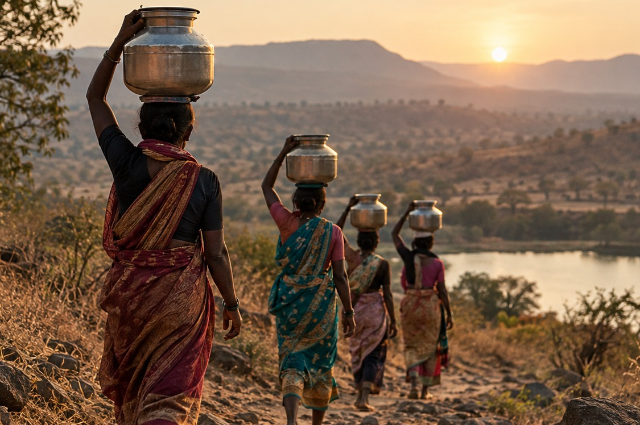
Every afternoon, the women of Vadvi Pada face a calculation that should not have to be made in any household: how far must they travel to obtain the water their families will need before the day is over? The answer is nearly three kilometres. They leave with empty vessels and return carrying them filled, with some loads weighing between seven and ten kilograms. The journey is not an occasional response to an emergency. It has become part of everyday life in a tribal hamlet where a dependable source of water is not available close to home.
Vadvi Pada is part of Khadkapani village in Maharashtra's Nandurbar district. In June 2026, a report by a national newspaper brought wider attention to the women and girls who make this journey. The story was about water, but the distance travelled by these women reveals something larger about what happens when essential infrastructure is absent. The need for water remains constant even when the system that should deliver it does not. Someone has to fill that gap, and in Vadvi Pada, women have been doing so with their bodies.
The distance itself does not explain the full burden. A three-kilometre journey made once is one thing. A journey made repeatedly, often carrying a heavy load on the way home, becomes part of the structure of a person's day. It affects when she can work, when she can rest, when children can study and how much time remains for everything else a household requires. Water is not simply something these women collect. It is something around which part of their lives has been organised.
THE LABOUR HIDDEN INSIDE A LITRE
Most people rarely think about the labour behind the water that comes from a household tap. The infrastructure between the source and the kitchen is invisible precisely because it works. A person turns a handle, fills a vessel and goes back to whatever he or she was doing. The journey of the water has already been completed by a system of pipes, pumps and distribution networks.
For a household without that system, the journey becomes personal. Someone must know where the water is, travel there, wait if necessary, collect it and carry it home. Only then can the household use it for drinking, cooking, washing and cleaning. The water itself may be free, but obtaining it is not without cost. The payment is made in time and physical effort.
The World Health Organisation and UNICEF have found that women and girls are responsible for collecting water in seven out of ten households worldwide that do not have water on their premises. Their research also identifies the wider consequences of this responsibility, including time lost from education, employment, rest and leisure. The significance of this is easy to underestimate because water collection is usually unpaid. It does not appear as a formal occupation or generate a wage, yet if the work is not done, the household cannot function.
This creates an unusual kind of invisible labour. The infrastructure is absent, but the service is still somehow provided. A woman walks to the source and carries the water back. The household receives what it needs, and the system appears to function. The cost has simply been transferred from infrastructure to the individual. The woman carrying the vessel is, in effect, performing part of the work that a functioning water system is supposed to perform.
WHEN THE BODY PAYS
The physical consequences of this arrangement become more serious when the same work is repeated over long periods. The report by the national newspaper documented health concerns among women in the region, including chronic pain, miscarriages and uterine prolapse, associated with the physical demands of collecting water. A water shortage can therefore enter the body in ways that may not be immediately visible to someone observing the problem from a distance.
It is easy to describe a distant water source as an infrastructure problem. It is much harder to describe the accumulated effect of repeatedly carrying heavy loads over difficult ground, especially when the same person also has other domestic responsibilities. The journey does not end when the vessel reaches the house. The work that depends on the water is still waiting, and the woman who returns from the source must continue with the rest of her day.
This is one reason the human cost of water scarcity can remain hidden. There is rarely a single dramatic moment when the damage becomes visible. Instead, the burden is repeated until it becomes familiar. Familiarity can make hardship appear normal, but it does not make the hardship harmless. The woman who carries the vessel is doing work that a functioning water system is supposed to make unnecessary, and the longer that arrangement continues, the greater the physical price can become.
WHAT A WOMAN GIVES UP
The most obvious thing lost in this routine is time. A journey to the water source takes time to make, and the return journey takes more. There may be waiting involved, and there may be other household duties that cannot be postponed. The total cost is therefore larger than the distance suggests.
Time is often treated as though it were equally available to everyone, but it is not. A woman who spends hours obtaining water cannot spend those same hours elsewhere. She may have less time for paid work, less time to rest and less time for the activities that allow a person to develop opportunities beyond the immediate demands of survival. A young girl accompanying her mother may have less time for schoolwork or education. The loss does not necessarily appear as a measurable economic figure, but it can influence the choices available to a person over many years.
This is why water scarcity should also be understood as a problem of opportunity. The World Health Organisation and UNICEF's findings make this connection particularly clear. Where water is not available at home, collecting it can interfere with education and employment as well as everyday domestic life. A household may therefore pay for a missing water connection several times over. It pays in physical labour, in lost time and sometimes in opportunities that cannot easily be recovered.
The price of water is not always visible on a bill. Sometimes it is visible in the number of hours a woman has left after she has finished bringing it home.
WHAT CHILDREN INHERIT
There is a generational dimension to this story. Children learn the routines of their homes by watching the adults around them. A daughter who grows up seeing her mother collect water learns the route almost as naturally as she learns the way home from school. She may learn how to carry the vessel, where to go and how to manage the journey. Practical knowledge is normally something worth passing from one generation to another, but there is a difference between passing down wisdom and passing down an adaptation to deprivation.
The mother is not responsible for creating the shortage. She is teaching her daughter how to manage the circumstances available to them. Yet if those circumstances remain unchanged, the same knowledge can become necessary for the next generation. A daughter should inherit her mother's memories, values, language and wisdom. She should have the opportunity to study, work and decide what she wants her future to look like. Knowing how to walk kilometres carrying water should never have to be one of the conditions of becoming an adult.
That is where a water problem becomes more than a household inconvenience. It can become part of a child's understanding of what is expected of her. The connection between water and education is therefore more direct than it first appears. Every hour spent collecting water belongs to the child or woman who spends it, and if those hours replace school, study, paid work or rest, then water scarcity has entered another part of life. The absence of water infrastructure can consequently become an absence of opportunity.
MORE THAN A TAP
India's Jal Jeevan Mission was created to provide safe and adequate drinking water through individual household tap connections in rural areas. The programme also addresses issues such as water-source sustainability, rainwater harvesting, water conservation and grey-water management. The larger objective matters because a dependable water supply can alter much more than the way a family obtains drinking water. It can change the amount of time available to women, reduce physical strain and make household routines more predictable.
At the same time, the existence of a tap and the dependable availability of water are not necessarily identical. For someone living with scarcity, what matters is whether water is actually there when it is needed. A water connection is important, but its significance is ultimately determined by what happens at the household level. If a woman still has to walk several kilometres to collect water, the burden that the infrastructure was supposed to remove remains.
This is also why development cannot be measured entirely through construction figures. A pipeline can be counted, and a household connection can be counted, but the more important question is what happens afterwards. Does the woman still leave home with an empty vessel? Does she still return carrying it? If so, there is still work to be done. The purpose of infrastructure is not simply to exist, but to make difficult and unnecessary journeys disappear from people's lives.
WHEN THE INVISIBLE BECAME VISIBLE
The national newspaper's reporting produced an immediate response. Officials visited the area and tanker water was arranged, bringing some relief to residents who had been living with the shortage. The response was important for another reason as well. It demonstrated how quickly an overlooked problem can become an administrative priority once it is documented and brought into public view. For years, the journey had been part of the community's routine. Once the story was reported, the situation could no longer remain invisible.
Yet tanker water was not the same as a permanent solution. Residents said the supply was insufficient for all the affected areas and continued to seek more dependable arrangements, including piped water and a borewell. There is a useful lesson in that distinction. Emergency relief addresses an immediate need, while infrastructure addresses the condition that creates the need. A tanker can bring water to a village, but it cannot give a woman back all the hours she has already spent walking for it. A permanent and dependable water source can prevent those future journeys. That is the difference between responding to a problem and changing it.
BEYOND RESILIENCE
There is a familiar way of telling stories about women who live with hardship. We describe their courage, their endurance and their ability to continue despite difficult circumstances. There is truth in such descriptions, but they can also lead us towards the wrong conclusion. The remarkable thing about these women should not be that they have learned to carry burdens that society has failed to remove.
Their resilience is not an infrastructure policy. A woman who carries ten kilograms of water home is certainly demonstrating physical and mental strength, but the appropriate response to that strength is not to admire the burden and leave it in place. It is to ask why she is carrying it at all. There is dignity in work, but there is no reason to romanticise the absence of basic infrastructure and then praise people for surviving without it.
The women of Vadvi Pada do not need to become symbols of suffering or resilience. They need the ordinary conditions that allow people to live ordinary lives. The goal should not be to celebrate how much hardship a woman can endure, but to build circumstances in which that hardship is no longer necessary.
THE HOUR THAT RETURNS
One of the most useful ways to understand the importance of reliable water is to imagine the hour that comes back when the journey disappears. A woman might use it for paid work, childcare, household responsibilities, rest or simply for herself. That last possibility matters because not every recovered hour needs to become productive. A person should be allowed to have time that belongs to her without having to justify what she does with it.
This is why water access is connected to freedom in a way that is rarely discussed. Freedom is not always a dramatic political or economic concept. Sometimes it is freedom from a task that has consumed the same part of your day for years. It is the freedom to wake up without wondering who will collect the water, to remain at home when someone is ill, to allow a daughter to attend school without first completing an adult responsibility and to look at an empty vessel knowing that filling it does not require a three-kilometre journey.
For someone who has spent years walking for water, the ability to say, “I don't have to go today,” can represent a profound change in the structure of everyday life.
WHEN THE JOURNEY ENDS
The story of Vadvi Pada should not end with admiration for the women who have carried water. It should end with a question about whether they will still need to. The tanker intervention showed that the problem could attract attention and produce action, while the continuing demand for a permanent water source shows why the response cannot stop there. A community should not have to depend indefinitely on temporary arrangements for something as fundamental as drinking water.
The most useful measure of progress may therefore be what disappears from the daily routine. The road to the distant water source should eventually disappear from the woman's schedule, along with the physical burden of carrying heavy vessels, the hours lost to the journey and the anxiety of having to secure enough water for the household. A daughter should not need to learn the route because her mother no longer needs to travel it, and the vessel that once had to be carried home over several kilo metres should eventually remain where it belongs, inside the household, filled from a dependable source nearby.
Somewhere in Nandurbar, a woman knows exactly what it feels like to carry the household's water on her head. She knows the distance. After all, she has walked it, the weight because she has carried it and the value of water because obtaining it has required a part of her day for years. Perhaps the most meaningful change will come when her daughter knows none of those things from experience. There may be no ceremony when that happens. No camera may record it, and no official may stand beside the tap. The day may look completely ordinary. Water will simply be available at home, and a woman who once had to walk for it will spend those hours doing something else.
That ordinary day is what development should ultimately deliver. It should not be celebrated because a woman became strong enough to carry a heavier burden. It should be recognised because the system around her became strong enough to ensure that the burden no longer belonged to her.