
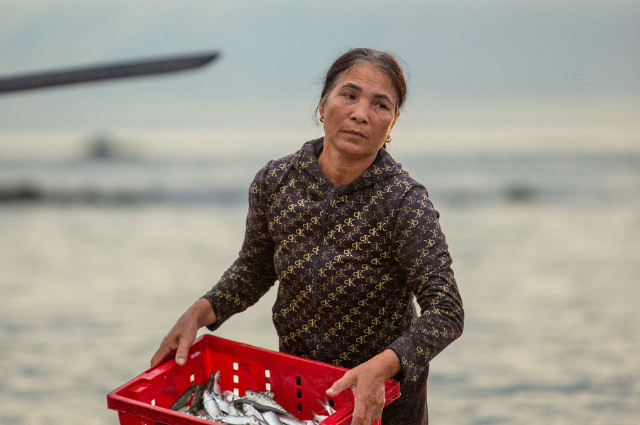
For years, the sea was simply where Ramalakshmi went to work.
She lived in Budagatlapalem, a coastal village in Srikakulam district of Andhra Pradesh, and earned her living through marine fish vending and dry fish processing. Like many families living along the coast, her livelihood depended on something she could never completely control. The sea could give, but it could also leave people wondering what the next day would bring.
Then, in 2025, she decided to try something new.
Ramalakshmi volunteered for a seaweed cultivation project under the Enhancing Climate Resilience of India’s Coastal Communities programme, carried out with the Department of Fisheries and technical support from the ICAR Central Marine Fisheries Research Institute. Until then, the sea had been a place from which she earned her living. Now she was going to try growing something in it.
Before beginning, she received training in marine ecology and raft construction. With support from her husband and members of her Self Help Group, she put ten rafts into the sea.
Then came the waiting.
Forty-five days later, she harvested her first crop.
For someone trying an unfamiliar livelihood, those forty-five days must have meant more than simply waiting for a harvest. There was no certainty that the idea would work for her just because it had worked elsewhere. She had invested her time, effort and hope into something she was still learning.
This time, it worked.
The first harvest gave Ramalakshmi something that was perhaps just as important as the crop itself. It gave her a reason to believe that seaweed cultivation could become another source of income.
And other people began to notice.
According to UNDP India, Ramalakshmi’s experience encouraged others in the community to take up seaweed cultivation. The ten rafts eventually became fifty, with support from the Green Climate Fund and the Pradhan Mantri Matsya Sampada Yojana. The group has also been working towards better market connections, branding and packaging for its produce.
Ten rafts had become fifty.
That change becomes even more interesting when we look at what is happening with seaweed cultivation across India.
Seaweed is not something new to India’s coastline. Coastal communities have collected and used it for generations, while researchers have been studying ways to cultivate it on a larger scale. The ICAR Central Marine Fisheries Research Institute has worked on seaweed mariculture and its uses since 1972 and has developed cultivation methods including raft and monoline farming.
Today, seaweed is receiving greater attention as a possible livelihood for coastal communities.
A 2025 Lok Sabha document reported that 384 sites covering 24,707 hectares had been identified along India’s coastline as suitable for seaweed cultivation. Andhra Pradesh accounted for 40 sites covering 1,355 hectares. Budagatlapalem, in Srikakulam’s Etcherla Mandal, was among the places where pilot cultivation was being carried out.
The figures show how much potential there may be. But numbers cannot tell us what it feels like to be the person who tries something new for the first time.
Ramalakshmi already knew the sea. She had spent years earning from it. What she did not know was whether she could make a living by putting something into it and waiting for it to grow.
She took the chance anyway.
That does not mean seaweed farming is an easy answer for coastal families. It still comes with its own difficulties. Farmers need suitable conditions, reliable buyers, processing facilities and stable markets. Seaweed is also perishable, which means what happens after harvesting matters just as much as the cultivation itself.
So this is not a story about a woman finding a magical solution to poverty or climate change.
It is a much simpler story.
Someone was given an opportunity.
She decided to try.
The first attempt worked.
And because it worked, other people could see the possibility for themselves.
There is also something significant about Ramalakshmi being a woman at the centre of this change. Women have long been part of India’s coastal economy through fish vending, processing and marketing, although much of that work remains less visible than fishing itself. Learning a new livelihood can give women another way to contribute to their families and communities, while also giving them skills they did not have before.
Ramalakshmi’s story began with ten rafts. Her group now has fifty.
The number is worth remembering, but perhaps the journey from ten to fifty matters more.
A new idea had to be tried before it could become a community effort.
Someone had to be first.
Ramalakshmi was.
The sea that had always been part of her working life became something different. Not easier, not predictable, and certainly not without risk. But different.
She did not have to leave the sea behind to start again.
She simply learned to look at it differently.
And sometimes, perhaps, a new beginning does not mean going somewhere new.
Sometimes it means returning to the place you already know and discovering that it still has something you have never seen before.