
There is a particular kind of loneliness in belonging to a city that never fully claims you, while carrying a heritage tied to a homeland you have never seen. That, in many ways, is what it feels like to grow up as a Calcutta Sindhi.
I have spent my entire life in Calcutta. Its humidity, its chaos, its political arguments, its yellow taxis and crumbling grandeur feel more familiar to me than anything else in the world. The city exists in my muscle memory. I argue about Kathi rolls and biryani with the passion of someone whose roots run deep here. And yet, all it takes is a surname to remind you that, to many people, you are still an outsider.
This is not only my story. It is the story of tens of thousands of Sindhi families who settled in Calcutta after Partition and have spent three generations negotiating between two worlds, two languages, and two versions of home. To understand that negotiation, you have to understand what the partition actually did to the Sindhis. Not only the political facts, which are well documented, but also the quieter devastation that followed the political facts.
A Homeland Left Behind: The Sindhi Displacement of 1947
When British India was divided in August 1947, the province of Sind fell entirely within the borders of the newly created Pakistan. Unlike Punjab and Bengal, which were themselves partitioned, Sind was not divided at all. The entire homeland of the Sindhi Hindus became, overnight, a foreign country.
According to historical estimates, approximately 1.4 million Sindhi Hindus crossed into India in 1947 and 1948. They came with very little. The migration was not always accompanied by the immediate violence that tore through Punjab, but it was displacement nonetheless, and in many cases it was permanent. Almost no Sindhi Hindu family that was left in 1947 was able to return and reclaim property, business, or land.
What made the Sindhi situation uniquely difficult was the absence of a receiving state. Punjabi refugees moved toward East Punjab. Bengali Hindus from East Pakistan moved toward West Bengal. They arrived in regions that shared their language, their food, and at least a portion of their cultural memory. Sindhi Hindus had no equivalent destination. They scattered across India, with significant concentrations forming in Mumbai, Pune, Delhi, Hyderabad, Ulhasnagar, and Calcutta.
The scholar Rita Kothari, in her extensive work on Sindhi identity and literature, has written about the particular psychological condition created by this rootlessness. Unlike other Partition communities, Sindhis could not point to a piece of the Indian map and say: That is where we come from. The homeland was gone. What remained was memory, language, and community.
Calcutta's Sindhis: Settlement, Commerce, and the Making of a Community
Calcutta had a small but established Sindhi mercantile community even before Partition. Sindhi traders had been active across Southeast Asia, East Africa, and the ports of the British Empire throughout the nineteenth and early twentieth centuries. Calcutta, as the largest city in British India and a major commercial hub, was a natural point of settlement for some of this trading class.
After 1947, the Sindhi population of Calcutta grew considerably as refugees arrived and settled into the city's commercial fabric. The area around New Market, already a centre of bustling trade and commerce, absorbed many Sindhi business families. The communities that formed were tight, organised around shared language, religious practice, and the networks of commerce that Sindhis had always relied upon.
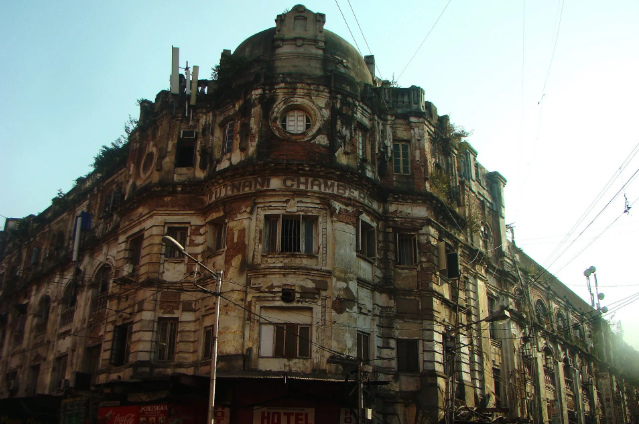
One visible landmark of this settlement is Futnani Chambers in the New Market Area, a colonial-era building repurposed by the Futnani family as a centre of Sindhi enterprise. It stands today as quiet evidence of how thoroughly Sindhi families planted themselves in the city's commercial architecture, even as the city around them remained overwhelmingly alien.
The Sindhi community built its own institutions in Calcutta. There were Sindhi sabhas, community halls, and religious spaces centred around the veneration of Jhulelal, the patron saint of the Sindhi people, whose worship holds particular importance for Sindhis across India. These spaces served not only spiritual functions but social ones, maintaining the connective tissue of a community that had been geographically scattered and needed internal networks to survive.
The Language Question: What Happens When a Tongue Is Lost
Sindhi is one of the scheduled languages of India, recognised under the Eighth Schedule of the Constitution. It is the only scheduled language in India without a state of its own. That absence is not merely administrative. It reflects and perpetuates a deeper fragility.
In states like Punjab or Bengal, language is reproduced naturally through schools, government, media, and the street. Children absorb the language without effort because it surrounds them. For Sindhi children growing up in Calcutta, there was no such environment. The street spoke Bengali. The school spoke English. The state spoke Hindi. Sindhi existed only inside the home, and even there, it competed with the languages of greater social utility.
The consequences have been severe. Research on Sindhi language preservation in India consistently shows a pattern of rapid attrition across generations. The first generation of post-Partition Sindhis spoke the language fluently. The second generation often understood it but found English or Hindi easier to speak. The third generation, in many families, can manage only fragments.
I belong to that third generation. I can understand Sindhi when my grandparents speak it. I can catch the rhythm and the warmth of it. But I cannot carry on a full conversation. There is guilt in that, an uncomfortable awareness that something irreplaceable has thinned within my own lifetime. When I hear elderly relatives speaking fluent Sindhi, I feel as though I am listening to a door slowly closing.
Efforts at preservation exist. The Sindhi Academy in Delhi runs language programmes, and various diaspora organisations have pushed for Sindhi-medium education. But the structural conditions that allow a language to thrive, a territory, a school system, a media ecosystem, are absent, and good intentions cannot fully substitute for structure.
Living Between Cultures: Identity at the Intersection
Growing up Sindhi in Calcutta means inhabiting two parallel worlds simultaneously, and rarely feeling entirely at home in either.
Inside the house, one universe. Grandparents speaking Sindhi in fragments. Family conversations carry echoes of Partition, stories of Hyderabad in Sind told with a strange mixture of pain and nostalgia. Customs that felt inherited rather than understood. Sindhi food on festival days. Community events where everyone somehow knew everyone, where surnames carried familiarity before faces did. Beneath all of it, an unspoken expectation that we would preserve something that history had already scattered.
Outside the house, Calcutta is overwhelmingly Bengali in language, culture, and emotional rhythm. My schooling, friendships, humour, and political consciousness were shaped entirely by Bengal. The sound of dhaak in October triggers something instinctive inside me. Rabindrasangeet feels familiar. So does the particular melancholy that Bengalis carry about the decline of their city, a melancholy I have somehow absorbed as my own.
But identity is rarely neat in India, and the double margin is real. To many Bengalis, Sindhis are viewed through a narrow lens: business families, Marwari-adjacent, people who settled in the city but never became part of its cultural soul. To many Sindhis from elsewhere in India, Calcuttan Sindhis can appear overly assimilated, too far removed from an authentic Sindhi identity. You begin to understand that existing between cultures means being partially claimed and partially refused by both.
The sociologist Fazal Rizvi, writing on diaspora identity, describes this condition as a form of 'hyphenated belonging', where individuals develop identities that are genuinely compound rather than divided. That framing is useful, though it makes the experience sound more comfortable than it often feels. Compound identity is not always a richness. Sometimes it simply means that you have twice as many ways to feel like an outsider.
What Survives: Culture Without a Country
And yet, culture survives. It survives in unexpected places and in forms that are harder to measure than language.
It survives in the smell of Sindhi curry on Sunday afternoons, in the particular spice balance of sai bhaji and dal pakwan, foods that my grandmother prepares from memory rather than a recipe. It survives in the instinctive emphasis on education and financial stability, values shaped by displacement, by the knowledge that material security, once lost, can vanish entirely. It survives in surnames that still carry the geography of a lost homeland: Mahtani, Kriplani, Hinduja, Vaswani. Each name is a small archive.
It survives in the religious life of the community, particularly the veneration of Jhulelal, the river deity and patron saint of the Sindhi people, who has become a defining symbol of Sindhi Hindu identity across India. Jhulelal temples and community spaces devoted to his worship function as anchors in cities where Sindhis have settled, including Calcutta, providing a shared spiritual and social space that is distinctly Sindhi without requiring a territory.
It survives too in the oral history that grandparents carry, the stories of Karachi and Hyderabad and Sukkur that get retold at family gatherings, stories that I grew up half-listening to and now wish I had recorded. Partition scholarship has increasingly recognised the importance of this oral archive. Urvashi Butalia's work on Partition testimony, while focused primarily on Punjab, helped establish that the personal and familial accounts of ordinary people are themselves historical documents, often preserving details and emotional truths that official records never captured.
The Third Generation and the Question of the Future
What does the future hold for this identity? The question is not rhetorical. It has practical dimensions that Sindhi community organisations across India are actively trying to address.
Among the third and fourth generations of post-Partition Sindhis, the community is facing a familiar tension between integration and preservation. Integration has been, by any measure, a success. Sindhis in India have achieved high levels of educational attainment and economic stability relative to the national average. They have entered professions, built institutions, and contributed substantially to Indian commercial and cultural life.
But integration has costs. The more thoroughly a community integrates into the surrounding culture, the more its distinctive characteristics are diluted. Language is the most visible casualty, but it is not the only one. Endogamy, the traditional preference for marrying within the community, has weakened significantly among younger Sindhis. Distinctive customs and rituals are simplified or abandoned. The community itself is shrinking, not through emigration but through assimilation.
Some community leaders argue that this is simply the natural trajectory of any diaspora community over time, and that mourning it is a form of nostalgia that serves no one. Others argue that the Sindhi case is different because there was no gradual process of voluntary migration: the community was uprooted by history, and its cultural losses are therefore a form of historical injury that deserves to be acknowledged and, where possible, reversed.
Both positions contain truth. The loss is real. And the loss does not erase the life that has been built.
Calcutta and the Sindhi Soul
I keep coming back to Calcutta because I cannot help it. The city is where my memories were formed, and memory is, finally, the strongest form of belonging.
Calcutta is a city of hyphenated identities. It is a city built by successive waves of migration, by Marwaris and Biharis and Punjabis and Chinese and Anglo-Indians and Armenians, all of whom have layered their presence onto a British foundation. The Sindhis are one layer among many. The city's genius, if it has one, is that it absorbs all of these layers without fully dissolving them.
Being a Calcutta Sindhi means carrying both sides of that layering: the Sindhi heritage that arrived with displacement and grief, and the Calcuttan identity that formed through decades of living, schooling, arguing, and belonging. Neither side cancels the other. Both are real.
Perhaps that is, finally, what the real story is. Not the loss alone, although the loss is real and should be named. Not the resilience alone, although the resilience is remarkable and should be honoured. The real story is that a community can be scattered by history, can lose its homeland and much of its language, and can persist, still transmit something essential across generations, still gather in a city that is not its own and make it, in time, into something that feels like home.
I was born in Calcutta. I may never be fully native in the eyes of those who consider Calcutta theirs by inheritance. But the city is inside me in a way that cannot be undone. And somewhere inside me, equally real, is the memory of a place I have never been, a language I have half-forgotten, and a community that has carried both loss and persistence in the same hands for nearly eighty years.
That is what it means to be a Calcutta Sindhi. It is not a simple thing. But it is, without any doubt, a real story.
References
- Kothari, Rita. The Burden of Refuge: The Sindhi Hindus of Gujarat. Orient Longman, 2007.
- Butalia, Urvashi. The Other Side of Silence: Voices from the Partition of India. Penguin Books India, 1998.
- Rizvi, Fazal. 'Identity, Culture and Cosmopolitan Futures.' Higher Education Policy, vol. 12, 1999.
- Bhavnani, Nandita. The Making of Exile: Sindhi Hindus and the Partition of India. Westland, 2014.
- Census of India, 2011. Statement 1: Abstract of Speakers' Strengths in Languages and Mother Tongues. Office of the Registrar General, India.
- Thakur, Vijay Kumar. 'Sindhi Diaspora and the Question of Homeland.' Indian Journal of Political Science, vol. 68, no. 4, 2007.