
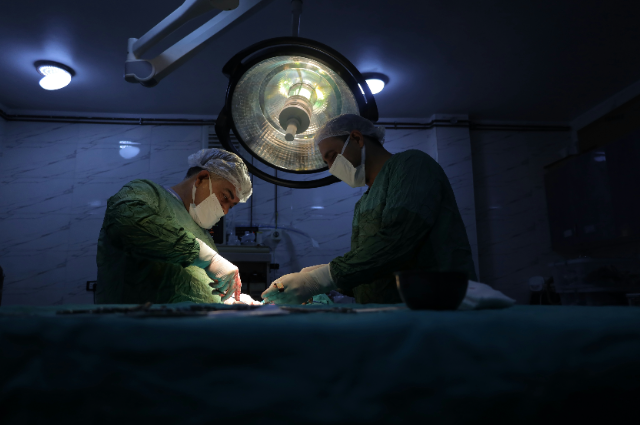
In 2011, a medical intervention in the United States quietly unsettled one of humanity’s oldest certainties: that life depends upon a beating heart. A patient, Craig Lewis, suffering from terminal cardiac amyloidosis, underwent a procedure at the Texas Heart Institute in which his failing heart was replaced not by a donor organ, but by a continuous-flow mechanical system. For several weeks thereafter, he lived without a pulse. This article examines the scientific innovation, clinical implications, and ethical tensions surrounding that case, drawing upon research from global health institutions and peer-reviewed medical literature. More fundamentally, it explores a question that medicine can no longer avoid: when technology replaces the body’s most symbolic organ, what, then, defines life?
The Silence of a Missing Rhythm
There are sounds we assume will always be there.
The quiet ticking of time
The rise and fall of breath.
And beneath it all, the steady, unspoken rhythm of the human heart.
For centuries, that rhythm has served as both a biological signal and a metaphor measured by physicians, invoked by poets, and trusted as the most fundamental proof of existence. A pulse beneath the skin has long been understood not merely as circulation, but as life itself.
And yet, in 2011, that assumption faltered.
In an operating room in Texas, surgeons completed a procedure that would leave a man without a heartbeat. No pulse could be felt. No rhythmic contraction echoed within his chest.
And still against everything medicine had once taken for granted, he lived.
The monitors did not display the familiar peaks of a beating heart. Instead, they showed something quieter, almost unnerving: a continuous flow, smooth and unbroken, like a river without waves.
Life, it seemed, had found another way to move.
A Body at the Edge of Failure
Craig Lewis did not arrive at this moment by choice. He arrived because there was nowhere else left to go.
He suffered from cardiac amyloidosis, a rare and relentless disease in which misfolded proteins accumulate within the heart, stiffening its walls until they can no longer expand or contract effectively. Over time, the organ becomes less a pump than a shell present, but incapable.
Clinical studies published in The New England Journal of Medicine have long documented the severity of this condition. Once advanced, it resists nearly all forms of treatment. Medications lose effectiveness. Surgical interventions offer limited benefit. Even transplantation medicine’s most definitive solution often fails, as the disease does not confine itself to a single organ.
By the time Lewis reached the Texas Heart Institute, his heart was no longer sustaining his life.
It was merely delaying its end.
The Decision to Cross a Boundary
Medicine, at its best, operates within the boundaries of the known. It refines, improves, and extends what has already been proven possible.
But there are moments rare, irreversible moments when those boundaries must be crossed.
For Lewis, conventional options had already been exhausted. There would be no transplant. No recovery. No gradual stabilisation.
What remained was a question.
Could life continue if the heart itself were removed entirely?
The answer, until that moment, had been theoretical.
The surgical team proposed an alternative: a continuous-flow mechanical system capable of circulating blood without pulsation. Unlike traditional ventricular assist devices, which support the heart’s natural rhythm, this system would replace it entirely.
It would not mimic the heartbeat.
It would eliminate it.
The Machine That Replaced a Pulse
The device installed within Lewis’s body did not resemble the heart it replaced, not in form, nor in function.
Where the biological heart contracts and relaxes in rhythmic cycles, this system moves blood in a constant stream. There was no systole, no diastole, only flow.
From a physiological perspective, the implications were profound.
For generations, medical education had centred on the pulse as the defining characteristic of circulation. Blood pressure, cardiac output, and vascular resistance were all understood in relation to rhythmic movement.
But continuous-flow technology suggested something different:
It is not rhythm that sustains life.
It is a delivery.
Oxygen must reach tissues. Nutrients must circulate. Waste must be removed.
How that movement occurs, whether in pulses or in silence, may be less important than once believed.
After the Operation: A Different Kind of Life
When the procedure was complete, clinicians searched instinctively for signs that had guided them throughout their careers.
They reached for a pulse.
There was none.
They listened for a heartbeat.
There was silence.
And yet, the patient awakened.
He spoke. He responded. He remained aware.
Blood continued to circulate. The brain received oxygen. Organs functioned.
The absence of rhythm did not signify death.
It signified transformation.
For physicians, the moment was both extraordinary and disorienting. It demanded a recalibration of instinct, a willingness to trust data over sensation, flow over pulse.
The body had adapted to a new definition of life.
The Disruption of Certainty
Every scientific breakthrough carries with it a quiet destabilisation.
When antibiotics were first introduced, they challenged the inevitability of infection. When organ transplantation became viable, it challenged the permanence of organ failure.
This case challenged something more foundational.
It questioned whether the symbols through which we understand life, heartbeat, pulse, and rhythm are essential or merely familiar.
Research published in Circulation: Heart Failure and subsequent cardiology studies has since confirmed that continuous-flow devices can sustain patients for extended periods. Thousands now rely on such technologies as bridges to transplantation or as long-term support systems.
What began as an experiment has become an emerging standard.
And yet, the philosophical implications remain unsettled.
The Ethics of Extending Life
With innovation comes responsibility, and with responsibility, doubt.
The procedure raised questions that extend beyond medicine into ethics, philosophy, and even identity.
If a human body can function without its most iconic organ, what defines the boundary between natural and artificial life?
If technology can prolong survival without restoring health, is that extension always justified?
Bioethicists often frame such dilemmas through four principles: autonomy, beneficence, non-maleficence, and justice.
In this case, autonomy was honoured when the patient consented. Beneficence guided the decision; the intent was to preserve life. Yet uncertainty lingered in the balance between benefit and burden.
The intervention did not cure the underlying disease.
It bought time.
And time, in medicine, is both a gift and a question.
A Life Measured Differently
Craig Lewis lived for several weeks following the surgery.
Measured clinically, the outcome was temporary.
Measured scientifically, it was transformative.
Measured humanly, it was something quieter, more difficult to quantify.
He existed in a state that medicine had not previously defined.
Not because he defied death entirely.
But because he altered its timeline.
The Future of the Human Body
Modern medicine stands at a threshold.
Artificial organs, neural interfaces, and bioengineered tissues each advance the possibility of replacing what was once irreplaceable.
The question is no longer whether such technologies will develop.
They already have.
The question is how they will reshape our understanding of the human body.
Will life become a function of biological continuity, or technological support?
Will the boundary between organism and machine remain meaningful?
Or will it dissolve into something new?
Beyond Biology: A New Definition of Life
For centuries, the heart has served as both an anatomical reality and a symbolic centre. It has represented emotion, identity, and vitality.
But symbols evolve more slowly than science.
The case of a man living without a heartbeat reveals a quiet truth:
Life is not contained within a single organ.
It is distributed across systems, processes, and interactions.
It resides in continuity.
In adaptation.
In the capacity to endure change.
The Question That Remains
In the end, this story does not offer a simple conclusion.
It offers a question.
If life can persist without a heartbeat, then what, truly, defines it?
Is it rhythm?
Is it consciousness?
Is it a function?
Or is it something more elusive, something that exists not in any one organ, but in the fragile coordination of all?
The operating room in Texas did not answer that question definitively.
But it ensured that we must now ask it differently.
Because somewhere, beyond the reach of rhythm, beyond the comfort of certainty, life continues quietly, steadily, without a pulse.
And perhaps, for the first time, we are beginning to understand what that means.