
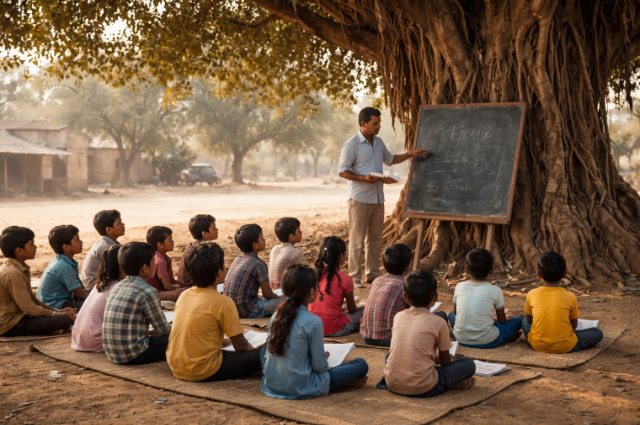
A Classroom Without Walls
At seven o’clock each morning in a small village in Rajasthan, a group of children gathers beneath a large banyan tree. There are no classroom walls. No rows of desks. No blackboard hanging on a painted wall. Instead, there are notebooks balanced on laps, chalk markings on a wooden board tied to the tree trunk, and the steady voice of a teacher explaining mathematics to students sitting in a circle on the ground. For years, this tree has served as the village’s unofficial school.
What began as a temporary solution to a broken system has grown into something far more significant: a grassroots educational movement that is transforming the lives of children who once stood on the margins of India’s formal education system. The story of this “school under the tree” is not merely about learning without classrooms. It is about how communities, when confronted with institutional failure, sometimes create their own solutions. And in doing so, they challenge the very definition of what education can be.
The Hidden Crisis in Rural Education
India has made significant progress in expanding access to education over the past two decades. Government initiatives such as the Right to Education Act (2009) have helped increase enrolment rates across the country. However, access to school buildings does not always guarantee meaningful learning.
Educational surveys conducted by organisations such as ASER (Annual Status of Education Report) consistently reveal a troubling pattern in rural India: many children enrolled in schools struggle with basic reading and arithmetic skills.
According to several ASER reports, a large percentage of students in elementary grades are unable to read texts meant for younger classes or solve simple mathematical problems.
The reasons are complex.
Teacher shortages, overcrowded classrooms, limited resources, and socioeconomic pressures often combine to create learning gaps that widen over time.
For children from economically disadvantaged families, these challenges can lead to school dropouts and reduced opportunities later in life.
A Teacher Who Refused to Accept Failure
In the village of Kheda, located several kilometres from the nearest town, these problems had become painfully visible. Although the government primary school existed, attendance fluctuated, and learning outcomes remained poor. One local teacher, Ramesh Sharma, began noticing something troubling. Children who had been enrolled in school for years still struggled to read basic sentences. Some had lost confidence in their ability to learn altogether. Ramesh believed the issue was not the children’s intelligence but the structure of teaching itself. Large classrooms with rigid schedules made it difficult for struggling students to receive individual attention. He decided to try something different.
The First Lessons Beneath the Banyan Tree
In 2015, Ramesh began inviting a few students from the village to join him in the evenings for extra lessons. Instead of using a classroom, he gathered them beneath a banyan tree near the centre of the village.
At first, only five children came. They sat on the ground as Ramesh explained reading and arithmetic using simple stories, games, and everyday examples. Word spread quickly. Parents noticed that their children were beginning to read more confidently. Within months, the group had grown to more than twenty students. The banyan tree had become an informal classroom.
Learning Without Fear
One of the most striking aspects of the open-air school was the atmosphere. Unlike traditional classrooms where students often feared making mistakes, the sessions under the tree encouraged curiosity and participation. Children asked questions freely. Lessons included storytelling, puzzles, and practical exercises.
Educational psychologists often emphasise that confidence and engagement are essential for effective learning. When students feel safe expressing confusion and curiosity, they are more likely to develop deeper understanding. The informal environment beneath the tree helped create exactly that kind of learning space.
Community Participation
As the initiative grew, the village community began supporting it in unexpected ways. Local shopkeepers donated notebooks and pencils. Parents helped organize schedules so children could attend lessons after finishing household chores. A retired farmer offered a wooden board that served as the classroom’s first “blackboard.”
What began as one teacher’s experiment slowly evolved into a community-driven educational effort. This grassroots participation became one of the initiative’s greatest strengths. Education was no longer seen as the responsibility of a single institution but as a shared community mission.
A Model That Started Spreading
The success of the village classes began attracting attention from nearby communities. Teachers from neighbouring villages visited the Banyan Tree School to observe its methods. Some began replicating the model in their own areas. These informal learning circles emphasized small group instruction, interactive teaching, and peer learning among students. Such approaches align with modern educational research that encourages active learning rather than passive memorisation. Over time, what started as a small experiment became a broader local movement aimed at improving foundational literacy and numeracy.
The Power of Foundational Learning
Education experts widely agree that early literacy and numeracy skills are the foundation of all future learning. If children struggle to read or perform basic mathematics in their early school years, the difficulty compounds as subjects become more complex. Organisations working in educational development have repeatedly emphasised the importance of focusing on foundational learning before advancing to higher-level content.
The village initiative demonstrated how targeted attention at this stage could dramatically improve student confidence and performance. Children who once avoided reading began volunteering to read aloud during sessions. Mathematics exercises that previously caused frustration became manageable through interactive practice.
Challenges and Criticism
Despite its success, the “school under the tree” model also faced challenges. Some critics argued that informal education initiatives might unintentionally undermine the formal school system. Others worried about sustainability, questioning whether such efforts could continue without consistent funding or institutional support. Ramesh acknowledged these concerns.
His goal, he explained, was never to replace formal schools but to strengthen them by helping students build essential skills. In many ways, the open-air classes functioned as a bridge between struggling students and the formal education system.
Recognition and Impact
As the initiative continued to grow, local education officials began to take notice. Some district administrators visited the village to observe the classes. The model's success prompted discussions about integrating similar approaches into existing educational programs. Meanwhile, the impact on students was already visible. Several children who once struggled academically began performing significantly better in school examinations. More importantly, they developed confidence in their ability to learn.
Education Beyond Infrastructure
The story of the Banyan Tree School highlights an important lesson: education is not defined solely by buildings or facilities. While infrastructure is important, the quality of teaching and the learning environment often matter even more. A motivated teacher, engaged students, and supportive communities can sometimes overcome resource limitations. This insight is particularly relevant for developing regions where educational resources remain unevenly distributed. Innovative community-led solutions can play an important role in bridging these gaps.
A Symbol of Possibility
Today, the banyan tree continues to host daily learning sessions. Some improvements have been made: a simple shelter now protects students from rain, and donated books form a small library. Yet the essence of the initiative remains unchanged. Children gather in a circle, guided by teachers who believe that education should be accessible, engaging, and empowering. The tree itself has become a symbol of possibility. It represents the idea that meaningful change often begins with small acts of determination.
Lessons From a Tree
The story of the school under the banyan tree reminds us that solutions to complex problems sometimes emerge from the most unexpected places.
In a world where educational reform is often discussed in terms of large policies and institutional strategies, this village initiative offers a different perspective. It shows that individuals and communities can play a powerful role in shaping the future of education. The children sitting beneath that tree are not only learning mathematics and reading. They are learning something equally important: that education does not belong only to classrooms or institutions.
It belongs to everyone who believes in the power of knowledge to change lives. And sometimes, all it takes to begin that transformation is a teacher, a few students, and a tree.