
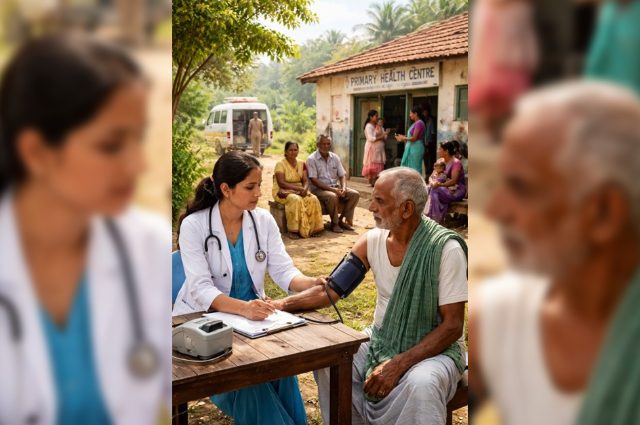
In India, healthcare inequity is less a matter of policy absence than of uneven execution. While national frameworks such as the National Health Mission (NHM) and Ayushman Bharat have expanded coverage and infrastructure, rural access to consistent, quality medical care remains fragile. According to the Government of India’s Rural Health Statistics (2023), over 60% of India’s population resides in rural regions, yet significant vacancies persist in Primary Health Centres (PHCs), particularly in specialist and long-term medical positions. This research-based article examines the real-life case study of a government physician who chose to remain in a chronically under-resourced rural PHC in eastern India, where staffing instability, logistical delays, and geographic isolation compromised public health outcomes. Through policy analysis, public health data, and structured field documentation, this article explores how sustained professional presence, data-led accountability, and community trust-building can incrementally strengthen fragile systems. This is not a story of heroism. It is a study of what changes when a trained professional refuses to treat institutional decline as inevitable.
Where Care Depends on Distance
Healthcare inequality in India is not abstract; it is mapped.
The difference between a tertiary hospital in a metropolitan city and a Primary Health Centre located fifty kilometres beyond district headquarters is not merely infrastructural. It is experiential. It determines waiting time, survival probability, referral efficiency, and, in many cases, dignity.
Urban healthcare narratives often focus on technological advancement, robotic surgery, teleconsultation, and digital records. Rural healthcare discussions, by contrast, revolve around vacancies, stock-outs, transport delays, and fragile electricity supply. The asymmetry is systemic.
The Rural Health Statistics Report (2023) identifies thousands of PHCs operating with limited staff strength. Specialist shortages in Community Health Centres remain high in multiple states. Although infrastructure expansion has improved coverage ratios over the last decade, human resource retention remains uneven.
In policy language, this is described as a “distribution challenge.”
In lived experience, it is described differently.
The Posting That Defined a Career
Dr Meera completed her medical degree from a government college in a state capital. Like many graduates under public bond agreements, she was assigned a rural posting.
The PHC to which she was appointed served nearly 38,000 residents across twelve villages. It was accessible by a narrow road that became partially submerged during the monsoon months. The nearest blood bank was over an hour away under optimal conditions.
Official documentation described the facility as “operational.” The building existed. The designation existed. The staff chart existed.
Functionality was less consistent.
Two nursing posts were intermittently filled. Laboratory support was limited to basic diagnostic kits. Electricity supplies fluctuated, affecting vaccine storage reliability despite backup systems.
Rural postings are often approached as transitional assignments. Transfer applications typically begin within months. Career progression, specialisation opportunities, and professional networking all tend to favour urban centres.
Meera did not submit a transfer request.
Statistics Become Patients
In her first quarter, she observed a recurring pattern: preventable complications arriving late.
A middle-aged man with unmanaged hypertension presented only after a minor stroke. A pregnant woman with anaemia sought care in her third trimester despite early warning signs. A child with severe dehydration had been treated at home for days before referral.
National Sample Survey Office (NSSO) health utilisation reports indicate that rural households frequently delay institutional care due to transportation cost, wage loss, or distrust of public facilities. These delays amplify otherwise manageable conditions.
To policymakers, delayed presentation is a statistical indicator.
To physicians, it is a prognosis altered.
The Architecture of Maternal Risk
Maternal health metrics in India have improved substantially over the past decade. The Sample Registration System (SRS) reports a declining Maternal Mortality Ratio nationally. However, district-level disparities persist, particularly in geographically remote blocks.
Within her first year, Meera handled multiple obstetric emergencies requiring urgent referral. The PHC lacked surgical infrastructure. Stabilisation protocols were followed; outcomes depended on transport speed.
During the monsoon season, ambulance response time frequently exceeded ninety minutes.
In one case, a young woman in prolonged labour arrived after traditional home attempts had failed. Transfer was arranged, but complications escalated before surgical intervention could occur. The mother survived. The infant did not.
There was no media coverage. There was no inquiry.
The incident was recorded in district data as “perinatal mortality.”
Data, by design, compresses grief.
Trust as Infrastructure
Meera recognised early that infrastructure alone would not increase utilisation. The PHC had existed for years; attendance remained inconsistent.
WHO primary healthcare studies emphasise that community trust determines service uptake more strongly than awareness campaigns alone. In several villages under her jurisdiction, informal practitioners remained preferred because they were geographically and socially accessible.
Rather than rely exclusively on clinic-based care, Meera began attending local village council meetings. She conducted structured discussions on high-risk pregnancy indicators, chronic disease symptoms, and immunisation schedules.
She visited schools to speak about sanitation and adolescent health. She met community elders individually.
Attendance at the PHC increased gradually, not because new services were added, but because reliability was demonstrated.
Trust does not expand through posters. It expands through presence.
Logistics: The Invisible Constraint
Medicine stock-outs were recurrent.
Although centralised procurement systems aim to ensure uniform supply, distribution gaps persist due to transportation delays, administrative lag, and forecasting inaccuracies.
Rural Health Statistics reports consistently identify supply-chain inefficiencies as contributors to treatment discontinuity. When prescribed medications are unavailable, patients often turn to private pharmacies, incurring additional cost.
Meera began maintaining independent monthly reconciliation logs tracking requested versus delivered stock. She escalated discrepancies formally through district channels.
Responses were neither immediate nor confrontational. They were procedural.
Yet documentation created traceable accountability.
Data as Leverage
Beyond clinical duties, Meera structured a basic data dashboard using manual logs:
- Average referral delay times
- High-risk pregnancy percentage
- Non-communicable disease registrations
- Seasonal infectious disease clusters
Quarterly reports were submitted to district health authorities.
Public health literature emphasises the importance of localised data in influencing resource allocation. In under-resourced settings, aggregated national data often obscures micro-level strain.
Over time, additional cold-chain support and an auxiliary nurse-midwife were sanctioned for her PHC.
Change did not arrive as reform. It arrived as a marginal adjustment.
The Weight of Professional Isolation
Rural practice entails a particular solitude.
In tertiary hospitals, clinical responsibility is distributed. In PHCs, it concentrates.
Burnout research published in the Indian Journal of Community Medicine identifies isolation, workload variability, and limited peer consultation as primary stressors among rural doctors.
Meera experienced exhaustion. She described evenings of administrative backlog and nights interrupted by emergency calls. Yet she did not characterise her experience as a sacrifice.
Frustration was directed at structural delay, not at patients.
Institutional Deliveries: A Measurable Shift
Within two years, institutional deliveries at the PHC increased by approximately 22%. Immunisation coverage surpassed the block average. High-risk pregnancies were referred earlier in gestation.
These figures did not appear in national headlines. They were reflected in district quarterly reports.
Policy analysts often caution against attributing system-level improvement to individual effort. Structural reform requires structural intervention.
Yet in fragile systems, continuity of personnel alters outcomes.
Retention is itself reform.
The Offer to Leave
After completing three years of rural service, Meera qualified for transfer eligibility. An urban posting would have provided improved facilities, professional networks, and proximity to family.
Colleagues encouraged her to move. Such decisions are rarely judged; they are understood.
She chose to remain.
Her reasoning was pragmatic. Community rapport, once established, cannot be transferred. Continuity reduces risk during vulnerable transitions.
Her decision was not a statement. It was an assessment.
Public Health in Practice
India’s healthcare architecture includes multiple layers: Sub-centres, PHCs, Community Health Centres, district hospitals, and tertiary institutions.
Policy reform over the last decade has emphasised expanding insurance coverage, digital health missions, and infrastructure modernisation. Yet frontline delivery still depends heavily on local operational stability.
Public health scholars consistently argue that sustainable improvement requires not only infrastructure funding but human resource retention and decentralised decision-making.
In Meera’s PHC, improvements were incremental:
- Stabilised medicine supply cycles
- Strengthened referral coordination
- Increased antenatal care compliance
- Reduced seasonal outbreak escalation
None of these changes required innovation. They required consistency.
The Economics of Staying
Retention incentives for rural doctors remain under discussion in policy circles. Financial allowances exist, but professional development opportunities remain urban-centric.
Economic modelling studies suggest that investment in rural healthcare yields a high social return due to prevention-based cost savings. Early management of chronic disease reduces tertiary burden.
Meera’s continued presence likely reduced the district hospital's workload through earlier detection and stabilisation.
Such savings are rarely visible at the point of service.
Beyond the Individual
It is tempting to frame this story as individual heroism. That would be analytically incomplete.
No physician can compensate indefinitely for systemic deficiency. Sustainable rural reform requires:
- Transparent staffing policies
- Incentive-aligned retention structures
- Reliable supply-chain monitoring
- Telemedicine integration
- Strengthened ambulance networks
However, individual continuity prevents attrition from accelerating collapse.
Systems are strengthened both by policy and by people who refuse withdrawal.
A Broader Reflection on Professional Ethics
Medical ethics often centres on patient autonomy, confidentiality, and non-maleficence. Less discussed is the ethics of location.
Where one chooses to practice influences health distribution.
In countries with geographic inequality, professional migration intensifies disparity. This is neither moral failure nor personal obligation; it is a structural imbalance.
Meera’s decision to remain did not resolve national inequality. It narrowed it locally.
Those narrowing matters.
Endurance Without Applause
There are no public awards for consistent immunisation schedules. No ceremonies for stabilised blood pressure readings.
Yet public health advances through such increments.
The PHC today remains modest. It is not technologically advanced. It is not immune to supply delay. It still faces staffing gaps.
But maternal referrals occur earlier. Chronic illness management is more consistent. Outpatient attendance is predictable.
The difference between neglect and attention is often one committed professional.
Reform as Continuity
Rural healthcare reform in India is frequently debated at the macro scale, including funding, policy, insurance coverage, and digital integration.
These debates are essential.
Yet on the ground, reform sometimes appears as continuity.
Dr Meera did not transform rural healthcare nationally. She did not pioneer new technology. She did not generate headlines.
She stayed.. In systems where attrition is expected, staying becomes structural resistance.
This real story is not extraordinary because it defies probability. It is extraordinary because it confirms what policy often overlooks: infrastructure does not heal; people do. And sometimes, the most consequential decision in public service is not innovation, but endurance.