
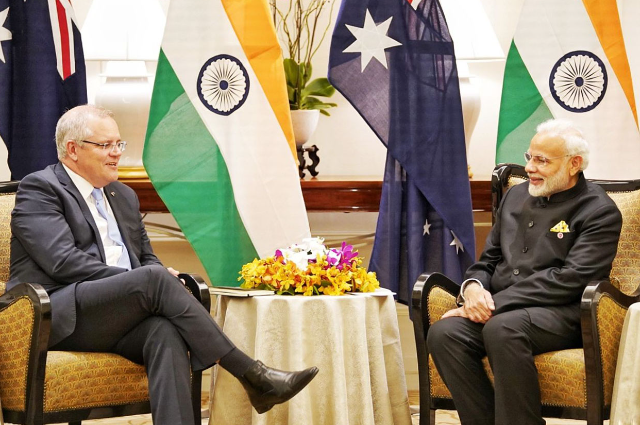
The emerging India-Australia trade agreement is more than an economic pact – it is a test of trust between two very different societies. With India under a “stress test” on foreign payments, New Delhi urgently seeks export markets, while Australia wants access to India’s huge consumer base. In 2024–25 bilateral trade reached about $24 billion, and Australian leaders hailed the deal as opening “a big door into the world’s fastest growing major economy” for their farmers. Yet these numbers mask a deeper tension: India’s vast farming population fears being swamped by cheap imports from Australia. The question is how to reconcile these interests: how to increase trade without leaving India’s food producers out in the cold.
Unequal Fields: The Agriculture Dilemma
The core issue is that Indian and Australian agriculture are fundamentally mismatched. India’s farms are tiny (about 0.73 hectares on average) and labour-intensive, supporting the livelihoods and food security of more than half of India’s people. By contrast, Australia’s farms are industrial-scale (over 1,400 hectares) and supply a global market. Indian agriculture contributes around 16% of GDP, while Australia’s is only 2–3%. In practical terms, this means Indian farmers – many with no more than a few acres – cannot compete on price with Australia’s highly mechanized farms.
This gap is not just economic but deeply political. As a recent analysis bluntly warned, insisting on a “level playing field” is misleading. Even with government help, Indian farmers still face big risks from changing weather. Their earnings stay low. If basic foods such as wheat or lentils enter tax free, many village lives may collapse suddenly. Analysts say shielding these goods goes beyond talks between nations - it strikes at power and people’s survival. Remember, in the 2022 trade pact, India kept key things safe - milk, grains, pulses - untouched by lower duties. That move revealed hard limits: what feeds families must never become a bargaining chip.
At the same time, Australia’s position is understandable. Canberra has limited appeal to Asian markets beyond raw minerals and commodities, and Covid-era disputes with China taught it to diversify. The 2022 interim agreement gave Australia 100% duty-free access to its market, with tariffs on most exports to India eliminated. Now Australia is pushing for reciprocity. From our vantage point, Australians see a booming Indian market of 1.4 billion consumers. They argue, with some truth, that opening India further could help their farmers and miners find new customers.
This mismatch breeds mistrust. Many Indian farmers see talk of parity as a trap – fearing the outcome will benefit Australian agribusiness while leaving them with empty granaries. The domestic debate in India is intense: allowing cheap imports could lower food prices (a policy goal) but at the cost of pushing small farmers into ruin. Any government that ignores this risks social unrest. In sum, the agriculture question in this FTA is not a simple free-trade problem; it is a socio-political minefield.
Beyond Tariffs: Rethinking Agricultural Trade
Still, farming needs space at the table, yet neither side sees it as a battle to win or lose. Maybe shifting gears helps - trying teamwork where fights once happened. Instead of just lowering taxes on goods, building faith in each other's rules might go further. By early 2025, India and Australia began trusting one another’s organic labels, a small step that could grow legs. Take grain checks. They might line up inspection steps, digital paperwork, plus border controls, letting Indian produce pass Australia’s health bars - the reverse too - while blocking low-cost surges at random. These details, really just shared procedures, create trust trades won’t risk harm or seem rigged.
Meanwhile, India might build cooperation through this industry. Look at the data: around 15–35% of Indian crops are lost annually because of bugs, sickness, and weak storage systems. Drought expertise from Australia stands out globally, along with smart watering tools and strong refrigerated transport networks. Negotiators propose inviting Australian investment into India’s fields – not as mere exporters of rice to India, but as co-developers of India’s supply chain. Imagine Australian companies helping build silos and refrigerated storage in India, or providing drones and data analytics to improve yields. These are not fairy tales: both governments have already talked about an India-Australia Agri-Tech Forum for technology transfer. By blending Australian know-how with Indian needs (and investing capital and training on the ground), India’s farmers could actually gain skills and facilities that raise productivity.
This is the idea of complementarity: use each country’s strengths to shore up the other’s weaknesses. It is not about treating them the same, but fitting them together. Several commentators note that the future FTA must be built on “complementarity over parity”. In practice, that could mean letting a few more tonnes of high-value Australian wool or pulses in over time, while ensuring India’s staples stay protected unless alternatives are ready. It could mean joint ventures in crops or livestock rather than one-way imports. In short, the goal should be a win-win partnership, not an all-or-nothing market opening.
Importantly, this approach is not unique to India-Australia. Many recent FTAs have tried to thread this needle. The US-Mexico-Canada deal, for instance, allowed quotas for Mexican sugar and dairy to protect domestic farmers on all sides. Japan’s trade pacts often include long phase-outs for rice and beef. And the global WTO rules on sanitary measures (SPS Agreement) explicitly encourage countries to recognize each other’s food-safety standards rather than erect barriers. So India and Australia can draw lessons from others: build trust through collaboration.
Global Context and Strategic Stakes
This trade drama also reflects broader global shifts. Both New Delhi and Canberra see strategic value in closer ties. Their Quad partnership (with the US and Japan) is about countering power imbalances in the Indo-Pacific. Concluding a fair FTA would cement economic trust, not just security ties. As one analysis notes, balancing trade could even give India bargaining power elsewhere: a strong CECA helps hedge against U.S. tariff whims and integrate critical minerals supply chains. For Australia, deeper access to India diversifies its exports away from China, which is a high priority.
On both sides, officials publicly stress balance. In August 2024, India’s negotiators said they keep “domestic sensitivities” in mind and want “meaningful benefits” for everyone. Australia similarly talks of mutual gains – its foreign minister visited New Delhi to push for an outcome that boosts jobs and growth in both countries. These statements show awareness that trade deals cannot ignore democratic accountability.
Still, the real test will be on the ground. Indian farmers will judge any agreement by its effect on their fields and wallets. If wheat that costs half as much lands unsold, resentment will follow. Likewise, Australian farmers will watch which commodities they finally get to ship. The editorial writers warn that reducing Indian agriculture to mere items in a tariff schedule would be a grave mistake.
Towards a Balanced Harvest
What would success look like? Perhaps an FTA where Indian and Australian products do appear side-by-side at the breakfast table – but not by crushing one another. The same analysts imagine a day when Chyawanprash and Vegemite sit on the table together, symbols that both sides got something from the pact. Getting there means honest compromise: India may open some high-tech or niche markets (like wine or pulses) gradually, while locking in help for its farmers in technology and infrastructure. Australia, for its part, may need to accept that certain staples remain off-limits unless local productivity is raised.
In the end, the India-Australia FTA must be more than a paper exercise. It should reflect real lives. The negotiators have outlined paths – from organic certifications to investment initiatives – that move beyond rhetoric. If they follow through, the deal could become a model of modern trade diplomacy: one that trusts technical cooperation and shared development over simplistic market parity.
For Indian policymakers, the guiding principle is clear: our farmers cannot be collateral damage. As one commentary insists, “Indian agriculture is the socio-economic backbone of crores of people, and cannot be reduced to a line-item on a trade table”. Recognizing this means designing the FTA around complementarity, not just free-for-all access. If done right, India will gain new markets and technologies, without undermining rural stability. And Australia will get new customers and partners – not enemies.
The world will watch closely. With its demographic weight and fast growth, India needs stronger ties abroad. But it also needs to protect its farmers and food security at home. This deal, more than most, will test whether those goals can coexist. As this high-stakes negotiation unfolds, one thing is certain: only a carefully balanced, trust-based agreement – not a raw tariff war – will reap a lasting harvest for both nations.
Reference links
- Australia-India Economic Cooperation and Trade Agreement (ECTA)
- Australia-India ECTA Benefits Overview
- Australia-India Comprehensive Economic Cooperation Agreement (CECA)
- Australia-India ECTA Official Text
- Australia-India ECTA Snapshot Benefits