
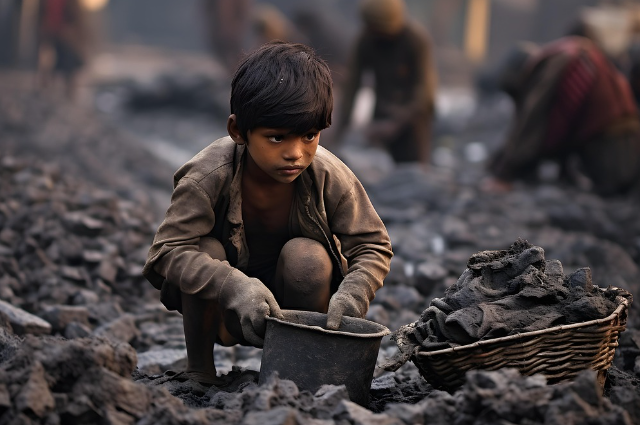
The Unfinished Struggle
Child labour is not merely a social problem; it is a continuing crime against childhood and human dignity. From the years immediately after independence, poverty, low literacy, and weak social protection pushed large numbers of Indian children into work, often in farms, small workshops, construction sites, and domestic service. Official counts show the long, slow movement: census and national surveys recorded millions of working children in the decades after 1951, and while the share of child workers has fallen over time, tens of millions of children have remained vulnerable to exploitative work. The Government of India’s own fact sheets and the national censuses document this decline in activity rates, even as the absolute numbers fluctuated with population changes.
This problem is not only an Indian tragedy but a global one: international agencies estimate that roughly 138 million children worldwide were engaged in child labour in recent years, many in hazardous jobs that damage health and curtail schooling. That global figure shows how deep-rooted and stubborn the issue is, and why local laws alone cannot end it without strong social and economic measures.
In India, child labour is both a cause and a consequence of poverty. Work steals time for education, makes health fragile, and passes deprivation from one generation to the next. Calling it a “crime” is not rhetorical: it steals childhood, violates rights enshrined in law and in the Constitution, and undermines the nation’s future. This essay will trace how child labour has persisted since independence, examine the legal and policy responses, compare India’s experience with successes elsewhere, and suggest realistic steps to bridge the gap between law and life. For now, let us keep clearly in mind: ending child labour demands more than laws; it demands political will, economic inclusion, and moral urgency.
Background & Scale of the Problem
The story of child labour in India is a long, uneven march that runs alongside the country’s economic and social transformation since independence. Reliable, comparable counts are available largely from the population censuses and periodic surveys; these show that child work was widespread in the decades after 1951, stayed stubbornly entrenched through the 1970s–1990s, and then began to show measurable decline in many official series even while hidden and hazardous forms of child labour persisted. The Census and government compilations document a fluctuating but clear pattern: millions of children were recorded as working in each census year, with the precise totals changing because of differences in definitions, age bands, and survey methods, as well as real demographic shifts. The Population Census provides the longest time series (for 1961, 1971, 1981, 1991, 2001, and 2011) and is the backbone for tracking long-term trends.
To put numbers beside the narrative: Census 2001 reported about 12.3 million working children in the 5–14 age group, and Census 2011 recorded about 10.1 million in the same bracket, a fall in absolute numbers and in the proportion of children recorded as workers, even while India’s child population remained large. Other national surveys provide different estimates: the National Sample Survey (NSS) rounds and government notes in the 2000s suggested figures nearer to 8–9 million for certain definitions of work, and sectoral studies (for example, on bonded labour or hazardous industries) have repeatedly warned that official counts miss many hidden workers. These divergences are not errors so much as reflections of method, household surveys, labour-force definitions, and whether “work” includes occasional helpers, family work, or only regular employment.
Regionally, the picture has been uneven. Some states that once recorded very large numbers of child workers, states with high rural poverty and limited schooling access, showed steep declines by 2011; other states with large informal sectors and seasonal migration continued to report significant child work. Official state-wise tables (Census 1971–2011 summaries) show how relative rankings changed: places with strong public schooling and focused anti-poverty programmes tended to reduce visible child labour more quickly, whereas areas with weak enforcement or entrenched industries that rely on cheap family labour showed persistence. But even when the visible headcount falls, many forms of child labour simply move underground: children shift from formal workshops to home-based units, carpet looms, brick kilns, agricultural casual work, or domestic service, making them harder to detect and rescue.It is also important to read the numbers against global trends. International agencies documented progress in the early 2000s, but the advance was fragile: globally, child labour reduction slowed and in recent years was partially reversed. The COVID-19 shock and rising household vulnerabilities raised the risk that children would be pushed back into work; one international analysis found several million more children in labour in 2020 compared with 2016, underlining how economic downturns and school closures can quickly undo gains. Thus, India’s numbers must be read alongside the larger, global context that links child labour tightly to poverty, schooling, migration, and crisis.
Finally, any honest account must highlight what statistics cannot show: the quality and danger of the work. Official counts may record a child as a “worker” without distinguishing whether the child is engaged in light family chores or in hazardous, exploitative work that injures health and forecloses education. Studies of hazardous sectors, brick kilns, mines, glass-bead manufacturing, certain agricultural tasks, and domestic work repeatedly find children doing long hours, exposed to health risks, and denied schooling. In short, while India’s long-term trend shows progress in many measures, the scale remains large enough and the hidden, hazardous nature of much child labour serious enough that laws and programmes must address both numbers and lived reality.
Government Laws & Schemes
From the earliest years after independence, the Indian state recognised that laws and programmes were needed to stop children from being exploited. The first strong national law specifically aimed at child labour was the Child Labour (Prohibition and Regulation) Act of 1986, which restricted children’s work in many hazardous occupations and regulated the conditions in others. That law was later tightened: a major amendment in 2016 broadened the ban to make engagement of children below 14 years in any work unlawful and made special provisions to protect adolescents from hazardous employment. This legal framework created clear standards: childhood must be protected, and hazardous work must be forbidden, at least on paper.
Laws alone were never the full answer, so the government also built schemes to find, rescue, and rehabilitate child workers. The cornerstone scheme is the National Child Labour Project (NCLP), launched in 1988 to identify child labour hotspots, run Special Training Centres (STCs) where rescued children receive bridge education and skills, and then mainstream them into regular schools. Over the decades, the NCLP was gradually expanded in the number of districts and centres; official records say that since the scheme began around 14.3 lakh children have been rescued, rehabilitated, and mainstreamed into education as of March 31, 2023. That is an important achievement, proof that organised rescue and training can work, but it also shows the scale of the problem that a flagship programme has to operate for decades.
Education and social protection became central to the government’s strategy because children go to work when schools are weak, and families are poor. The Right of Children to Free and Compulsory Education Act (RTE) of 2009 legally guaranteed free education for children aged 6–14, while programmes like Sarva Shiksha Abhiyan (SSA) and the Mid-Day Meal Scheme aimed to expand access and make schooling attractive and affordable. By creating a legal right to schooling and offering incentives and meals, these measures removed some of the immediate pressures that push children into work. Over time, mainstream education policy and child-labour rehabilitation were brought closer together so rescued children could be mainstreamed rather than left in separate, marginal schooling.
India’s policy stance also moved onto the international stage. The government ratified key International Labour Organisation conventions on child labour in 2017, signalling a formal commitment to minimum ages and to eliminating the worst forms of child labour. That ratification strengthened India’s obligations and opened the door to technical cooperation with the ILO and international partners on eradication strategies.
Yet the record is mixed when law and programmes meet ground reality. The NCLP’s Special Training Centres were an important bridge, but policy documents show that from April 2021, the NCLP’s functions were subsumed under wider education programmes and, by recent official notes, no STCs continue to operate under the old NCLP label, a shift that risks both better integration and potential gaps, depending on how states implement mainstreaming. At the same time, enforcement of bans remains uneven: many rescued children return to work because their families still lack a steady income, because informal employers evade inspection, or because social attitudes normalise child help in family enterprises. Where state governments have invested in strong rescue drives, child-friendly courts, and cross-departmental action, visible results appear; where coordination is weak, the same cycles of rescue and return repeat.
In short, the Indian government has built a broad legal and programmatic architecture of prohibition laws, a long-running rescue and rehabilitation scheme, legal guarantees to education, child-rights commissions, and international commitments. These are real and important steps. But they must be matched by reliable funding, consistent enforcement, effective welfare support for families, and careful monitoring so that children who are rescued do not simply slide back into hazardous work. The challenge for policy is not creating more laws on paper but making the ones we have deliver in villages, factories, and homes across India so that protection reaches every child, not only those who happen to be found by a raid or a survey.
Law versus Ground Reality: The Unwanted Truth
On paper, India has built a strong legal framework against child labour: the 1986 act, its 2016 amendment that broadened prohibitions, and later international commitments signal a firm stance that childhood must not be exchanged for work. Yet the daily truth for millions of children has often been very different. Official laws and schemes have sometimes created the impression that the state is acting decisively, while in practice, enforcement remains patchy. Inspectors and labour officers are thin on the ground; prosecutions are few; employers who benefit from cheap child labour exploit gaps in monitoring and the long, slow wheels of criminal justice. Where penalties exist, they are often treated as a cost of doing business rather than a deterrent, and repeat violations are not uncommon.
A second, painful reality is that many interventions treat child labour as an isolated problem to be policed, rather than as a symptom of deeper social and economic neglect. Rescue operations that withdraw children from hazardous work are necessary and humane, but unless families have stable incomes, rescued children are likely to return to work. Programmes like the National Child Labour Project (NCLP) and its Special Training Centres offered a bridge back to education for many children, but their reach has been uneven across states and districts. The government’s own records show that while roughly 1.43 million children have been rescued and mainstreamed since the NCLP began, the need has remained persistent and long-term. Moreover, the recent administrative move to subsume NCLP functions under broader education programmes intended to mainstream services creates both opportunity and risk: opportunity for better integration, risk of diluting focused rehabilitation if implementation is not carefully monitored at the local level.
The problem of under-counting and masking is central to the gap between law and reality. Census figures and household surveys capture a visible portion of child work, but many children labour in hidden settings: home-based manufacturing, domestic work, seasonal agriculture, brick kilns, and informal supply chains where work is intermittent or coded as “family help.” These hidden forms are often excluded from simple counts or are normalised as part of childhood chores, which allows employers and households to deflect scrutiny. Researchers and international agencies repeatedly warn that headline declines in child-worker numbers can coexist with persistence or even growth in hazardous, under-reported work. That makes enforcement metrics dangerously optimistic unless they are paired with qualitative field evidence and community-level monitoring.
There is also a structural blindness to how powerful economic actors and intermediaries obscure responsibility. Large supply chains that claim compliance still source from subcontractors and homeworkers where child labour is cheaper and easier to hide; small workshops dissolve and reappear under different names when inspected; migration routes funnel children into urban informal economies that escape rural governance. At times, rescue drives are publicised as political wins while the employers who profited face little financial pain or legal consequence; the child quietly returns to work or is absorbed into another unseen place of labour. This selective visibility, what the system looks for and what it ignores, determines which children get help and which remain invisible.
Finally, social attitudes and the limits of welfare create an ethical and practical dilemma. In many households, the child’s earnings are critical to survival; social stigma or shame may prevent families from seeking help. Where schemes are slow, conditional cash supports are weak, or schooling poor quality, families rationally choose immediate income over uncertain public promises. The consequence is that laws alone cannot halt child labour: strong legal tools must be combined with reliable social protection, livelihood alternatives for adults, community mobilisation, and supply-chain accountability. Some states and local initiatives, when they converge with civil society and international partners, show meaningful reductions, proving that the law can work if backed by coordinated welfare, strict enforcement, and community ownership. But the national picture remains a patchwork: progress in places, persistence in others, and a worrying capacity of the system to mask problems behind better statistics rather than eliminate them in reality.
Comparison with Other Countries: What Works, What India Must Learn
Around the world, there are countries and regions where child labour, though never fully erased, has dropped to very low levels. Many of them are in what we call “developed” or high-income nations, or countries that long ago moved away from heavy reliance on agriculture and informal industry. In those places, the decline of child labour shows that with strong laws, universal education, social protection, and economic transformation, childhood and schooling can become the norm rather than an exception.
One clear reason child labour fell sharply in many Western and European countries is that industrialisation eventually demanded more skilled, educated labour, making child labour not only immoral but also economically unprofitable. As production became more mechanised and formal factories replaced cottage industry and home-based work, employers needed trained adults, not unskilled children. That structural economic shift reduced demand for child labour.
Moreover, developed countries built robust social and legal institutions: universal compulsory schooling (making education the norm), child-rights laws, minimum working-age laws, and labour regulation strictly enforced by inspection and legal consequences. Once childhood and schooling became socially expected and legally protected, working as a child came to be seen as unacceptable, even shameful.
International cooperation and global norms also helped: frameworks like the International Labour Organisation (ILO)’s conventions, the Minimum Age Convention (No. 138), and the Worst Forms of Child Labour Convention (No. 182) created shared standards across countries. Most developed countries ratified these, shaping their domestic laws and labour regulations over decades.
Recent global data shows progress: as of 2024, globally about 138 million children are in child labour, a large number, yes, but world figures have nearly halved since the early 2000s. Regions like Asia and the Pacific have achieved the most significant reductions in recent years. This suggests that progress is possible even in developing economies if the right mix of policies, enforcement, and social change is applied.
However, and this is where I examine the gap between models and our reality, many of the successful “child-labour-light” countries differ sharply from India in some structural features:
- They have smaller informal economies. In such economies, jobs are formal, recorded, and regulated, making the enforcement of child-labour laws possible. In contrast, in India, many industries are informal: agriculture, brick kilns, small workshops, domestic labour, supply chains that use subcontracting and home-based work. These are hard to monitor, easy to hide, and often fall outside labour-inspection regimes.
- Their social safety nets and adult employment are stable. When adult wages and social protection are decent, families do not rely on children’s incomes. Therefore, children go to school rather than work. In many developed countries, stable adult employment, social welfare, and universal education create an environment where child labour naturally fades away.
- Strong enforcement culture and labour regulation capacity: labour-inspection bodies, regular audits, policies against hazardous child labour, strict age-checks, heavy penalties for violations, these make child-labour laws real deterrents, not just paper.
In contrast, India’s struggle shows that economic growth alone is not enough. Large informal sectors, poverty, weak enforcement, and gaps in social protection mean many children still work, especially in sectors invisible to official statistics. As noted globally, the majority of children in child labourers are in agriculture, domestic work, family enterprises, or informal supply chains, often hidden.
Even globally, recent progress is fragile: while the world saw a reduction in child labour from 2020 to 2024 of over 20 million children, the total remains high. This fragility shows what lessons India can learn: progress must be sustained, backed by strong institutions and social protection, and must include marginalised communities.
Another important lesson from some developing countries (outside Western Europe) is integration of child-labour elimination with supply-chain reforms, education incentives, community awareness, and social welfare, not just laws and raids. For example, international efforts combining economic incentives for families, enforced labour standards in agriculture and textile supply chains, and community-based monitoring have shown promise in reducing child labour where purely legal approaches struggled.
From this comparison, for India (and similar economies), the message is clear: outlawing child labour is only the first step. To succeed, the country must ensure steady adult employment, enforce labour laws even in informal sectors, build strong social protection for vulnerable families, provide quality universal schooling, and transform supply chains to value children’s rights.
If India can combine structural economic growth with social justice, enforcement, and education like many of the countries that have reduced child labour drastically, then child labour can and must become part of history.
Solutions & Way Forward
Ending child labour in India is neither simple nor immediate, yet the path is clear if law, social protection, education, and economic opportunity act together. The first and most direct step is strict enforcement of existing laws. While the Child Labour (Prohibition and Regulation) Act, 1986, and its 2016 amendment provide a strong legal framework, enforcement must extend to informal sectors agriculture, domestic work, brick kilns, carpet weaving, and home-based manufacturing, where most child labour persists. Strengthening local inspection, increasing penalties for violations, and ensuring swift prosecution can create a real deterrent rather than a symbolic one. Regular monitoring by labour departments and civil society organisations, combined with community reporting mechanisms, can reduce the invisibility that allows employers to bypass the law.
Education is the second pillar. The Right to Education Act (2009) guarantees free schooling for children aged 6–14, but access and quality remain uneven. Expanding bridge courses and remedial learning for rescued children, improving teacher training, and ensuring schools are safe, inclusive, and engaging are essential. Mid-day meal schemes and conditional cash transfers can incentivise attendance, particularly for poor families who rely on children’s earnings. Vocational training for adolescents in safe, certified programs can provide them with marketable skills, preventing early entry into exploitative work.
Economic support for families is equally crucial. Child labour is often a survival strategy for households living below the poverty line. Targeted social protection schemes, cash transfers, employment guarantee programs like MGNREGA for adult members, and women-focused livelihood support can reduce dependency on children’s income. International evidence shows that when households have secured alternative income sources, children are more likely to stay in school.
Supply-chain accountability is another key measure. Many industries unknowingly or deliberately source products made with child labour. Mandating transparency in supply chains, regular audits, and certification programs can shift demand away from exploitative production. Countries like Bangladesh and Brazil have shown that coordinated enforcement and certification, combined with community engagement, can significantly reduce child labour in manufacturing and agriculture.
Finally, awareness and social change cannot be ignored. Laws and schemes work best when communities value education and recognise the risks of child labour. Local campaigns, partnerships with NGOs, media advocacy, and involvement of children and parents themselves create social pressure that complements legal and economic measures. Where government action, civil society, and community values converge, reductions in child labour are most durable.
In sum, ending child labour in India requires a multi-pronged approach: strict enforcement, universal quality education, economic support for families, supply-chain accountability, and social awareness. No single measure is sufficient; only coordinated, persistent, and well-funded interventions can give every child the chance to grow, learn, and thrive. With political will and societal commitment, the laws on paper can finally become laws in life.
Child labour is not just a statistic or a policy challenge; it is a deep moral and social failure that steals childhood, education, and dignity from millions of Indian children. From independence to today, India has made laws, created programmes, and built institutions to rescue and protect children, yet millions still work in hidden, hazardous, or informal settings. The gap between law and reality persists because poverty, weak enforcement, and social attitudes allow child labour to continue.
The solutions are clear, as the experiences of India and other countries show: strict enforcement, universal quality education, economic support for families, supply-chain accountability, and sustained community awareness. These measures must work together; piecemeal efforts will only move children temporarily.
Every child deserves a childhood filled with learning, play, and hope, not toil. Ending child labour is not only a legal duty but a moral imperative. India’s future depends on the freedom, protection, and opportunity it offers its youngest citizens today. Only by acting decisively can the nation ensure that every child’s right to grow, learn, and dream is fulfilled.
References:
- https://labour.gov.in
- https://labour.gov.in
- https://www.ilo.org
- https://www.unicef.org
- https://en.wikipedia.org
- https://testbook.com
- https://www.indiatoday.in
- https://www.unicef.org