
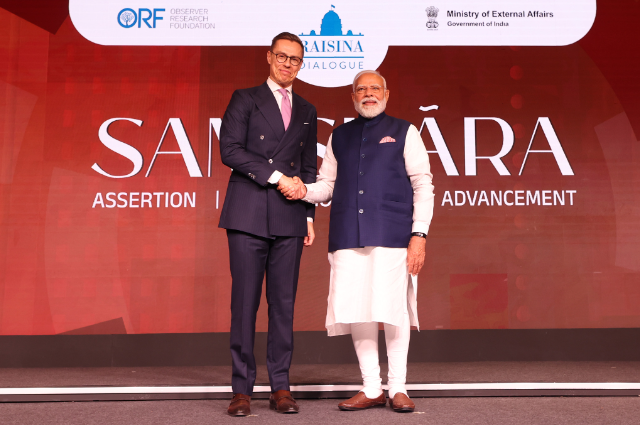
Figure: Prime Minister Narendra Modi on Thursday (March 6) attended the inaugural session of the Raisina Dialogue 2026 in New Delhi, where global leaders, policymakers and experts gathered to discuss pressing geopolitical and geo-economic challenges.
A high-profile gathering of world leaders to discuss international peace and security took place in New Delhi in 2026 at the Raisina Dialogue. It is India’s premier geopolitics conference, bringing officials from over 130 countries to discuss big issues. This year it came at a tense moment: just as the conference opened, a new war had broken out in West Asia (the Iran–Israel conflict). Flights were rerouted, and plans were disrupted, but leaders pressed on to talk about “war, peace and the new world order”. The event theme, drawn from the Sanskrit idea of saṃskāra, asked how our inherited habits and values shape the future. In simple words, Raisina 2026 was about people’s well-being and the quest for peace - a fitting backdrop for discussing India’s role in a divided world.
India: Friend to All Sides
India tries to be a “friend of the world.” Its leaders often say “One Earth, One Family, One Future,” meaning all people belong to one big family. In practice, India has friendly ties with both Western countries (like the US and Europe) and Middle East nations (including Iran and Israel). When the crisis began, Prime Minister Modi called for peace and talked to everyone. He told India’s Parliament that he had two rounds of phone calls with leaders in all Gulf countries, as well as Iran, Israel, and the US. He stressed that “our goal is to restore peace in the region through dialogue and diplomacy”.
It is entirely in keeping with the Indian strategic autonomy paradigm that India has always preferred not to align with any particular power bloc but to decide on its own. As another Indian official said at Raisina, "India's choices are determined by national interest and not by alignment to any single bloc." This basically means that India will not automatically take sides because of its alliances but rather pursue its own national interests. For instance, India described attacks on maritime and civilian infrastructure in the Gulf as "unacceptable." Yet, it continues to advocate dialogue; India prefers cool, measured tones over emotional rhetoric.
India's human ties to the Gulf were another factor. A major concern now is the safety of the approximately 10 million Indians who live and work in the Middle East. Every time there is news of missile strikes, a young Indian worker in Dubai says he fears for his family in Muscat. New reports talked about sailors being stranded: Rahul, a marine engineer on an LPG tanker, said that he, along with his crew, is "entrusted with ensuring India's energy security. Our vessel carries LPG cargo critical to the country." He and others were stuck for weeks in the Persian Gulf while warplanes and missiles were flying above them. In this crisis, India's leaders kept all communication lines open and laid emphasis on protection for citizens as well as trade. That "friend-to-all" approach was exactly like an ancient concept of India, as Vishwamitra (friend of the world) at Raisina.
Protecting India’s Energy Lifeline
One urgent problem for India is energy security. India imports most of its oil and gas, and much of it passes through the Strait of Hormuz - a narrow sea passage in the Gulf. About half of India’s oil (around 5 million barrels per day) normally travels this route. When warplanes began striking Iranian targets, shipping through Hormuz almost stopped. Rahul and his shipmates saw the impact firsthand: “Under normal conditions, crossing the Strait takes just two hours. Now we have been waiting here for weeks,” he said. He described the fear: “Every day, something is happening in the skies… It is not just the delay; it is the uncertainty that weighs on us”.
To keep India’s lights on and homes warm, the government sprang into action. Domestically, refineries ramped up production. Diplomatically, India sought new suppliers. By March 2026, officials reported that 70% of India’s crude now avoids Hormuz, up from 55% earlier. India bought more Russian oil (allowed by a U.S. waiver) and routed it via safer routes. As one energy expert noted, India’s use of the Hormuz corridor actually rose from 41% in 2025 to 52% recently because refiners cut some Russian imports. In any case, India tried to reduce that risk: “More than half of India’s crude imports pass through the Hormuz corridor, making the country vulnerable”, a report warned.
Meanwhile, Indian sailors like Rahul kept working despite danger. Rahul summed up their contribution: “Without us, supply chains collapse,” referring to how merchant sailors carry most of the world’s trade. His point shows why this matters to all Indians, not just ship crews. A blockage of Hormuz would drive up fuel prices at the pump and hurt factories. That is why PM Modi assured citizens that India would use every possible route and stockpile to keep fuel flowing. India’s strategic petroleum reserves cover about 74 days of imports, which helped get through the crisis. But the situation remained a reminder that a foreign war can quickly touch Indian lives through the energy we rely on.
Strategic Autonomy: India’s Own Path
At Raisina, officials were at pains to declare that India would go its own way. The Foreign Ministry said India is deepening its own capabilities and relationships, not being a junior partner of a superpower. This was seen in the actions: Indian naval escorts for merchant ships in the Gulf; India co-sponsoring a UN resolution condemning attacks on ships but not deploying combat troops abroad; and India using the global principles it supports to speak out, such as freedom of navigation and settlement by peaceful means.
In public statements, India’s tone was firm but quiet. At one session, the Foreign Minister of Finland quoted India’s diplomat, saying “Europe’s problems are not the world’s problems”, meaning no country should ignore conflicts outside its borders. That message met applause. The speaker added that “the global south will decide what the next world order will look like, and India…will be a major force”. In plain terms, India is part of a big shift: the world order is moving from Western leadership to a more multipolar system.
For India, acting with autonomy means pushing its own ideas. During Raisina, they highlighted projects like the India–Middle East–Europe Economic Corridor, aimed at linking India with Europe through the Gulf. Such initiatives reflect India’s strategy: build new trade and tech links while saying clearly what India thinks is right. A summary from India’s foreign ministry was simple: India values dialogue, not fighting. “Whether in Ukraine or West Asia, India consistently emphasises dialogue and diplomacy”. In other words, India’s preferred tools are talking and teamwork.
In practical terms, strategic autonomy also meant energy policy (as stated above) and diversified partnerships. India maintained its large defence and technology relationship with the United States, but sold major equipment to the United Arab Emirates. It increased deals with Europe regarding trade and with Russia regarding raw materials. However, Indian officials were adamant that India would not give up independent choices. As one minister put it, “India has been unambiguous and consistent: India’s decisions are guided by national interest, not by alignment with any single bloc.” This particular line from Raisina was meant to assure the world that India will continue to judge for itself.
Building a Cooperative World
World. Many speakers at Raisina viewed India’s approach as the template for a world that was to be. They observed an order in which one side dominated was coming to an end. The Finnish president said at the conference that the era of Western-dominated order is over. He used the words of India’s own minister, who said, “Europe’s problems are not the world’s problems.” That was a big clue that we are talking here about a new order where the Global South is going to be in the driver’s seat: Asia, Africa, and Latin America. And India, by virtue of its size and leadership, has a significant role to play in that.
Additionally, India's message at Raisina was spot on: remember the bigger picture. The dialogue "centred around human well-being, peace, and planetary stewardship," as the Observer Research Foundation report put it succinctly. To put it another way, India was attempting to shift the focus from conflict to cooperation. Raisina 2026 demonstrated that India is still attempting to find common ground in spite of the rivalry between superpowers.
The final takeaway was almost a challenge: can the world remember these lessons? India’s answer was to do so with clarity and calmness, with facts and with empathy. Judges of such debates would recall an opening that grabbed attention and an ending that left them thinking. That was what India was trying to do, though perhaps not very successfully in terms of international perception. One idea that stayed with many was that “one Earth, one family” also means we share each other’s problems and destinies. In the months ahead, as the war in Israel and Gaza evolves, India’s balancing act between staying friends with all while ensuring its own people and energy are secure and pushing for peace will be tested. But Raisina showed India ready to try: determined yet cautious; simple in word yet strong in deed; aiming to be in a fractured world that steady friend who nudges it toward peace.
References:
- Raisina Dialogue - Raisina Dialogue https://raisinadialogue.org
- Raisina Dialogue 2026 Opens in New Delhi https://www.asiamediacentre.org.nz
- Remarks of Minister of State Shri Kirti Vardhan Singh at the 11th Raisina Dialogue 2026 (March 06, 2026) https://www.mea.gov.in
- PM Modi calls for peace, assures energy security amid West Asia crisis | DD News https://ddnews.gov.in
- Seafarers from the coast stranded due to the West Asia war | Mangaluru News - The Times of India https://timesofindia.indiatimes.com
- India’s Oil Supply Risk Rises as 52% of Imports Pass Through Hormuz: S&P Global | Republic World https://www.republicworld.com
- India reroutes 70% of crude imports away from Strait of Hormuz - Introduction | Autocar India https://www.autocarindia.com