
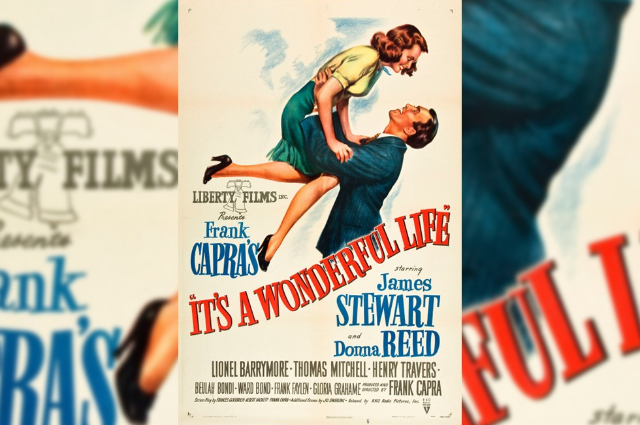
Introduction: Why It’s a Wonderful Life Still Matters
Released in 1946, It’s a Wonderful Life occupies a singular place in American cinema. Few films are as widely known, as frequently revisited, or as emotionally resonant across generations. Directed by Frank Capra and starring James Stewart in one of the most defining performances of his career, the film has become inseparable from the Christmas season and from broader ideas of hope, kindness, and moral renewal. Yet its iconic status today obscures a striking historical irony: It’s a Wonderful Life was not always loved. On its initial release, the film struggled at the box office and failed to capture the popular imagination of postwar audiences. That a once-overlooked film would evolve into one of the most cherished works in cinematic history is itself central to its meaning.
The paradox of It’s a Wonderful Life—its early commercial failure followed by cultural immortality—mirrors the story it tells. Like its protagonist, George Bailey, the film was undervalued in its own time. Post–World War II audiences, weary from years of conflict, sought light entertainment and escapism. Capra’s film, however, dared to confront despair, financial anxiety, and the quiet terror of feeling one’s life has amounted to nothing. It asked uncomfortable questions at a moment when America preferred reassurance. Decades later, as the film found new life through repeated television broadcasts, audiences began to recognise its emotional honesty and moral depth.
The film’s enduring relevance lies in its refusal to romanticise success. George Bailey is not a hero in the conventional sense: he never leaves his hometown, never achieves wealth or fame, and spends much of his life surrendering personal dreams for the sake of others. His crisis is not caused by villainy alone but by exhaustion, disappointment, and the slow accumulation of self-denial. In presenting despair not as weakness but as a deeply human response to invisible sacrifices, It’s a Wonderful Life speaks powerfully to viewers across eras and cultures.
At its core, the film endures because it confronts three universal anxieties—despair, self-worth, and belonging—without irony or detachment. Frank Capra’s vision, shaped by postwar uncertainty and his lifelong faith in the dignity of ordinary people, transforms a small-town story into a moral inquiry about what it means to live a meaningful life. In doing so, It’s a Wonderful Life transcends its historical moment and remains a timeless meditation on human value in an often indifferent world.
Historical and Cultural Context: America After World War II
It’s a Wonderful Life emerged at a moment of profound transition in American society. World War II had ended just a year earlier, and the nation was struggling to redefine itself in peacetime. While victory brought relief and optimism, it also exposed deep psychological and social fractures. Millions of soldiers were returning home, attempting to reintegrate into civilian life after years of violence, discipline, and emotional suppression. The economic landscape was shifting from wartime production to consumer capitalism, and although prosperity would soon follow, the immediate postwar period was marked by uncertainty, housing shortages, labour unrest, and unspoken trauma.
During the war, American cinema had played a clear role: reinforcing unity, patriotism, and moral clarity. Films celebrated collective sacrifice and heroic purpose. With the war over, however, that clarity vanished. Audiences faced the more ambiguous challenges of peacetime—financial responsibility, family pressures, and the fear that personal sacrifices made during the war would go unrecognised. Many returning veterans struggled with what would later be understood as post-traumatic stress, though the term did not yet exist. Feelings of dislocation, guilt, and emotional numbness were widespread but rarely discussed openly. In this context, the emotional turmoil experienced by George Bailey resonated deeply, even if audiences were not yet ready to confront it.
The public mood in 1946 oscillated between hope and unease. On the surface, America projected confidence and renewal, but beneath that optimism lay anxiety about economic stability and social roles. The idealised vision of domestic life—stable jobs, happy families, and suburban homes—was becoming a national expectation. Those who failed to achieve this ideal often internalised their disappointment as personal failure. It’s a Wonderful Life directly challenges this mindset by centring its narrative on a man who does everything society asks of him and still feels defeated.
Hollywood in the mid-1940s was also undergoing change. During the war years, studios had produced a steady stream of patriotic dramas and escapist musicals. By 1946, audiences were showing signs of genre fatigue. They wanted entertainment that affirmed life and offered relief from hardship. Capra, however, delivered a film that blended sentiment with darkness, fantasy with realism. The inclusion of suicide, alcoholism, and moral despair unsettled viewers who expected a lighter tone from a Christmas-season release. These themes felt discordant in a culture eager to move forward without reflection.
George Bailey’s character can be read as a symbolic representation of the returning veteran. Like many soldiers, George sacrifices personal ambition for a greater good, only to feel invisible once the crisis passes. His suppressed anger, emotional outbursts, and sense of entrapment echo the struggles of men who returned home to find that their service did not translate into fulfillment. In this way, It’s a Wonderful Life captured a psychological truth that 1946 America was not fully prepared to acknowledge, but one that later generations would recognise as painfully authentic.
Frank Capra: The Director and His Philosophy
To understand It’s a Wonderful Life, one must understand Frank Capra. More than a director, Capra was a moral storyteller whose films consistently reflected his personal journey, political beliefs, and faith in ordinary people. Born Francesco Rosario Capra in 1897 in a poor Sicilian village, he immigrated to the United States as a child. Growing up in Los Angeles, Capra experienced firsthand the instability, ambition, and opportunity that defined the immigrant experience in America. This background shaped his worldview and would later inform his enduring fascination with the dignity of the “little man” struggling against overwhelming forces.
Capra’s rise in Hollywood was improbable and emblematic of the American Dream he often celebrated on screen. After earning a degree in engineering from Caltech, he entered the film industry with no formal training, learning every aspect of filmmaking from the ground up. By the 1930s, he had become the most prominent director of the decade, winning three Academy Awards for Best Director. His success coincided with the Great Depression, a period that profoundly influenced his creative philosophy. While many filmmakers leaned toward cynicism or escapism, Capra embraced moral idealism, crafting stories in which decency, empathy, and civic responsibility ultimately prevailed.
Central to Capra’s films is the recurring conflict between the individual and powerful institutions. Whether banks, corporations, or political machines, these forces are often portrayed as morally hollow when detached from human values. In Mr. Deeds Goes to Town (1936), a small-town man inherits a fortune and challenges the corruption of urban elites through simple kindness and integrity. Meet John Doe (1941) explores how populist movements can be manipulated by media and political interests, even as it affirms the power of collective goodwill. In both films, Capra argues that moral clarity resides not in authority but in ordinary citizens acting with conscience.
It’s a Wonderful Life synthesises these ideas but pushes them further inward. Unlike Capra’s earlier heroes, George Bailey does not publicly confront institutions or deliver grand speeches. His struggle is largely private and internal. The antagonist, Mr. Potter, is not defeated through exposure or justice; he remains powerful and unpunished. Instead, Capra shifts the battleground from society to the soul. The question is no longer whether the little man can triumph over corruption, but whether he can recognise his own worth in a world that measures success materially.
This inward turn marks both the peak and the turning point of Capra’s career. Artistically, It’s a Wonderful Life represents his most emotionally complex and personal film. It distils decades of thematic exploration into a single narrative about sacrifice, despair, and redemption. Yet its initial commercial failure deeply affected Capra. The film’s rejection by audiences signalled that the cultural mood had shifted away from his brand of earnest idealism. In the years that followed, Capra would struggle to regain his former influence, making fewer films and gradually retreating from Hollywood.
At the heart of Capra’s philosophy is a profound belief in individual worth and human dignity. He rejected the notion that value is determined by wealth, status, or recognition. Instead, his films insist that a life is meaningful if it improves the lives of others. It’s a Wonderful Life stands as Capra’s clearest articulation of this belief—a cinematic manifesto declaring that no life is insignificant, and that the quiet acts of kindness we rarely acknowledge may matter most of all.
Narrative Structure and Storytelling Technique
The emotional power of It’s a Wonderful Life lies not only in what it says but in how it tells its story. Frank Capra employs a carefully layered narrative structure that blends realism, fantasy, and memory to guide the audience toward a deeply cathartic conclusion. Rather than unfolding in a straightforward linear fashion, the film is framed as a moral inquiry—one that invites viewers to reflect on the value of a single life before revealing its full meaning.
The film opens with an unusual and disarming framing device: prayers for George Bailey being heard in heaven. This celestial perspective immediately elevates a small-town crisis into a cosmic concern, suggesting that ordinary human lives possess spiritual significance. By beginning outside time and space, Capra establishes that the story to follow is not merely personal but universal. The heavenly narration also softens the film’s entry into dark territory, preparing the audience for themes of despair without overwhelming them at the outset.
From this frame, the narrative moves into an extended series of flashbacks that reconstruct George Bailey’s life. These flashbacks are not random memories but carefully selected moments that illustrate George’s defining traits—his selflessness, responsibility, and repeated sacrifices. Capra uses these scenes to build emotional equity with the audience. By witnessing George’s choices from childhood onward, viewers understand not only what he has done but what he has given up. This cumulative storytelling ensures that George’s later despair feels earned rather than exaggerated.
A key strength of the film is its balance between realism and fantasy. For much of its runtime, It’s a Wonderful Life operates as a grounded social drama, dealing with economic pressures, family obligations, and moral compromise. The fantasy elements—angels, divine intervention, alternate realities—are deliberately delayed. Clarence Oddbody, the angel tasked with saving George, does not appear in person until well into the film. This delay is crucial. By postponing Clarence’s intervention, Capra allows George’s crisis to reach a point of genuine emotional collapse, preventing the supernatural elements from feeling like an easy escape.
Clarence’s late arrival also serves a narrative function: he acts as a guide rather than a rescuer. He does not solve George’s problems directly but helps him reframe them. This distinction preserves George’s agency and reinforces the film’s moral argument that salvation comes through understanding, not external reward. Clarence’s humility and lack of authority contrast sharply with traditional depictions of divine figures, further emphasising the film’s focus on empathy over power.
The centrepiece of the film’s structure is the “alternate reality” sequence in which George is shown what the world would be like if he had never existed. This narrative device is both simple and devastatingly effective. By transforming familiar settings and characters into darker versions of themselves, Capra externalises George’s internal fear that his life has been meaningless. The stark contrast between Bedford Falls and Pottersville visualises the moral consequences of absence, making the abstract idea of influence tangible and immediate.
Pacing plays a critical role in the film’s emotional impact. The first two acts unfold gradually, allowing tensions to accumulate quietly. When the emotional climax arrives, it feels overwhelming but not manipulative. The final resolution—George’s return home and the community’s response—functions as a release of long-suppressed emotion. The payoff is powerful precisely because the film has taken its time, trusting the audience to sit with discomfort before offering hope. In this careful orchestration of structure and sentiment, It’s a Wonderful Life achieves its enduring emotional resonance.
Character Analysis: George Bailey as the Ultimate Everyman
George Bailey stands at the emotional and moral centre of It’s a Wonderful Life, not as a traditional hero but as one of cinema’s most fully realised portraits of the ordinary individual. His power as a character lies in his contradictions: ambition restrained by duty, generosity paired with resentment, moral strength shadowed by profound self-doubt. George is not undone by evil or incompetence but by the quiet accumulation of sacrifices that go unrecognised, making him a deeply human figure whose struggle transcends time and place.
From an early age, George is defined by his dreams. He longs to travel, build things, and escape the confines of Bedford Falls. These aspirations are not selfish fantasies but expressions of curiosity and creative energy. Yet at every pivotal moment, responsibility intervenes. He saves his brother Harry at the cost of his own hearing, remains in town to keep the family business alive after his father’s death, and repeatedly postpones personal freedom to protect others from financial exploitation. Each choice is morally admirable, but collectively they form a life shaped more by obligation than desire.
What makes George’s story compelling is not the sacrifices themselves but the emotional repression that follows. He rarely articulates his frustration, choosing instead to project optimism and reliability. Over time, this suppression becomes corrosive. The film suggests that constant self-denial, when paired with a lack of affirmation, can erode one’s sense of identity. George’s outward stability masks an internal crisis, reflecting a broader cultural tendency—especially among men—to equate emotional expression with weakness.
The film’s exploration of masculinity is central to George’s psychological conflict. In the context of mid-20th-century America, success was often measured by professional achievement, financial independence, and authority. By these standards, George feels like a failure. He remains tied to a modest business, lives in a drafty old house, and watches others surpass him in wealth and status. Despite being indispensable to his community, he internalises society’s narrow definitions of success and judges himself accordingly. This dissonance between lived value and perceived failure fuels his despair.
James Stewart’s performance is crucial to the character’s authenticity. Stewart, who had served as a bomber pilot during World War II, brought a raw emotional truth to the role that distinguished it from his earlier screen persona. His portrayal of George is marked by nervous energy, flashes of anger, and visible exhaustion. Stewart allows George to be irritable, impatient, and emotionally volatile, resisting the temptation to idealise him. This vulnerability resonated with postwar audiences, many of whom were grappling with their own sense of displacement and inadequacy.
The film’s most powerful moment—the breakdown scene—captures this tension with unsettling realism. George’s anger erupts not in grand speeches but in sharp, painful outbursts directed at those closest to him. His cruelty is not malicious but born of desperation. Capra and Stewart refuse to sanitise this moment, presenting despair as messy and frightening rather than noble. George’s subsequent collapse on the bridge, where he expresses the wish that he had never been born, is one of the most honest depictions of suicidal ideation in classic Hollywood cinema.
George Bailey’s despair feels timeless because it speaks to a universal fear: that a life devoted to others might go unnoticed and unvalued. His crisis is not about money alone but about meaning. He embodies the anxiety of countless individuals who wonder whether their sacrifices mattered, whether their presence made a difference. By grounding this existential doubt in the life of an unremarkable man, It’s a Wonderful Life asserts that such questions are not signs of failure but of humanity. George Bailey endures because he reminds us that worth is not measured by visible achievements, but by the invisible lives we touch.
Supporting Characters and Moral Forces
While George Bailey anchors It’s a Wonderful Life, the film’s moral vision is completed by the network of characters and forces surrounding him. Each supporting figure represents a distinct ethical position, and together they form a moral ecosystem that defines the film’s understanding of human value, responsibility, and community. Rather than existing merely to advance the plot, these characters illuminate different responses to power, vulnerability, and compassion.
Mary Bailey stands as the emotional cornerstone of George’s life. Unlike George, whose dreams pull him outward, Mary’s strength lies in her rootedness. She does not frame her life in terms of sacrifice but in terms of purpose and connection. Her love is active rather than idealised—she builds a home from a broken house, transforms scarcity into warmth, and provides emotional stability when George falters. Importantly, Mary’s role is not passive. She recognises George’s value long before he does, and her faith in him remains constant even when his own self-belief collapses. Through Mary, the film affirms the quiet power of emotional labor and steadfast companionship.
Clarence Oddbody, the second-class angel, offers a contrasting moral presence. He is not authoritative or grand, but gentle, awkward, and deeply empathetic. Clarence’s innocence allows him to see worth without judgment. He functions less as a supernatural saviour and more as a moral guide, helping George reframe his life rather than fixing it. By presenting an angel who earns his wings through kindness rather than power, the film reinforces its central argument that compassion, not dominance, defines moral greatness.
If Clarence represents moral clarity, Mr. Potter embodies moral emptiness. As the film’s antagonist, Potter is not driven by chaos or malice but by cold calculation. He symbolises capitalism stripped of conscience—a system that values control over care and profit over people. Potter’s power is unchecked, and notably, he is never punished. This narrative choice is significant: the film does not suggest that evil will always be defeated, only that it can be resisted. Potter’s presence sharpens the film’s critique of economic systems that thrive on exploitation while eroding communal bonds.
Uncle Billy represents another essential moral dimension: human fallibility. His carelessness triggers the film’s crisis, yet he is never portrayed as malicious. Instead, he embodies the fragility and imperfection of ordinary people. The film refuses to scapegoat him, emphasising that communities must absorb and forgive human error if they are to survive. This acceptance of imperfection deepens the film’s realism and ethical maturity.
Finally, Bedford Falls itself functions as a living character. It is shaped by the collective actions of its residents, reflecting the moral consequences of presence and absence. In contrast to Pottersville, Bedford Falls embodies cooperation, empathy, and shared responsibility. In the end, it is the community—not divine intervention—that saves George. Through this collective act, the film declares its most radical idea: that community, when grounded in mutual care, is the true hero of It’s a Wonderful Life.
Symbolism, Motifs, and Visual Language
It’s a Wonderful Life communicates its moral vision as much through images and symbols as through dialogue. Frank Capra’s use of recurring motifs and visual contrasts transforms a seemingly simple narrative into a layered meditation on life, worth, and moral consequence. These symbolic elements operate subtly, reinforcing the film’s themes without overwhelming its emotional realism.
One of the film’s most significant symbols is the bridge, the physical space where George Bailey reaches the edge of despair. The bridge functions as a threshold between life and death, hope and surrender. It is here that George’s internal crisis becomes externalised, and it is no coincidence that Clarence enters the story at this point. The bridge marks a moment of suspension—George is no longer anchored to his former certainties but has not yet discovered renewed meaning. In cinematic terms, it is a liminal space where transformation becomes possible.
Equally iconic is the bell that rings at the film’s conclusion, signalling that Clarence has earned his wings. While often remembered sentimentally, the bell carries deeper symbolic weight. It represents spiritual validation not bestowed arbitrarily but earned through compassion and service. Importantly, the bell rings only after George’s community comes together to save him. Divine grace, the film suggests, operates through human action. The symbol reinforces the idea that redemption is relational rather than solitary.
Capra’s visual language also relies heavily on the contrast between light and darkness. Bedford Falls is frequently bathed in warm, soft lighting that conveys safety, continuity, and belonging. Interiors glow with domestic warmth even when resources are scarce. In contrast, Pottersville is visually harsher, defined by sharp shadows, glaring neon signs, and crowded, chaotic streets. This stark difference underscores the moral divergence between the two spaces. Light becomes associated with empathy and connection, darkness with alienation and moral decay.
The contrast between Pottersville and Bedford Falls functions as a symbolic moral landscape. Bedford Falls reflects a world shaped by mutual care, where individuals matter beyond their economic utility. Pottersville, named after Mr. Potter, represents unchecked greed and moral indifference. It is not merely a worse version of the town but a fundamentally different ethical environment, illustrating how one person’s absence can alter the moral fabric of a community.
Recurring physical elements further deepen the film’s symbolic texture. Water appears at key moments—George’s childhood rescue of his brother, the icy river beneath the bridge—symbolising both danger and renewal. Money, though central to the plot, is portrayed ambiguously: it holds power but lacks inherent value unless used in the service of others. Houses, especially the dilapidated Bailey home, symbolise stability, belonging, and the transformation of hardship into meaning.
Sound and music play a crucial role in shaping emotional resonance. Dimitri Tiomkin’s score shifts subtly between hope and despair, guiding the audience without manipulation. Moments of silence, particularly during George’s breakdown, heighten emotional authenticity. Together, these visual and auditory elements create a symbolic language that deepens the film’s exploration of human worth and moral choice.
Failure, Success, and the American Dream
At the heart of It’s a Wonderful Life lies a quiet but radical redefinition of success. In a culture that traditionally equates achievement with wealth, mobility, and status, the film challenges the very foundations of the American Dream. George Bailey’s life, when measured by conventional standards, appears unremarkable. He does not accumulate riches, rise in social rank, or escape his hometown. Yet the film insists that these markers are insufficient—and often misleading—measures of a life well lived.
Capra’s critique of materialism is woven throughout the narrative. Money in It’s a Wonderful Life is a necessary tool but never a moral end. Mr. Potter, the wealthiest and most powerful figure in Bedford Falls, is also the most spiritually bankrupt. His accumulation of capital brings neither happiness nor social good. In contrast, George’s financial “failures” are the result of prioritising people over profit. By repeatedly choosing community welfare over personal gain, George undermines the idea that success must be competitive or extractive.
The film also stages a clear moral conflict between capitalism and community responsibility. The Bailey Building and Loan operates on principles fundamentally opposed to Potter’s business model. Where Potter seeks control and dependency, George fosters opportunity and dignity by helping working-class families own homes. Capra does not reject capitalism outright, but he argues for a humanised version—one tempered by empathy, accountability, and social obligation. Economic systems, the film suggests, must serve people rather than dominate them.
Despite embodying these ethical values, George feels like a failure because he has internalised society’s narrow definitions of success. He watches his peers travel, achieve recognition, and accumulate wealth, while his own life feels stagnant. His sacrifices are invisible, and his labor is taken for granted. This emotional dissonance—between actual impact and perceived worth—drives his despair. George’s tragedy is not that he has failed, but that he cannot see his success in a culture that refuses to measure it properly.
In this sense, It’s a Wonderful Life functions as a powerful counter-narrative to what might now be called toxic productivity. George’s value does not lie in constant self-optimisation or measurable output, but in relationships, trust, and continuity. The film affirms rest, care, and moral consistency over ambition at any cost. It questions the idea that a meaningful life must be exceptional or externally validated.
This message remains strikingly relevant in an era of modern economic anxiety. In a world marked by job insecurity, rising inequality, and pressure to monetise every aspect of existence, George Bailey’s crisis feels contemporary. It’s a Wonderful Life offers a humane alternative to relentless competition, reminding viewers that dignity is not earned through productivity alone. By reframing success as the positive impact one has on others, the film restores a moral dimension to the American Dream—one rooted not in accumulation, but in connection.
Reception, Rediscovery, and Cultural Legacy
The cultural stature of It’s a Wonderful Life today stands in sharp contrast to its modest beginnings. Upon its release in December 1946, the film received respectful but restrained critical attention and failed to perform strongly at the box office. Audiences emerging from World War II were drawn to lighter, more escapist entertainment, and Capra’s emotionally complex film—steeped in despair, moral doubt, and financial anxiety—felt out of step with prevailing tastes. Despite strong performances and craftsmanship, the film was unable to recoup its production costs, contributing to the eventual decline of Capra’s independent studio, Liberty Films.
At the Academy Awards, It’s a Wonderful Life earned five nominations, including Best Picture, Best Director, Best Actor for James Stewart, Best Sound, and Best Editing. Yet it won none. The major awards that year went to William Wyler’s The Best Years of Our Lives, another postwar film but one that more directly aligned with contemporary expectations of realism and reconciliation. While Capra’s film was acknowledged as significant, it was not yet embraced as essential.
The turning point in the film’s legacy came decades later through an accident of legal oversight. In the 1970s, It’s a Wonderful Life temporarily fell out of copyright, allowing television networks to broadcast it freely. Stations began airing the film repeatedly during the Christmas season, and what had once been a box-office disappointment gradually became a shared cultural ritual. Its frequent broadcasts introduced the film to new generations, embedding it in collective memory as a seasonal tradition rather than a historical artefact.
As the film’s visibility increased, so did its emotional impact. Viewers began to connect its themes of despair, gratitude, and communal responsibility to their own lives. Lines such as “No man is a failure who has friends” entered the cultural lexicon, quoted in everyday conversation and echoed in countless works of popular culture. The film influenced later movies and television shows that explored alternate realities, moral reckonings, and the unseen consequences of individual lives. From dramatic homages to parodies, its narrative structure and themes have been endlessly reinterpreted.
Academic and critical reevaluation further solidified the film’s status. Scholars began to view It’s a Wonderful Life as one of the most psychologically honest films of classical Hollywood, notable for its treatment of despair and moral ambiguity. Critics reexamined James Stewart’s performance as one of the finest in American cinema, praising its vulnerability and emotional intensity. Institutions such as the American Film Institute and the Library of Congress recognised the film for its cultural and historical significance.
The film’s endurance lies in its adaptability. It continues to be referenced, remade, and reimagined because its core questions remain unresolved: What makes a life meaningful? How do we measure worth? By offering no easy answers, It’s a Wonderful Life invites each generation to find its own reflection within George Bailey’s journey, ensuring its place as an enduring cultural touchstone.
Conclusion: “No Man Is a Failure” — The Film’s Enduring Message
At its core, It’s a Wonderful Life endures because it dares to ask a question that most stories avoid: what if a life that appears ordinary is, in fact, profoundly meaningful? Frank Capra’s film rejects spectacle and heroism in favour of moral intimacy, arguing that human worth is not measured by wealth, recognition, or escape, but by presence, responsibility, and care for others. Through George Bailey’s journey from despair to understanding, the film affirms its central truth—that no life is insignificant when it touches others with compassion.
In the 21st century, this message feels more urgent than ever. Modern life is increasingly shaped by isolation, economic pressure, and constant self-comparison. Social media and productivity culture encourage individuals to measure their value through visibility and achievement, often leaving little room for quiet contributions or emotional labour. George Bailey’s crisis mirrors these anxieties. His suffering stems not from failure, but from living in a world that fails to recognise the kinds of success that cannot be easily quantified.
The film’s power lies in its insistence that meaning is relational. George is saved not by money, miracles, or status, but by empathy—by the collective recognition of his value from those whose lives he shaped. This emphasis on interconnectedness offers a counterweight to contemporary burnout, reminding viewers that human beings are not isolated units competing for worth, but participants in shared moral ecosystems. Gratitude, the film suggests, is not sentimental excess but a necessary corrective to despair.
Ultimately, It’s a Wonderful Life transcends its status as a holiday classic because it functions as a moral compass. It does not promise that goodness will be rewarded or that injustice will be corrected, but it affirms something more enduring: that kindness matters even when it goes unnoticed. In a world often defined by noise, speed, and indifference, Capra’s film quietly insists on the radical idea that a life of integrity, empathy, and connection is not only enough—it is everything.
References & Source Links
Primary Film History + Encyclopedia Sources
Historical Context & Film Legacy
- Library of Congress — National Film Registry: It’s a Wonderful Life
- American Film Institute — AFI’s 100 Greatest American Films
Academic & Scholarly Commentary
- Basinger, Jeanine — The It’s a Wonderful Life Book (University of Michigan Press, 1986)
- Poague, Leland — Another Frank Capra (Cambridge University Press, 1994)
- Del Vay, David — “Frank Capra and the American Dream” – Film Quarterly
- Ellen Cheshire — It’s a Wonderful Life (BFI Film Classics)
News Articles, Essays, and Criticism
- Roger Ebert — Review of It’s a Wonderful Life
- New York Times — Original 1946 Review
- Time Magazine — “How It’s a Wonderful Life Became a Christmas Classic”
- The Guardian — Capra’s populism and legacy
Production History, Casting, and Reception
- Turner Classic Movies (TCM) — Production Notes
- IMDb — Trivia and Production Details
- Academy Awards Database — 1947 Nominations