
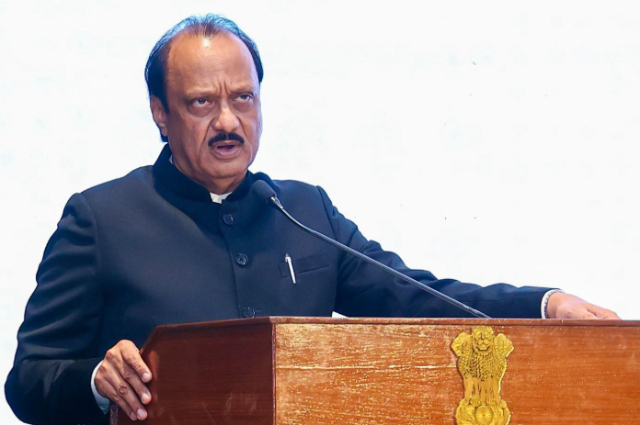
As dawn broke over the Pune-Mumbai Expressway on February 2, 2026, the asphalt carried no warning of the tragedy about to unfold. The morning mist hung low, the highway stretched endlessly, and somewhere between the promise of a new day and the routine of political duty, a life—no, an entire legacy—was about to be violently erased in a fraction of a second.
Ajit Pawar, the seasoned politician, the Deputy Chief Minister of Maharashtra, the man who had navigated the treacherous waters of state politics for decades, could not navigate a single moment of human error on the road. His journey ended not in the legislative assembly, not in a political rally, but in the twisted metal of a highway collision. A phone call that should have waited. A speed that should have been checked. A moment that should have been prevented.
He left behind a wife who will never hear his voice again. Children who will forever carry the weight of an unfinished goodbye. Colleagues who lost not just a leader, but a mentor. And a state that lost a political stalwart in the most preventable way imaginable—on a road that claimed yet another soul, adding one more name to India's staggering tally of 180,000 annual road deaths.
This is not just the story of Ajit Pawar. This is the story of every person who steps onto India's roads and gambles with fate. This is the story of a nation that has normalized death on its highways. This is the story of how one crash can awaken a state—and perhaps, a country—to the brutal reality we have been ignoring for far too long.
The Morning of February 2, 2026: When Routine Became Tragedy
It was supposed to be an ordinary Monday. Ajit Pawar, 65, had scheduled meetings in Mumbai. His convoy left Baramati at 6:15 AM, a routine he had followed hundreds of times before. The Pune-Mumbai Expressway, a symbol of Maharashtra's infrastructure pride, stretched before them—smooth, wide, and deceptively safe.
At approximately 7:42 AM, near the Khalapur toll plaza, everything changed.
Eyewitnesses reported seeing the Deputy Chief Minister's vehicle—a white Toyota Fortuner—traveling at an estimated speed of 110 km/h in the fast lane. The speed limit on this stretch: 80 km/h. Behind the wheel sat Pawar himself, a decision that would prove fatal. His security detail followed in a separate vehicle, powerless to intervene.
What happened next unfolded in mere seconds, yet its impact will reverberate for generations:
A phone call came through. Pawar reached for his mobile device.
His eyes left the road for three seconds—just three seconds.
A container truck ahead had slowed due to a minor breakdown.
By the time Pawar looked up, it was too late.
The Fortuner slammed into the rear of the container truck at nearly full speed. The impact was devastating. The vehicle's front crumpled like paper. The airbags deployed, but physics is unforgiving at 110 km/h. Within minutes, the Deputy Chief Minister of Maharashtra was declared dead at the scene by emergency responders.
Three seconds. One phone call. One life. Gone.
The Immediate Aftermath: A State in Shock
News of the crash spread through Maharashtra like wildfire. By 8:30 AM, social media was ablaze. Political leaders from across party lines rushed to express condolences. The state assembly was adjourned. Flags flew at half-mast.
But beneath the official mourning, a different conversation was brewing—one that made many uncomfortable, yet one that desperately needed to happen.
The questions came swiftly:
- Why was the Deputy Chief Minister driving himself without his designated security driver?
- Why was he using a mobile phone while driving, a violation he himself had legislated against?
- Why was the vehicle traveling 30 km/h above the speed limit?
How many ordinary citizens have died under identical circumstances, yet received no headlines, no state mourning, no national attention?
The preliminary police report, released on February 3, 2026, confirmed what eyewitnesses suspected: distracted driving combined with excessive speed. The Maharashtra Highway Police noted evidence of a phone call in progress at the time of impact. Forensic analysis of the crash site revealed skid marks spanning only 12 meters—indicating Pawar had almost no time to react once he saw the obstacle ahead.
The container truck driver, 42-year-old Ramesh Kamble from Satara, was immediately detained for questioning but was released within hours. His vehicle had broken down legitimately, and he had activated hazard lights. He had done nothing wrong. He was simply in the wrong place when someone else made a fatal choice.
The Grim Statistics: Ajit Pawar Becomes Number 180,001
In 2024, India lost 180,000 lives to road accidents. That's one death every three minutes. Ajit Pawar's death, tragic as it is, represents a continuation of a pattern, not an aberration.
Let's put this into perspective with data that should shock every Indian into action:
- Distracted Driving: According to the Ministry of Road Transport and Highways, approximately 12% of all fatal accidents in 2024 involved mobile phone usage while driving. That's 21,600 preventable deaths. Ajit Pawar joins this statistic.
- Speeding: Over-speeding contributed to 68% of highway fatalities in 2024—approximately 122,400 deaths. Pawar was traveling 37.5% above the legal limit when he crashed.
- The 'Productive Bracket': 66% of road fatalities occur among individuals aged 18-34, but the 55-65 age group—Pawar's demographic—accounts for another 14%, representing experienced professionals and leaders whose loss creates institutional voids.
- Maharashtra's Highway Crisis: In 2024, Maharashtra's state and national highways saw 36,084 accidents resulting in 14,247 deaths. The Pune-Mumbai Expressway alone accounted for 127 fatalities. Ajit Pawar is now number 128 for this stretch.
- But here's the most astonishing fact: Despite being one of India's best-maintained highways, despite having clearly marked speed limits, despite having regular police patrolling, despite having emergency services stationed every 50 kilometers, the Pune-Mumbai Expressway continues to claim lives because human behavior remains unchanged.
Ajit Pawar had access to every resource imaginable: professional drivers, security protocols, GPS-tracked vehicles, and instant communication with emergency services. Yet none of these protected him from a three-second lapse in judgment. If this can happen to a Deputy Chief Minister, imagine the vulnerability of ordinary citizens who lack even basic safety infrastructure.
The Uncomfortable Truth: When Leaders Fall Victim to Laws They Create
There is a profound irony in Ajit Pawar's death that Maharashtra cannot ignore.
In 2019, as a member of the state cabinet, Pawar had voted in favor of Maharashtra's stringent anti-mobile phone usage law while driving. The penalty: ₹1,000 fine for first-time offenders, ₹2,000 for repeat violations, and potential license suspension. He had publicly supported the cause, even participating in road safety awareness campaigns.
In 2021, he had inaugurated a state-wide speed governor initiative for commercial vehicles, stating in his speech: "Speed thrills, but it also kills. Every kilometer above the limit is a step closer to tragedy."
Yet on that Monday morning, the man who had legislated safety for others became a victim of his own disregard for the very rules he helped create.
This is not about vilifying Ajit Pawar. This is about recognizing a systemic cultural failure. When even our leaders—the very people who create road safety laws—succumb to the temptation of speeding or distracted driving, it reveals a deeper truth about how India perceives road rules: as suggestions, not as life-saving mandates.
Social media exploded with debates. Some mourned genuinely. Others pointed out the hypocrisy. Traffic police officers across Maharashtra shared the story with a grim sense of validation—they had been saying this for years, but nobody listened until tragedy struck someone 'important.'
One traffic constable from Pune, speaking anonymously, said: "We stop vehicles every day for mobile phone violations. Most people pay the fine and drive off, only to repeat the behavior within hours. We've stopped MLAs, bureaucrats, even judges. They all think the rules don't apply to them. Now we've lost a Deputy CM to the same mindset. When will we learn?"
The Ripple Effect: A Family Shattered, A State Stunned
Beyond the political implications, beyond the statistics, beyond the debates on social media, there is a family in mourning.
Ajit Pawar's wife, Sunetra Pawar, was preparing breakfast when the call came. She collapsed upon hearing the news. Their children—adults now, but forever their father's children—rushed to the crash site, only to find emergency workers covering the mangled remains of the Fortuner with tarps. No parent should die this way. No child should receive such news.
The family released a statement on February 3rd, heartbreaking in its simplicity:
"Our father, husband, and leader is gone. We request privacy in this time of grief. But we also request that his death not be in vain. If his tragedy can prevent even one family from experiencing this pain, then perhaps there is meaning in this senseless loss. Please, drive carefully. Put down your phones. Slow down. Come home safe."
This statement, more than any government notification or police report, captured the raw humanity of the tragedy. It wasn't about politics. It wasn't about blame. It was a family begging others to learn from their irreversible loss.
The political vacuum created by Pawar's death is significant. He was a key figure in Maharashtra's coalition government, a master negotiator, and a bridge between competing factions. His sudden absence triggered immediate speculation about power realignments, succession battles, and cabinet reshuffles.
But the real cost isn't political—it's human. It's in the empty chair at the dinner table. It's in the unfinished conversations. It's in the grandchildren who will grow up knowing their grandfather only through photographs and stories. It's in the 'what ifs' that will haunt his family forever.
What Happens Next: Will Maharashtra Finally Wake Up?
Within 48 hours of Ajit Pawar's death, Maharashtra Chief Minister Eknath Shinde announced the formation of a high-level committee to review road safety protocols for government officials. The announcement was met with skepticism.
"Another committee. Another report. Another shelf to gather dust," tweeted a prominent road safety activist. "What we need isn't more committees. What we need is enforcement. What we need is cultural change. What we need is for every Indian to understand that roads are not battlegrounds—they're shared spaces where one mistake can end multiple lives."
However, some concrete measures have emerged:
Mandatory GPS-Based Speed Limiters: The Maharashtra government announced that all government vehicles would be equipped with intelligent speed limiters linked to GPS systems by June 2026. These devices will automatically reduce vehicle speed based on road-type and weather conditions, making it physically impossible to exceed safe limits.
Enhanced Mobile Phone Detection Systems: Building on technology already deployed in some Western countries, Maharashtra is piloting AI-powered cameras that can detect mobile phone usage by drivers. The first phase will cover the Pune-Mumbai Expressway by April 2026.
The 'Ajit Pawar Memorial Road Safety Fund': ₹100 crores have been allocated to improve emergency response infrastructure along Maharashtra's highways, including more trauma centers, faster ambulance deployment, and better crash barriers.
Compulsory Driver Refresher Courses: All government officials and employees will be required to complete annual road safety refresher courses, including virtual reality simulations of crash scenarios.
These are positive steps. But the question remains: Will they be implemented with the urgency and rigor required? Or will they suffer the fate of countless other post-tragedy announcements—forgotten within months, overtaken by new headlines, buried under bureaucratic inertia?
The National Wake-Up Call: This Could Be Any of Us
If there is one lesson from Ajit Pawar's death, it is this: Road accidents do not discriminate. They don't care about your position, your wealth, your influence, or your connections. On the road, we are all equally vulnerable to the consequences of poor decisions.
Every day, 493 Indians die on our roads. That's 493 Ajit Pawars. 493 families shattered. 493 futures erased. But because they're not Deputy Chief Ministers, their deaths don't make headlines. They become statistics in a government report that most people will never read.
This is the eye-opening truth every Indian must internalize:
That WhatsApp message can wait. That phone call can go to voicemail. Those extra 10 km/h won't get you there meaningfully faster, but they might ensure you never arrive at all.
Every time you glance at your phone while driving, you're playing Russian roulette. Every time you exceed the speed limit 'because the road is empty,' you're gambling with lives—yours and others'.
Every time you think 'it won't happen to me,' remember Ajit Pawar thought the same thing. So did the 180,000 others who died in 2024.
The real question isn't whether road safety laws are strict enough—it's whether we, as a society, respect life enough to follow them.
A Call to Action: Let This Death Mean Something
As Maharashtra mourns and prepares for Ajit Pawar's state funeral, as political parties eulogize his decades of public service, as social media debates the circumstances of his death, there is an opportunity—a brief window—to transform tragedy into meaningful change.
Here's what needs to happen, and it needs to happen now:
- For the Government: Fast-track the implementation of AI-powered enforcement systems. Make mobile phone detection cameras operational within three months, not three years. Install intelligent speed management systems on all major highways by the end of 2026. Stop treating road safety as a low-priority administrative matter and treat it as the national emergency it is.
- For Law Enforcement: Zero tolerance. No exceptions for VIPs, politicians, or the wealthy. The law must apply equally, or it applies to no one. Every violation must carry consequences, regardless of who commits it. Create a public database of traffic violations by government officials to ensure accountability.
- For Vehicle Manufacturers: Make advanced driver assistance systems (ADAS) standard, not optional luxury features. Integrate phone-blocking technology that prevents mobile usage while a vehicle is in motion. Build vehicles with intelligent speed assistance that warns and, if necessary, intervenes when drivers exceed safe limits.
- For Media and Influencers: Stop glamorizing speed and reckless driving in movies, advertisements, and social media content. Make road safety campaigns as viral as dance challenges. Use your platforms to normalize responsible driving behaviors, not dangerous ones.
- For Every Indian Citizen: This is the most important part. Technology and laws can only do so much. The real change must come from within each of us.
Put your phone in the glove box before you start driving. Not on the seat. Not on the dashboard. Out of reach.
Respect speed limits. They're set based on road engineering, weather patterns, and accident data. They're not suggestions
Take rest breaks on long journeys. Fatigue kills as surely as speed.
Speak up when someone else is driving dangerously. Your silence could cost lives.
Teach your children, from their earliest years, that road safety is not negotiable.
The Final Word: 180,001 and Counting
On February 2, 2026, at 7:42 AM, on a stretch of the Pune-Mumbai Expressway near Khalapur, India lost a political leader. But more fundamentally, a family lost a father, a husband, a grandfather. And the nation was reminded, once again, that our roads are killing us.
Ajit Pawar's death will be debated, analyzed, and eventually, like so many tragedies before it, forgotten. The news cycle will move on. Political life will continue. Someone else will take his position.
But his family will never move on. They will carry this loss forever. And 493 more families will join them tomorrow. And 493 more the day after. And so on, endlessly, until we decide—collectively, urgently, unequivocally—that enough is enough.
This article is not just about Ajit Pawar. It's about the 180,000 who died in 2024. It's about the hundreds of thousands more who will die in 2026, 2027, and beyond unless we change.
It's about recognizing that every journey we take is a covenant with fate, and that we have more control over our destiny on the roads than we think.
Ajit Pawar's last journey ended in tragedy. But perhaps, just perhaps, it can mark the beginning of a transformation in how India approaches road safety. Not through more committees and reports, but through immediate, sustained, and uncompromising action.
The question is: Will we learn? Or will we simply add his name to the ever-growing list of preventable deaths and continue as before?
The answer lies with each of us. Every time we get behind the wheel. Every time we reach for our phone while driving. Every time we decide whether to speed or slow down.
Make the right choice. Come home safe. Because somewhere, someone is waiting for you. And they deserve to see you walk through that door, not receive a phone call that changes their life forever.
180,001 lives lost. And counting.
When will the counting stop?