
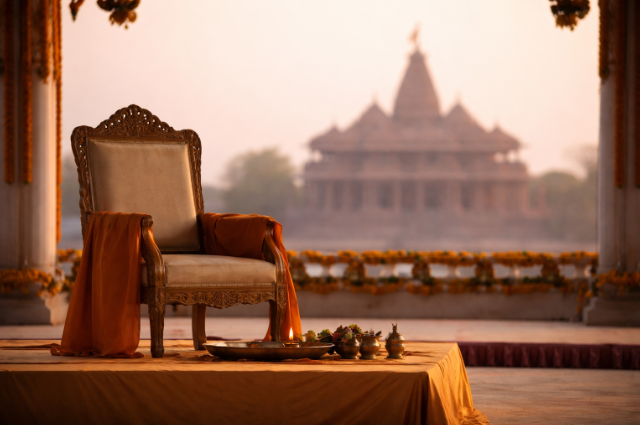
It did not begin in a courtroom. It began with a refusal.
In early 2024, Swami Avimukteshwaranand Saraswati publicly chose not to attend the Ram Temple consecration ceremony in Ayodhya. His reason was not political, at least not directly. He argued that the religious rituals were incomplete and that the ceremony was being conducted before the temple’s full construction, which, according to tradition, was improper.
That one decision created ripples far beyond religion. Because this was not just any voice. This was Shankaracharya speaking.
India has always walked a careful line between faith and governance. The country is deeply religious, yet constitutionally secular. It respects belief, but it is governed by law.
Most of the time, this balance holds. Sometimes, it doesn’t.
The Ayodhya event was projected by the government as a historic and unifying moment. Political leaders, including the Prime Minister, took active roles in the ceremony. For millions, it was a matter of pride, identity, and long-awaited cultural restoration.
But the absence of key Shankaracharyas told a different story.
Not loud. But noticeable.
Swami Avimukteshwaranand and a few others questioned both the timing and the manner of the ceremony. Their argument was rooted in religious procedure, not politics. Yet, the moment it entered public space, it became political.
That shift was almost immediate.
Supporters of the government dismissed the criticism, calling it unnecessary or even divisive. Some television debates reduced it to a difference of opinion among religious leaders.
But the issue was deeper than that. It raised a quiet but uncomfortable question.
Who defines religion in a modern state?
The spiritual authority. Or the political one.
The Indian Constitution, under Article 25, guarantees freedom of religion. People are free to practice and propagate their beliefs. But this freedom comes with conditions. Public order, morality, and health remain the boundaries.
The state does not reject religion. It regulates the space in which religion operates.
That is where friction begins.
A Shankaracharya does not operate within legal frameworks. His authority is moral, traditional, and spiritual. For followers, it is unquestionable.
The state, on the other hand, operates through law. It cannot function on belief alone. It needs rules, procedures, and enforceable decisions.
When these two systems overlap, even slightly, tension builds.
This was not a street protest. There were no arrests. No legal notices. And yet, it was a confrontation. A silent one. The social reaction made it clearer.
In some sections, people supported the Shankaracharya, arguing that religious traditions should not be altered for political timelines. For them, faith is not an event to be scheduled. It is a process to be followed.
Others saw no issue. They believed the ceremony represented national culture, and political participation was natural in such a moment.
Same event. Completely different interpretations. This is where modern India stands today. Not divided in the usual sense.
But layered. One layer sees faith as sacred and unchanged. Another sees it evolving with the nation.
Media, as always, amplified the moment. Short clips, strong opinions, half-context debates. What could have remained a theological discussion became a national talking point.
And then, like most debates, it faded from headlines. But not from memory. The Shankaracharya state episode may not have resulted in legal action, but it revealed something more important.
The balance between faith and law is not fixed. It shifts. Sometimes slowly. Sometimes suddenly.
In the end, the Constitution still stands above all institutions. It protects religious freedom but also ensures that governance is not dictated by any single belief system.
But documents alone do not maintain balance. People do. Leaders do. And moments like this test how carefully that balance is being handled.
Because the real confrontation is not always loud. Sometimes, it is a quiet disagreement. A refusal to attend. A statement made at the right time. And a country left thinking, even after the noise fades, about where the line truly lies.
References:
- The Hindu – Coverage of Shankaracharya's remarks on Ram Temple consecration https://www.thehindu.com
- Indian Express – Debate on religious leaders and Ayodhya event https://indianexpress.com
- Bar & Bench – Article 25 and religious freedom analysis https://www.barandbench.com
- PRS India – Constitutional provisions on Fundamental Rights