
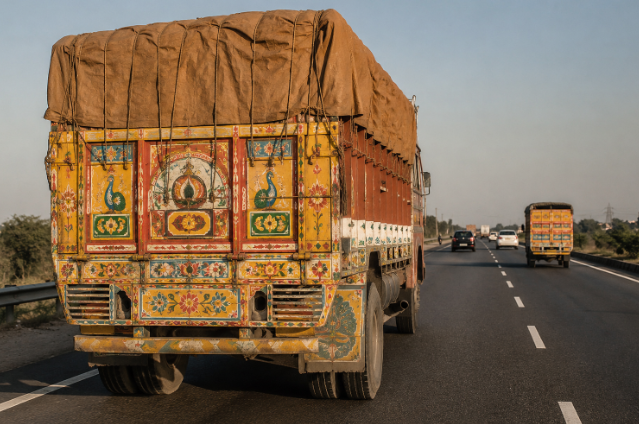
If you have ever been stuck behind a massive cargo truck on an Indian highway, you have seen it. Painted across the back in bright, swirling letters is the phrase "Horn OK Please."
It is as much a part of a road trip as roadside dhabas and sweet cutting chai. What looks like a quirky, confusing piece of pop culture is actually a mix of old-school road safety, wartime survival, and accidental corporate advertising.
It is the story of how drivers managed to write their own rules for staying alive on some of the world's most chaotic roads.
To understand why a truck driver would actively beg you to honk your horn, you have to picture what driving used to be like.
Decades ago, most trucks did not have side mirrors, and even if they did, the massive, bulging cargo completely blocked the driver's view. Highways were narrow, winding, and poorly lit. Because the driver sat far forward in a loud, rumbling cabin, they were completely blind and deaf to what was happening behind them. Sound became the only way to see.
"Horn Please" was a literal instruction to anyone trailing behind: Please honk so I know you are there and trying to pass me.
But how did the word "OK" get jammed right into the middle? There is no single official answer, but drivers and historians usually point to three fascinating theories.
The first is about safe spacing. On old single-lane roads, the words were painted far apart: "HORN" on the left, "PLEASE" on the right, and "OK" dead centre. If you were driving right behind the truck, your eyes naturally focused on the "OK," which meant you were at a safe braking distance. Some trucks even had a little green light bulb above the "OK."
When the truck driver saw that the road ahead was clear, they would flip a switch to light it up, signalling it was genuinely okay to pass.
The second theory goes back to the resource shortages of World War II.
Fuel was scarce, and transport trucks were forced to run on highly unstable, makeshift kerosene mixtures. Because kerosene catches fire easily, a minor rear-end collision could cause a massive explosion.
Fleet owners began painting "Horn Please, On Kerosene" across the back to warn people to keep their distance. Over the years, the fuel changed, but "On Kerosene" got shortened to "OK" and just stuck around as a habit.
The last theory is a story of pure marketing genius. In the mid-twentieth century, the Tata Group manufactured almost all the commercial trucks in India. Around the same time, they launched a budget washing detergent called "OK" soap. To get the word out to millions of people who did not have televisions or radios, Tata used the backs of their own trucks as moving billboards, painting the brand name "OK" right in the middle of the standard safety sign. The soap eventually flopped and
disappeared from stores, but local sign painters kept copying the design for decades, assuming it was just part of the official highway code.
Over generations, this simple phrase gave rise to a whole subculture of truck art. Painting a truck became a labour of love. Drivers who spent months away from their families turned their vehicles into mobile homes, framing "Horn OK Please" with intricate paintings of peacocks, lotus flowers, and protective symbols to ward off the evil eye.
It transformed a brutal, exhausting job into a canvas for personal pride.
Today, the world is changing, and the iconic phrase is slowly fading from the roads. Government officials have started banning it, arguing that it encourages India’s chronic, stressful honking culture.
Besides, modern trucks come with wide-angle mirrors and rearview cameras, and old single-lane roads are being replaced by massive, multi-lane expressways. Fleet managers now prefer quick, reflective safety stickers over paying a traditional artist to hand-letter a chassis.
Even if the physical paint is disappearing from the highways, "Horn OK Please" has found a second life.
You can find its distinct, colourful style inside trendy city cafes, on pop art clothing lines, and on home decor. The roads might finally be getting a little quieter, but the famous slogan endures as a warm reminder of a time when a little hand-painted advice kept an entire country moving safely through the chaos.
References:
- https://blindtobounds.blog
- https://www.atlasobscura.com
- https://blog.nrigujarati.co.in
- https://www.prabhatkhabar.com