
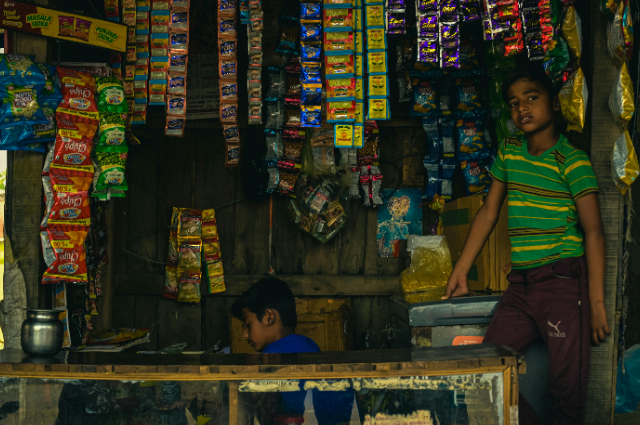
The latest numbers from the Household Consumption and Expenditure Survey (HCES) 2023-24 tell a story that is hard to hear.
In rural India, the dream of a better life through education is being quietly smothered by a ₹5 sachet. The data shows that while rural families are putting only about 2.5% of their total budget toward education, they are spending nearly 4% on tobacco.
A massive chunk of that goes straight to gutka.
This isn't just a slow increase; it is an explosion. Over the last decade, the number of rural households using gutka has shot up nearly six times, going from roughly 5% to over 30%.
In the heart of the country, places like Madhya Pradesh, Uttar Pradesh, and Bihar, gutka has become as common as tea. In rural MP, more than six out of ten households are regular users. It has become the king of tobacco in the countryside, making up 41% of all rural tobacco spending.
The most heartbreaking part of this is how it targets those who have the least. Tobacco use is now heavily concentrated among the poorest families. In rural India, over 70% of households in the bottom 40% of the income ladder use tobacco. In states like Bihar and UP, that number passes 85%.
These families aren't just spending spare change; they are spending their survival money. The poorest rural homes spend a larger portion of their income (1.7%) on tobacco than the richest families (1.2%).
To put that in human terms, if a father in one of these homes took the money he spent on gutka and put it toward food instead, he could add 500 calories a day to the plates of his children. That’s the difference between a child going to bed hungry and having enough energy to grow.
It is easy to judge from the outside, but for a migrant worker or a labourer doing back-breaking work for 12 hours a day, gutka isn't just a vice. It’s a tool. It’s a ₹5 way to get a quick "high" and forget the exhaustion for a moment.
Even more importantly, it is a hunger suppressant. When you can’t afford three full meals, a sachet of gutka tricks your brain into thinking you aren't hungry, so you can finish your shift.
On top of that, there is the cultural weight. In many villages, gutka is part of how people bond. It’s shared at weddings, used in rituals, and supported by myths, people truly believe it helps with digestion, cleans the mouth, or stops a toothache. The immediate relief it provides feels more real to them than the "distant" threat of cancer.
If you walk into any roadside shop, you’ll see the failure of the law. Gutka was technically banned in 2012. But the manufacturers didn't stop; they just got smarter. They started selling the product in two separate pouches, one with the pan masala and one with the tobacco. You buy them together and mix them yourself. Even though the Supreme Court called out this "twin sachet" trick back in 2016, a decade later, it’s still happening everywhere.
The fallout is devastating. Tobacco is killing 13 lakh people in India every year. It isn't just a health crisis, it’s an economic one. For every ₹100 the government collects in tax from these products, a massive ₹816 cost is dropped on society in the form of healthcare bills and lost work.
The biggest problem revealed by the 2024 survey is that as people’s incomes rise, they aren't taking that extra money and moving it to better food or school books. They are sticking with the tobacco. This shows that gutka isn't just something people do because they are poor; it is one of the main reasons they stay poor.
It’s a cycle of addiction, hunger, and weak laws that is siphoning off the very money meant to lift the next generation out of poverty.
References:
- https://www.mospi.gov.in
- https://www.thehindu.com
- https://main.mohfw.gov.in
- https://www.thelancet.com
- https://www.business-standard.com