
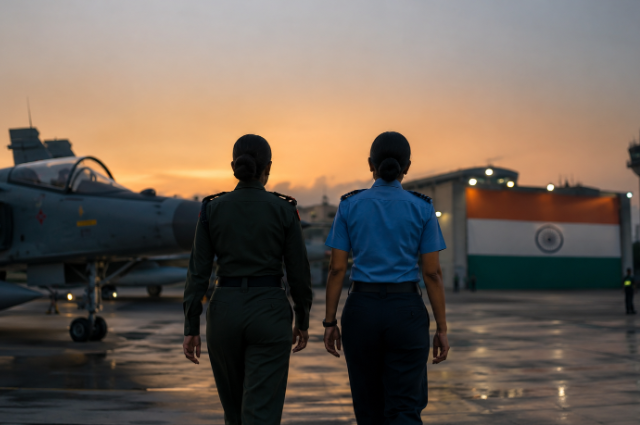
The history of modern Indian defence will likely remember May 7, 2025, not just for the missiles that crossed the Line of Control, but for the faces that appeared on television screens across the globe to explain why.
Operation Sindoor was the culmination of two weeks of intense national mourning and strategic calculation, following the brutal April 22 massacre in Pahalgam. In that tragedy, 26 tourists, mostly newlyweds, were systematically executed in the Baisaran Valley, an event that local media described as the deadliest civilian attack since 2008.
The response, when it came, was a 23-minute surgical blitz using precision-guided munitions like the HAMMER and SCALP missiles, striking nine designated terror hubs. However, the true force multiplier of the operation was the unprecedented briefing led by Colonel Sofiya Qureshi of the Indian Army and Wing Commander Vyomika Singh of the Indian Air Force.
Their appearance marked the first time in Indian military history that two women officers served as the primary voices for a high-stakes combat mission, signalling a paradigm shift in how India projects its power and its values.
Colonel Sofiya Qureshi, a third-generation officer from the Army Signal Corps, brought to the podium a legacy of grit that spanned decades.
Born in 1974 in Vadodara, Qureshi had already spent a lifetime breaking glass ceilings long before Operation Sindoor. Whether it was her pivotal work developing mobile digital communication networks during Operation Parakram in 2002 or her time as a UN military observer in the Democratic Republic of Congo in 2006, her career was defined by technical excellence and humanitarian empathy. In 2016, she made global headlines as the first woman to lead an Indian Army contingent in a multinational military exercise, ASEAN-Plus FORCE-18.
When she addressed the nation regarding the destruction of launchpads in PoK, her voice carried the weight of an officer who had survived dangerous militia zones and earned the Chief of Army Staff Plaque of Honour. Her presence was a living rebuke to the sectarian ideology of the Pahalgam attackers, illustrating that the Indian Army’s strength is rooted in its diversity and its rigid adherence to merit.
Beside her stood Wing Commander Vyomika Singh, whose name literally translates to "daughter of the sky."
Unlike Qureshi, Singh was the first in her family to join the armed forces, rising from a middle-class household in Lucknow through the National Cadet Corps. Her career in the IAF’s Flying
Branch is a testament to the long-fought battle for women's permanence in combat-related roles.
Having logged over 2,500 flying hours in high-altitude terrains like the Siachen Glacier and the snow peaks of Arunachal Pradesh, Singh represented the tip of the spear. She was among the cohort granted a permanent commission in 2019, a reform that finally allowed officers of her calibre to reach the senior leadership roles they had earned through blood and flight hours. During the briefing, she dismantled claims of civilian collateral damage with surgical clarity, providing telemetry and footage that proved the IAF had hit only terror infrastructure. Her transition from an NCC cadet to the face of a national strike became a viral sensation, particularly on social media, where she gained over 150,000 followers overnight, becoming a symbol of aspiration for a new generation of Indian women.
The strategic landscape surrounding Operation Sindoor was equally complex. The 2025 crisis pushed the Indo-Pakistani relationship to its most precarious point in decades. Beyond the kinetic strikes, India engaged in a form of "total diplomacy" that saw the temporary suspension of the Indus Waters Treaty and the expulsion of diplomatic staff. The briefing by Qureshi and Singh was a critical component of this information warfare. By showcasing two women in command, India wasn't just reporting on a military success; it was contrasting its progressive, professional military culture against the regressive nature of the terror groups it sought to neutralise.
This humanised approach to military communication broke the standard AI-generated or corporate style government press releases, offering instead a narrative of lived experience and genuine resolve.
As of May 2026, the anniversary of Operation Sindoor serves as a reminder of that fragile balance between quiet and wild. The ceasefire negotiated on May 10, 2025, remains largely intact, but the cultural impact of that briefing persists. Qureshi and Singh did not just report on an operation; they authored a new chapter in the identity of the Indian soldier.
They proved that the glass ceiling in the armed forces wasn't just cracked, it was shattered by the very competence required to defend a nation in its darkest hours.
Their legacy is seen today in the rising enrollment of women in the National Defence Academy and the normalisation of women leading strategic briefings, ensuring that the faces of India’s resolve will always be as diverse and resilient as the people they protect.
References:
- https://pib.gov.in
- https://www.ndtv.com
- https://www.thehindu.com
- https://en.wikipedia.org
- https://timesofindia.indiatimes.com
- https://www.ptcnews.tv
- https://vajiramandravi.com