
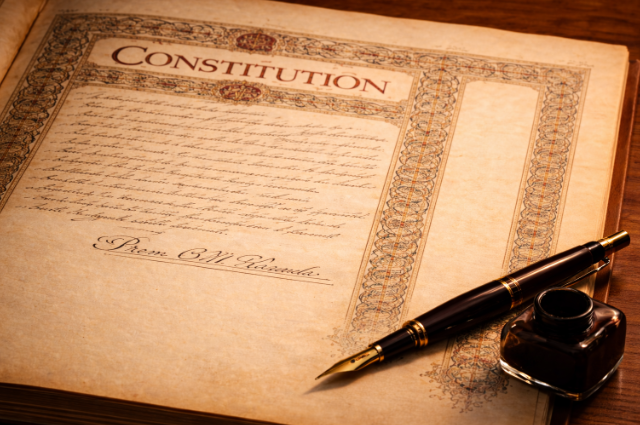
When the constitution came into force on 26 January 1950, it marked the moment when the world’s largest democracy officially adopted a written constitution. That sacred document became the supreme law of the land, guiding rights, duties, powers, freedom, structure, and values of the newly independent nation. But beyond the legal finery and philosophical depth, there’s a fascinating story woven into the very pages of the Constitution itself: the story of the one man permitted to sign every page of this historic text.
The Indian Constitution is more than a legal document. It is a symbol, a bridge between colonial rule and self- rule. It was drafted by the Constituent Assembly over a period of almost three years, from December 1946 to November 1949.
The task was monumental: to draft a living document capable of uniting hundreds of millions of people from different languages, religions, cultures, and traditions under one democratic framework.
As the drafting concluded, the need arose for a formal final copy, one that wasn’t just printed but artfully handwritten so it could be preserved, displayed, and honoured as a treasured national artefact. The person chosen for this once in a nation’s history task was Prem Bihari Narain Raizada, an exceptionally skilled calligrapher based in New Delhi.
Calligraphy is the art of beautiful handwriting, not mere penmanship, but writing that feels alive on the page. Raizada’s reputation as a master of flowing italic script made him the ideal choice for this sacred task.
Between 4 December 1949 and 24 January 1950, Raizada worked day and night, writing out the entire Constitution by hand, all 395 articles, the Preamble, schedules, and annexures, in an elegant, uniform style.
The original handwritten version of the Constitution has 395 articles, 22 parts, and 8 schedules, amounting to about 145,000 words.
In today’s world, a digital or printed document is taken for granted. But in 1950, a handwritten copy carried dignity, artistic value, and permanence.
The Constituent Assembly wanted a version that matched the gravity of India’s momentous achievement. The Constitution was not just a law; it was art, identity, and destiny, carefully penned onto fine papers bound in rich covers.
Here is where the story gets remarkable: Most official documents carry one or a few signatures, usually at the end. But in the case of the Indian Constitution’s original manuscript, Prem Bihari Narain Raizada was given explicit permission to sign his name on every single page.
So when you look at the original Constitution today, each page bears his signature in graceful ink: “Prem B. N. Raizada”, a humble mark that silently declares his contribution to Indian democracy. This wasn’t a vanity gesture. It was a token of respect and affection from the leaders of the day. It acknowledged that his labour of art was woven into the very soul of the nation’s founding document.
Perhaps the most touching detail about Raizada’s role is that he refused any payment for his work. Calligraphy is skilled labour; this kind of project would normally have brought a significant commission. But when offered remuneration, he said he wanted no pay. He only wished to sign each page.
That choice reveals something deeper: it shows how people of that era invested not just time and talent, but personal pride and patriotism into the birth of a new nation. Raizada became part of history not for money, but for honour, knowing that his pen would be remembered as long as the Constitution itself.
Despite his essential role, Raizada’s name is not as widely known as the political architects of the Constitution, like Dr B. R. Ambedkar or Jawaharlal Nehru. But among historians and Scholars cherish, his contribution is cherished.
His work continues to inspire people who see the Constitution as not only a legal text but a work of art. Modern exhibitions of the original handwritten Constitution always draw attention to his script, especially his signatures that appear like a heartbeat across each page.
Raizada’s story teaches a simple truth: history isn’t made only by leaders and lawmakers. It’s also shaped by people whose work happens behind the scenes, whose hands, hearts, and skills make great things visible.
The Indian Constitution stands tall as a framework of democratic ideals, rights, and justice. But it also carries the signature of an artist, a man who wrote each word with care and left his mark on every page without asking for anything in return.
This blend of legal brilliance with artistic expression reminds us that creativity always lives in the margins of history and that even great nations are built by people who love their craft.
. . .
References:
- National Portal of India (Govt. of India) – Constitution History https://www.india.gov.in
- Interesting details on Prem B. N. Raizada https://journals.sagepub.com
- Articles noting Raizada’s work and signature on each page https://timesofindia.indiatimes.com
- https://www.thehindu.com
- India Today Historical Feature on Indian Constitution https://www.indiatoday.in
- National Archives of India — Exhibits on Constitution https://nationalarchives.nic