
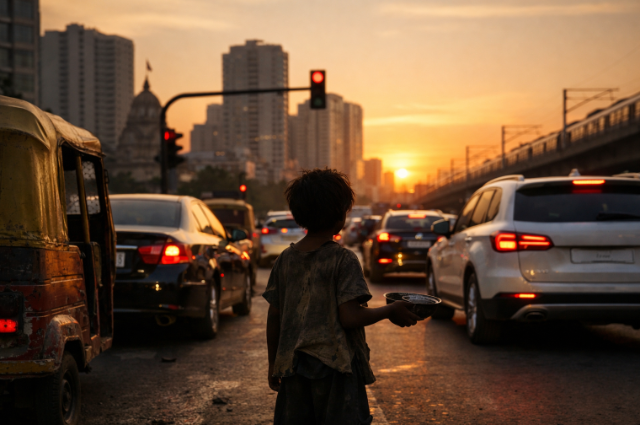
Begging in India is a reality that sits in public spaces every day, yet most people do not stop to understand it deeply. At traffic signals outside temples near railway stations and markets, people stretch out their hands asking for money. Some faces show hunger and helplessness, while others seem oddly confident and persistent. This creates a confusing picture. Are all beggars poor and forced into this life, or are some choosing it because it brings easy money? The truth lies somewhere in between. Begging in India has two very different sides. One side is systemic exclusion, where people are pushed into begging because society fails them. The other side is professional greed, where begging becomes an organised activity or even a profitable choice.
India still struggles with poverty, unemployment, lack of education and unequal access to opportunities. For many people, begging is not a choice but a last option for survival. Elderly people without family support, disabled individuals who cannot find work, migrants who arrive in cities with no resources and people suffering from mental illness often end up on the streets. Without identity documents, shelter or skills, they cannot easily enter the formal job market. Social welfare systems exist, but they do not always reach those who need them the most. In such situations, begging becomes a survival strategy rather than a profession.
Children who beg are often victims of even deeper systemic problems. Many come from families trapped in generational poverty. Some are forced by parents who themselves have no income source. Others are trafficked or controlled by criminal networks. These children lose access to education and childhood itself. When society sees them only as beggars it ignores the structural failure that created their situation. Poverty is rarely just about money. It is about lack of access to healthcare, education, housing and dignity. Begging becomes the visible symptom of invisible inequality.
At the same time, there is another side that people talk about often. Some individuals treat begging as a business. In busy urban areas, certain beggars earn more money in a day than low-wage workers. There are reports of organised begging rackets where groups control territories and use emotional manipulation to increase earnings. Fake injuries, rented babies or scripted stories are sometimes used to create sympathy. In such cases begging is no longer about survival but about exploiting public generosity. This is where the perception of rich beggars comes from. Stories of beggars owning property or saving large amounts of cash circulate widely and influence public opinion.
Human psychology plays an important role here. Giving money to a beggar creates an instant feeling of compassion and moral satisfaction. People feel they have done something good even if the impact is small. Organised networks understand this psychology and use it. Emotional triggers such as children women with infants, or visible disabilities increase donations. Over time, some individuals realise that begging can provide income without the effort required in low-paying jobs. This does not mean that most beggars are greedy, but it shows how incentives can shape behaviour.
The challenge for society is to recognise both realities at once. If all beggars are treated as criminals, then vulnerable people suffer even more. If all begging is seen as innocent, then exploitation and organised crime continue. Policy responses in India have often focused on criminalisation. Several states have laws that allow police to detain beggars and send them to rehabilitation centres. However, these approaches rarely address the root causes. Without long term support, education, job training, mental health care and housing people often return to the streets after release.
There are successful examples that show a better path. Nonprofit organisations and social enterprises have helped homeless individuals learn skills and find employment. Some cities have started shelter programs and food distribution systems. Direct benefit transfers and identity registration drives also help reduce extreme vulnerability. When people receive stable support, they are less likely to depend on begging. Rehabilitation works best when it respects dignity rather than treating people as a problem to remove from public view.
Public behaviour also matters. Giving money directly may help in the moment but it does not solve systemic issues. Supporting verified charities, volunteering time or advocating for inclusive policies can create deeper change. At the same time, empathy should never disappear. Behind every extended hand there is a story and often a history of hardship that cannot be seen in a few seconds at a traffic signal.
The idea of rich beggars attracts attention because it challenges our sense of fairness. People feel cheated when generosity is misused. Yet focusing only on rare cases of professional beggars risks ignoring millions who struggle daily for survival. The conversation should not be about whether beggars deserve help, but about why conditions exist where begging becomes necessary or profitable. Poverty and inequality are complex systems influenced by education, economic growth, social safety nets and cultural attitudes. Solving them requires coordinated effort from government, communities and individuals.
India is changing rapidly with urbanization technology, and economic development. These changes create opportunities but also new forms of exclusion. Migrant workers, automation, informal labour markets and rising living costs can push vulnerable groups toward the margins. Begging will continue to exist unless structural inequalities are addressed. At the same time, stronger law enforcement against trafficking and organised exploitation is necessary to prevent abuse.
The two sides of systemic exclusion and professional greed are not opposites but interconnected realities. When society leaves gaps opportunistic systems grow inside those gaps. Understanding this duality helps create balanced solutions that combine compassion with accountability. A nation is often judged by how it treats its most vulnerable citizens. Looking at begging through a humane and informed lens is not just about charity. It is about justice, dignity, and the kind of society people want to build.
References
- https://www.censusindia.gov.in
- https://www.niti.gov.in
- https://www.unicef.org
- https://www.oxfamindia.org
- https://www.thehindu.com
- https://www.hindustantimes.com
- https://www.ilo.org