
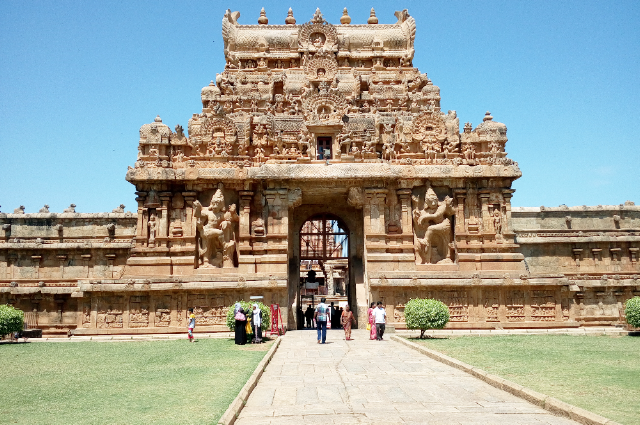
The Brihadeeswara Temple in Thanjavur isn’t just a place of worship. It is a thousand-year-old masterpiece of engineering made of solid granite. Built by the emperor Raja Raja Chola I and completed in 1010 AD, it stands as a massive reminder that ancient civilisations didn't need modern machines to achieve what we today might call "impossible."
When you look at it, you aren't just looking at religious art; you are looking at a structural feat that has lasted over a millennium.
One of the most impressive things about the temple is the material itself. The entire structure is made of granite. Now, while granite isn't as hard as a diamond, it is still incredibly tough to work with, especially for a civilisation that didn't have power tools. Ranking between 6 and 7 on the Mohs scale, it required specialised skill and immense effort to carve the fine, lace-like details seen across the temple walls.
What makes this even more significant is that Thanjavur is located in a delta region where granite isn't naturally found. While the exact location of the quarries is still debated by historians, it is generally accepted that the stone had to be transported from at least 50 to 60 kilometres away, likely from the areas toward Tiruchirappalli. Moving over 130,000 tons of this heavy stone across that distance involved a massive logistics chain of elephants and wooden rollers.
Then you have the "Vimana," the main temple tower. It stands 216 feet tall, and for centuries, it was one of the tallest structures in the world. The construction of this tower is a lesson in precision. Much of the temple relies on an interlocking stone technique, where the blocks are carved so accurately that they fit together like a giant 3D puzzle. While lime mortar was often used in Dravidian architecture during this era for finishing and certain joints, the structural integrity of the "Big Temple" largely depends on the perfect alignment and the massive weight of the stones themselves. This approach allows the building to be stable yet flexible, which is why it has survived over ten centuries of environmental stress and natural wear.
At the very top of the tower sits the "Kumbam", a massive capstone carved from a single block of granite that weighs approximately 80 tons. How the Cholas lifted this weight to a height of over 200 feet remains a subject of study. The most widely accepted theory is that the engineers built a massive earthen ramp, stretching several kilometres, to create a gradual slope. This allowed labour teams and animals to slowly haul the capstone to the summit, a method common in monumental ancient architecture.
The foundation of the temple is just as clever. Most buildings this heavy need deep foundations dug into the earth, but the Brihadeeswara Temple uses a "sandbox" or cushion-type foundation. By filling a rigid boundary with a dense sand mixture, the Cholas created a base that could absorb vibrations and support the immense weight of the granite tower without it sinking into the delta soil. It’s a "gravity structure" that uses its own weight to stay anchored and upright.
There is also a famous observation about the temple's geometry. The tower is designed so precisely that its shadow appears minimal or stays largely within its own base at noon during certain times of the year. It’s not a "magical" shadowless building, but rather a testament to incredible mathematical and solar orientation.
Inside the courtyard, a massive statue of Nandi, the sacred bull, stands guard. Carved from a single stone and weighing about 20 tons, it is one of the largest monolithic Nandi statues in India. While local stories sometimes say the stone "grows," scientists believe this is due to the natural mineral composition of the rock, though the massive scale was a very deliberate choice by the royal architects.
Walking through the temple today, you realise it was built to be a permanent statement of power. The Brihadeeswara Temple is a document of the Chola Empire's mathematical and administrative power. The Cholas used mathematics and logistics that were far ahead of their time. Every dimension of the temple follows a strict ratio, and the walls are covered in inscriptions that detail the grants, gifts, and even the names of the dancers and accountants who worked there.
The Brihadeeswara Temple remains a "Living Chola Temple" today because its stones still hold the secrets of a civilisation that refused to let the impossible stand in their way.
. . .
References: