
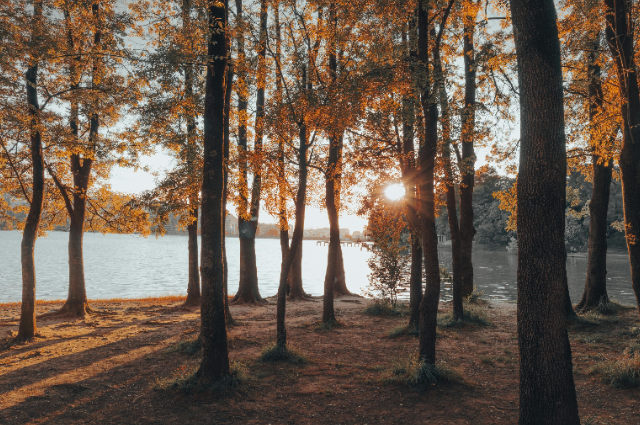
Chapter 1: The City Where Time Exhales
The bus groaned as it climbed the final hairpin bend into Nainital, its engine straining like a tired heart pushing against the weight of the mountains. Inside, Aarav leaned forward, his forehead resting against the cold glass of the window. Outside, the world blurred into a quiet wash of greys and fading gold—like a memory slowly losing its edges.
In Nainital, autumn is not just a season; it feels like a pause in the rhythm of existence. It is the moment when the world stops trying to become something else and simply begins to remember what it is. Leaves drifted from the trees in slow, spiralling motions—not falling, but surrendering. There was no resistance in them, no urgency. As they touched the earth, it felt as though they carried a silent message in the wind:
“We are not leaving… we are becoming.”
Aarav shifted slightly, his hand instinctively brushing against his jacket pocket. The letter.
It had been three years. Three years of carrying something so small, yet impossibly heavy. The edges of the envelope had softened with time, worn down by hesitation and distance. Even his name, once written clearly across its surface, had begun to fade—as if it no longer belonged to the person holding it.
He had never opened it.
Because opening it meant more than reading words.
It meant facing Meera.
Facing the silence he had left behind.
Facing the version of himself he had chosen to walk away from.
And he wasn’t sure there was enough space left inside him for all of that. The bus came to a halt with a quiet jolt.
Aarav stepped down.
The air hit him instantly—cold, clean, and alive with the scent of pine, damp earth, and distant woodsmoke. He took a deep breath, but instead of relief, there was only awareness.
Nainital didn’t welcome him with noise or movement.
It welcomed him with silence.
A still, reflective silence that felt less like absence—and more like a mirror. And in that silence, for the first time in a long time, Aarav could hear something clearly: his own heartbeat.
Chapter 2: The Architecture of Silence
The hotel room felt almost deliberately bare—wood, glass, and quiet restraint. Nothing unnecessary. Nothing distracting. Just space.
Through the wide window, Naini Lake stretched into the distance, its surface reflecting the fading light like beaten silver—dark, still, and impossible to read. It did not invite thought; it absorbed it.
Aarav sat on the edge of the bed.
The letter lay on the nightstand beside him.
Not just placed there—but present.
Like a silent witness.
Or perhaps… a judge waiting for him to speak.
He closed his eyes.
And the mountains disappeared.
Suddenly, he was back in Delhi.
Sunlight spilt through the kitchen window, warm and familiar. The sharp whistle of the pressure cooker cut through the air, followed by the soft, rhythmic clink of Meera’s bangles against a ceramic mug.
That sound—
It had once meant home.
“You’re leaving, aren’t you?”
Her voice had been calm. Too calm.
No anger. No accusation.
Just a quiet certainty that made the truth impossible to escape.
“Just for a while,” he had said.
Even then, he knew it wasn’t true.
Meera had looked at him—not at his face, but beyond it. As if she could already see the version of him that would exist after this moment. The one shaped by absence, regret, and time.
“Some things don’t come back, Aarav,” she had said softly.
“They don’t break… they just disappear.”
Aarav opened his eyes.
The room had changed.
Or perhaps the light had.
The silver lake had vanished into darkness. What remained was not water, but a vast, quiet void—deep and unknowable.
He stared at it for a long time.
And then, slowly, something settled inside him.
He hadn’t come to Nainital to find Meera.
That had been the illusion.
The truth was harder.
He had come looking for himself—
for the man who had survived her absence.
But sitting there, in that cold and silent room, Aarav realised something unsettling: he didn’t see that man anymore.
And worse—
He wasn’t sure he liked him.
Chapter 3: The Anatomy of a Ghost
The morning did not arrive—it seeped in.
The sun hung behind the fog like a fading memory, a pale disc that offered light but no warmth. From the balcony, Aarav watched the mist slowly claim the lake, swallowing its edges until water and sky became indistinguishable.
In Delhi, fog had always felt suffocating—thick with smoke, impatience, and noise. But here, it moved differently. It wasn’t intrusive. It was intentional. Almost protective. As if the mountains had wrapped themselves in silence to keep the world at a distance.
Aarav slipped his hand into his pocket and pulled out the letter.
He didn’t open it.
He didn’t even look at it.
He just held it.
The envelope had softened over time, its edges worn smooth by years of hesitation. It no longer felt like something new or urgent—it felt familiar. Too familiar. Like a presence he had learned to live with.
It was his in-between.
Not closure.
No connection.
Just a quiet, suspended existence.
A space where Meera was neither gone… nor truly there.
He remembered the day it had arrived.
A Tuesday.
Ordinary. Forgettable.
Almost cruel in its normalcy.
He had placed the envelope on the dining table and stared at it for hours. Four hours of silence, of pacing, of almost reaching for it—and pulling back.
Because he knew.
The moment he opened it, something would end.
The version of Meera he carried—the one who still smiled, still waited, still belonged to possibility—would be replaced by something final.
And Aarav, for all his courage in leaving, had always been afraid of endings. He preferred uncertainty.
A haunting over a goodbye.
He left the hotel without thinking.
The streets of Nainital rose sharply, forcing his body to engage with gravity in a way his mind had avoided for years. Each step upward demanded effort. Each breath in the thin air reminded him—he was still here.
Still moving.
Even if a part of him had long refused to.
He followed the winding path until it opened to the lake.
The water lay still, framed by a row of weeping willows. Their branches dipped low, brushing the surface like hesitant fingers—testing something they weren’t sure they wanted to feel.
And there—
on a weathered stone bench—
sat a woman.
Wrapped in a soft, pale shawl, she was completely still.
Not waiting.
Not restless.
Just… present.
For a brief moment, Aarav thought she might not be real.
Like something placed there deliberately—
a part of the landscape.
He slowed, intending to walk past.
But as he came level with her, she spoke.
Her voice was quiet—yet it carried, deep and resonant, like a sound that didn’t need volume to be heard.
“The lake doesn’t like being watched with questions you already know the answers to.” Aarav stopped.
The crunch of gravel beneath his shoes sounded louder than it should have. He didn’t turn immediately.
“I didn’t realise the lake had opinions,” he said.
“It does,” she replied calmly. “Everything here does.”
Now he turned.
Her face held a quiet depth—not aged, but experienced. Her eyes were steady, unhurried. There was no flicker in them, no restless searching.
Nothing like his own.
“You’ve been walking for twenty minutes,” she continued, meeting his gaze. “But you haven’t moved at all.”
Aarav frowned. “You don’t know where I started.”
She glanced briefly at his jacket pocket.
“I don’t need to,” she said.
He felt it instantly—the shift in his posture, the subtle pull of the letter.
“It’s weighing you down,” she added. “Your left shoulder drops. Your steps don’t land evenly.” A pause.
“You’re not walking,” she said softly.
“You’re carrying something that hasn’t let you move forward.”
Something in him tightened.
“I’m just a tourist,” he replied, sharper than intended.
She smiled faintly.
“Tourists look at the view,” she said.
“You’re looking for somewhere to leave something behind.”
Silence.
Then she shifted slightly, making space beside her.
“My name is Naina,” she said.
A beat.
“And if you’re going to stand there like a ghost,” she added,
“You might as well sit down.”
Chapter 4: The Dialogue of the Falling Leaf
Aarav sat beside her—but not too close.
There was space between them.
Not awkward. Not forced.
Just… dense.
Like the kind of silence that gathers before something breaks.
For a while, neither of them spoke. The lake remained still, the mist hovering just above its surface like a thought that hadn’t fully formed.
“Why Nainital?” Naina asked at last, her voice soft but precise.
“People usually come here to celebrate something. A honeymoon. A promotion. A reunion.” She glanced at him briefly.
“You look like you came here to disappear.”
Aarav let out a quiet breath.
“Maybe I did,” he said.
The honesty surprised him.
“There’s something… easier about being a stranger. In a place where no one knows you, you don’t have to pretend. You don’t have to be the version of yourself people are waiting for.”
Naina tilted her head slightly.
“And who is that?”
Aarav let out a hollow laugh.
“Someone who has ‘moved on.’”
The words tasted bitter.
“Everyone seems to have a timeline for grief. A few months of sympathy… maybe a year of patience. And then it’s over. They start expecting you to be normal again.”
He looked at the lake, his jaw tightening.
“They want closure. As if it’s something you can just decide to have.”
He shook his head slowly.
“But closure…” he said, almost to himself,
“Closure is a lie.”
Naina bent down and picked up a fallen leaf. It was deep red, almost bruised—its veins fragile, its edges curling inward.
“Look at this,” she said, holding it out.
Aarav glanced at it.
“It’s dead,” he said flatly. “It fell.”
Naina shook her head gently.
“It didn’t just fall.”
She turned the leaf slightly, studying it as if it held a story.
“The tree let it go. There’s a process—abscission. When winter approaches, the tree realises it can’t sustain everything. If it holds on, the weight of the snow will break its branches. So it releases the leaves… not because they’re useless, but because survival demands it.”
She looked at him now.
“Let's go live.”
Aarav said nothing.
She placed the leaf in his hand.
It was dry. Fragile. Almost weightless.
“You think holding on keeps something alive,” she continued quietly. “But sometimes… it’s what slowly destroys you.”
Her gaze dropped briefly to his jacket pocket.
“You’re not preserving a memory, Aarav,” she said.
“You’re carrying something that has already ended.”
He tightened his grip on the leaf. It crumbled slightly under the pressure.
“If I open it…” he began, his voice faltering,
“Then it becomes real.”
His eyes stayed fixed ahead.
“Right now… it could still be anything. She could still love me. She could still…” He swallowed.
“If I open it and find out she doesn’t… or worse—that she doesn’t even remember—then what’s left?”
The question lingered in the air.
Naina stood slowly, adjusting the folds of her shawl. The mist had begun to thin, revealing the distant peaks of the mountains—sharp, silent, indifferent.
“You’re still there,” she said.
Aarav looked up at her.
“That’s what’s left.”
Her voice was steady now—grounded, certain.
“That’s where people get lost. They believe they are made of others. ‘I am a lover.’ ‘I am a partner.’ ‘I am someone’s person.’”
She paused.
“But those are roles. Not truths.”
Aarav’s voice dropped to a whisper.
“Then what am I?”
Naina held his gaze for a moment.
“Take everything away,” she said.
“The past. The relationships. The names. The expectations.”
A pause.
“What remains?”
Aarav opened his mouth—
But nothing came out.
“I… don’t know.”
Naina smiled—not with amusement, but with quiet approval.
“That,” she said softly,
“is the first honest answer.”
The wind shifted slightly. A few more leaves broke free from the branches above and drifted down toward the water.
“Most people spend their entire lives running from that,” she continued. “They fill the silence with noise. The emptiness with distractions. The heart with unfinished stories.”
She turned away from him.
“But here…” she said, glancing at the mountains,
“you don’t get to escape it.”
She began to walk.
“Wait,” Aarav called out, rising halfway from the bench.
“Where are you going?”
“To watch the sunset,” she replied, without turning.
A faint smile touched her voice.
“The sun doesn’t ask for permission to leave, Aarav. It just disappears—knowing it will return, somewhere else, in another form.”
She paused briefly.
“Try that,” she added.
“For just an hour.”
A beat.
“Don’t be who you think you are.”
Then, softer—almost fading into the air—
“Just be.”
And she was gone.
Aarav sat there long after she disappeared into the mist.
He opened his palm.
The leaf had broken into fragile pieces.
For the first time in three years…
his mind wasn’t fixed on the words inside the letter.
It drifted somewhere quieter.
Somewhere deeper.
To the space between words.
To the silence after something ends.
He looked at the trees.
Bare branches. Still. Waiting.
Not empty.
Just… preparing.
He stood slowly.
And as he did, he noticed something strange—
his shoulder felt lighter.
Not free.
Not healed.
But… aware.
He wasn’t ready to open the letter.
Not yet.
But for the first time—
he wasn’t pretending it didn’t exist.
And somehow,
That was enough.
Chapter 5: The Threshold of the Unspoken
By the third night, the cold had changed.
It was no longer something that brushed against the skin—it seeped inward, settling deep in the bones, as if the mountain air carried a quiet insistence: feel everything you’ve been avoiding.
Aarav sat in the dark.
He hadn’t turned on the lights.
Across the lake, distant streetlamps flickered weakly, their reflections trembling on the water. The faint glow slipped through the window, stretching long, skeletal shadows across the wooden floor—bars of light and darkness, like something unspoken trying to take shape.
The letter rested on the table.
Still.
Silent.
But not lifeless.
To anyone else, it would have been insignificant—just paper, ink, a forgotten message. To Aarav, it was something else entirely.
It felt… alive.
As if it carried its own pulse.
As if it was waiting.
Listening.
The longer he avoided it, the louder it became—not in sound, but in presence. It filled the room without moving. It occupied the space between his thoughts.
He stood up abruptly.
And began to pace.
Back and forth.
From wall to window. Window to door.
A familiar pattern.
This was how he had survived for three years—by staying in motion. By never letting stillness catch up to him.
He thought of Delhi.
The constant noise. The endless rush. The safety of distraction. Calls, deadlines, notifications—each one a convenient shield against something deeper.
He had mistaken movement for progress.
Noise for life.
But here—
The mountains stripped everything away.
There was nowhere to hide.
Silence wasn’t empty here.
It was revealing.
And it saw him clearly.
He stopped walking.
“What am I actually afraid of?”
The question slipped out softly, swallowed almost immediately by the room. But it lingered.
If the letter held forgiveness…
then he would have to face the truth that he had walked away from something rare. Something real.
If it held anger…
then he would have to accept himself as the one who broke it.
But neither of those possibilities unsettled him as much as the third. He swallowed.
What if it meant nothing?
What if it was just… closure?
A quiet ending. A simple goodbye.
No drama. No emotion.
No trace of what they had been.
That thought landed heavily.
Because indifference—
was far more final than pain.
He leaned against the table, his fingers brushing against the cold wood. A memory surfaced.
A line from a book he had once read, long before life had become complicated: “We are not punished for our sins, but by them.”
He closed his eyes.
His mistake hadn’t been leaving.
It had been everything that followed.
The three years of half-living.
Of staying suspended between past and present.
Of refusing to fully feel anything—just in case it reminded him of what he had lost. He hadn’t been holding onto Meera.
He had been holding onto the version of himself that existed with her. And in doing so—
he had slowly disappeared from his own life.
He pulled out the chair and sat down.
The letter was in front of him now.
Closer than ever.
He reached for a pen from the table—almost instinctively.
Maybe he could write something first.
A thought. A confession. A beginning.
He placed the pen against the paper.
Waited.
Nothing came.
The silence returned.
Deeper this time.
He exhaled slowly.
It wasn’t writer’s block.
It was something else.
A quiet understanding.
There were no new words left.
Not until he faced the old ones.
His gaze drifted to the envelope.
The stamp.
The faint postal mark.
A date from three years ago.
A moment frozen in time.
A version of the world that no longer existed.
And yet—
here it was.
Still waiting.
Unchanged.
While everything else had moved on.
At some point, exhaustion took over.
He leaned back in the chair, his head falling against the wood behind him. Sleep came unevenly.
Restless.
Fragmented.
And with it—
a dream.
He was standing by a lake.
But this one was different.
There was no surface.
No reflection.
Just depth.
Endless.
Dark.
Floating across it—
letters.
Dozens of them.
Hundreds.
White envelopes drifting like fragile lotus petals. He reached out.
One came close.
Then slipped away.
Another.
And another.
Always just beyond his grasp.
He woke with a sharp breath.
The room was still dark.
The letter is still there.
Unopened.
Unmoved.
But something inside him had shifted. Not enough to act.
Not yet.
But enough to know—
He was standing at the edge.
And there was no turning back.
Here is your cinematic, emotionally powerful rewrite of Chapter 6, refined for a global, bestselling novel tone with heightened drama, clarity, and emotional payoff:
Chapter 6: The Unveiling of the Sun
Morning arrived without hesitation.
The fog had disappeared overnight—as if it had never existed. The sky stretched wide and open, a deep, piercing blue that felt almost too honest. The air was still, carrying with it the faint, rhythmic echo of a temple bell somewhere across the valley.
For the first time since arriving, Aarav did not go to the lake.
He didn’t need it anymore.
The silence he had been avoiding was no longer outside him.
It was within.
He walked to the small garden behind the hotel.
It was empty.
Still.
At its center stood a lone maple tree, its branches holding onto a few stubborn leaves—golden, fragile, trembling in the quiet air.
Aarav sat on an iron chair beneath it.
Cold metal pressed through his clothes, grounding him.
The letter rested in his hands.
This time, there was no hesitation.
No pacing. No retreat.
Just a quiet, undeniable readiness.
His fingers slid beneath the flap.
And slowly—
He opened it.
The sound of paper tearing cut through the stillness.
Sharp. Final.
Like something long sealed… finally releasing its breath. Inside were two pages.
The handwriting was instantly familiar—slanted, hurried, alive. Meera.
Not a memory.
Not a ghost.
But her.
Present. Immediate. Unavoidable.
Aarav,
By the time you read this—if you ever do—the season will have changed.
I am not writing this to ask you to come back.
I am writing because I want you to arrive.
Aarav’s breath caught.
You had already left long before you walked away.
I would sit across from you, watching you drift somewhere I couldn’t follow.
You were always looking at the horizon.
And I was always looking at you.
His grip tightened on the paper.
I realized something after you left.
Love is not about holding someone in place.
It is about letting them go where they are already meant to be. So I let you go.
Aarav closed his eyes briefly.
The words didn’t hurt the way he had imagined.
They didn’t accuse me.
They revealed.
I’m not writing to say I miss you.
Missing is a kind of hunger… and I am learning to be full on my own. The wind shifted gently around him.
A single leaf loosened above.
The pain wasn’t because you were gone.
The pain was because I kept trying to hold onto something that had already ended. We were holding onto a version of “us” that no longer existed.
Aarav exhaled slowly.
Something inside him loosened.
We are like seasons, Aarav.
We have our autumn.
And we must have our winter.
But you…
you were so afraid of the cold…
that you never saw the beauty of the frost.
His eyes blurred slightly.
But still—
no tears fell.
Don’t look for me in the places we used to go.
I’m not there.
I’m here.
At this moment.
Breathing.
The words seemed to dissolve into the air around him. And you are there.
Breathing too.
A long pause.
We are not connected by what we were.
We are connected by what is.
Aarav felt his heartbeat slow.
Settle.
Expand.
Be brave enough to be alone.
Only the one who is truly alone…
can belong to everything.
The final line:
With a peace you haven’t found yet,
Meera
Silence returned.
But it was no longer heavy.
It was open.
Aarav lowered the letter slowly.
He waited.
For something to break.
For grief to rise.
For regret to crash into him like a wave. But it didn’t.
What came instead—
was light.
Strange. Quiet. Expansive.
Not the absence of pain—
but the absence of resistance.
He looked up.
The maple tree swayed gently.
A gust of wind passed through the garden. Three leaves broke free.
They didn’t fall.
They moved.
Spiraling. Turning. Surrendering.
Before settling softly into the grass. “She understood before I did,” he whispered. And for the first time—
He meant it without regret.
He looked at his hands.
At the letter.
At himself.
And suddenly, it became clear—
everything he thought he was…
was temporary.
His name.
His past.
His grief.
Even his love.
They were like leaves.
Beautiful.
Necessary.
But not permanent.
What remained—
was something quieter.
Stronger.
Unmoving.
The tree.
The witness.
The presence beneath everything.
Aarav stood.
I walked to the edge of the garden.
Below him, the valley stretched endlessly—open, alive, untouched. For three years, he had been a man defined by something unopened. Something unfinished.
Now—
he was simply…
here.
A shift happened.
Subtle.
Yet complete.
The distance between things dissolved. The letter.
The wind.
Meera.
The lake.
His breath.
All of it—
felt connected.
Not separate.
Not divided.
Just… expressions of the same unfolding moment.
He hadn’t lost Meera.
He had released her.
From memory.
From expectation.
From himself.
And in doing so—
he had freed something deeper.
A movement caught his eye.
Naina stood near the garden gate.
Still.
Watching.
She didn’t ask anything.
Her gaze fell briefly to the open letter in his hand. Then back to his face.
She already knew.
“The sun feels different now, doesn’t it?” she said softly. Aarav looked up.
The light was no longer harsh.
No longer distant.
It simply… was.
“It doesn’t feel like an ending anymore,” he said. A faint smile touched his lips.
“It just feels like light.”
Naina nodded.
Satisfied.
“Good,” she said, turning toward the path. “Now your journey can begin.”
A pause.
Then—
almost as an afterthought—
“The bus leaves at noon.”
She glanced back once.
“But you…”
a quiet smile,
“you’ve already arrived.”
Chapter 7: The Dissolution of the Mirror
After reading the letter, Aarav didn’t return to his room.
The idea of walls—of corners, ceilings, limits—felt unbearable. Something within him had opened, widened, stretched beyond containment. To step back inside would have been to shrink again.
So he walked.
Upward.
Away from the lake. Away from the familiar paths where footsteps echoed with memory. The higher he climbed, the quieter the world became, until even the faint hum of human presence dissolved into the hush of ancient deodar trees.
Here, the mountains didn’t speak.
They simply were.
And for the first time, Aarav felt the same.
Something had changed in the way he saw.
It wasn’t the landscape—it was the lens.
For three years, he had lived inside a single narrative: loss.
Every beautiful moment had been incomplete. Every silence felt like an absence. He hadn’t been seeing the world as it was—he had been measuring it against what was missing.
But now—
standing beneath an open sky, watching a hawk glide effortlessly through rising currents of air—
He realised something unsettling:
he had never truly been present.
He had been collecting experiences.
Comparing them.
Consuming them.
But not living them.
He reached a ridge that overlooked the entire valley.
Below, the lake shimmered like liquid metal—still, reflective, infinite in its quiet depth. The wind moved differently here—clean, uninterrupted.
He sat down on the cold earth, not caring about the dampness seeping through his clothes. “Be brave enough to be alone.”
The words echoed within him—not as memory, but as instruction.
He closed his eyes.
And began to let go.
Not physically—
but inwardly.
I am Aarav.
The thought surfaced first.
But what did it mean?
A name.
Given.
Borrowed.
Something he had learned to respond to.
I am an accountant.
A role.
A function.
A set of actions repeated until they formed an identity.
I am someone who was left behind.
A story.
A narrative shaped by pain.
One he had carried, repeated, believed.
He watched each thought as it arose.
And then—
he let it fall away.
Layer by layer.
Identity by identity.
Definition by definition.
Until there was nothing left to hold onto.
At first—
It was terrifying.
A vast, empty silence opened beneath him.
A place with no labels.
No anchors.
No certainty.
In the past, this was where he would have turned away.
Reached for distraction.
Filled the space with noise—music, conversations, anything to escape the weight of nothingness.
But today—
he stayed.
He let himself fall into it.
Not physically.
But inwardly.
And slowly—
The fear dissolved.
The silence changed.
It was no longer empty.
It was… full.
Alive.
Expansive.
He could hear things he had never noticed before.
The subtle whisper of wind threading through branches. The distant echo of movement in the valley below.
Even the rhythm of his own breath—steady, unforced. But it wasn’t just hearing.
It was awareness.
There was no longer a boundary between him and what he observed. No separation.
No distance.
There was no “Aarav” sitting on a mountain.
There was only—
this.
The wind.
The trees.
The sky stretches endlessly above.
And a quiet awareness holding it all.
This was what Naina had meant.
Not as an idea.
Not as philosophy.
But as an experience.
The mirror had dissolved.
There was no longer a reflection staring back at him— no fragmented self trying to make sense of itself. instead—
everything reflected everything.
The mountain in him.
Him in the sky.
The same presence moving through all of it.
A realisation surfaced—not as a thought, but as a knowing: Nothing had been lost.
Because nothing had ever been separate.
Meera had not “left.”
Because there was no fixed place for her to leave from. No solid “him” to be abandoned.
They had been moments.
Movements.
Two expressions of the same unfolding life.
Like waves rising and falling in the same vast ocean. Aarav opened his eyes.
But even that felt different.
Because now—
there was no longer a “him” looking out.
There was only seeing.
The valley remained.
The lake shimmered.
The hawk circled again, untouched by meaning.
And in that moment—
nothing needed to be understood.
Nothing needed to be held.
Nothing needed to be changed.
Everything is simple…
was.
Chapter 8: The Alchemist of Grief
By the time Aarav made his way back down into town, dusk had begun stitching soft amber lights into the fabric of Nainital. Street vendors were busy—oil crackled in iron kadhais, pakoras sizzled, and the smoky sweetness of roasted corn drifted lazily through the cool air. Once, these simple pleasures would have cut through him like quiet reminders of everything he had lost. But tonight, he breathed them in without resistance, as if tasting life for the first time rather than measuring it against absence.
Near the old public library, he spotted Naina. She stood beneath a flickering streetlamp, her silver hair glowing faintly, her attention fixed on a group of children chasing one another in a chaotic game of tag. Their laughter rang out—pure, unburdened, untouched by memory.
“You look… empty,” she said as he approached, her voice carrying a quiet satisfaction.
Aarav smiled faintly as he sat beside her. “I think I finally put some things down. Leave them somewhere the wind could take them.”
“The wind knows what to do with what we cannot carry,” she replied, turning to study his face. “And the letter?”
He exhaled slowly. “It wasn’t an ending. Not at all. It felt more like… an opening. Like she wasn’t closing a door, but asking me to step through one.”
Naina nodded, as though this confirmed something she had always known. “People mistake endings for finality. But most endings are just dissolutions. Like a river reaching the sea—it loses its name, yes, but becomes something far greater.”
Aarav looked out toward the lake, now reflecting the first scattered stars. “I spent years trying to stop that river. I thought if I held on tightly enough, I could keep things as they were. But all I did was trap the water… let it turn still.”
They fell into a gentle silence. Nearby, one of the children stumbled, scraping his knee. He cried out briefly, only to be pulled up by a friend. Within seconds, laughter replaced tears, and the game resumed as if nothing had happened.
Naina gestured toward them. “That’s the secret, you know. They don’t carry yesterday into today. They fall, they feel, and then they move. No stories. No identities built around pain.”
Aarav watched them, something soft unfolding in his chest. “And we spend years building those stories… wearing them like armor.”
“That’s where the real transformation lies,” Naina said. “Turning memory into awareness. Letting pain refine you instead of define you. That's alchemy—not escaping grief, but changing its nature.”
He turned to her. “And you? You make it sound so simple. How do you stay like this?”
She laughed quietly, a sound both light and weathered. “I don’t. Not always. I forget. I get caught in my thoughts, just like anyone else. But I’ve learned not to trust every voice in my head. When the mind says, ‘You are alone,’ I don’t argue. I just observed it. Like watching a cloud drift across the sky. It comes… and then it goes.”
Aarav followed her gaze to the lake. For the first time, he felt gratitude—not just for this moment, or for her presence, or even for Meera’s letter—but for the long, aching years that had led him here. The pain hadn’t been his enemy. It had been a quiet guide, leading him, step by step, toward this stillness.
“I leave tomorrow,” he said after a while.
“I know,” Naina replied softly. “The mountains don’t hold people. They simply return them to themselves.”
He hesitated. “Will I ever see you again?”
She looked out over the water, where the reflections of stars trembled gently. “You won’t need to. Once you’ve shared silence with someone, they don’t really leave. They become part of how you see the world.”
Aarav stood, then reached out and gently held her hand. It was warm, grounded—like something ancient and enduring.
“Thank you,” he said quietly.
“For what?”
“For showing me how to let go.”
She smiled faintly. “I didn’t. Life did. I just pointed at it.”
As he walked back toward his hotel, the night felt different—not heavier, but deeper. The letter was still in his pocket, but it no longer carried the weight of a ghost.
It felt like something else now.
Something alive.
Like a beginning waiting patiently beneath the surface.
Like a seed.
Chapter 9: The Altar of the Earth
The morning of his departure arrived gently, almost ceremonially—without the heaviness of an ending, without the urgency of leaving. Aarav folded his clothes into his small bag with quiet precision, but there was no sense of carrying anything away. The past, once jagged and piercing, had softened. What had once cut through him like broken glass now rested within him like smooth, rounded stones—shaped by time, worn down by silence.
He made his way to the lake one final time.
The water was impossibly clear, catching the early sunlight in shades of pale turquoise and gold, like a living mirror that no longer demanded reflection. He walked toward the weeping willows, their slender branches dipping into the stillness, and found the same stone bench where everything had first begun to shift.
He sat.
For a moment, he simply breathed.
Then, slowly, he reached into his pocket and took out the letter.
It was no longer sealed. No longer mysterious. Its weight had changed. The unknown it once carried had dissolved into understanding, and the understanding itself had dissolved into something even quieter—acceptance.
He traced Meera’s handwriting with his eyes, not as someone clinging to memory, but as someone acknowledging a path that had already been walked. There was no longing left in him to preserve it, no fear of losing it. Some things, he now understood, are not meant to be kept—they are meant to be lived, and then released.
Holding the letter gently, he stood and walked toward a quiet patch of earth beneath an old cedar tree. The ground was damp, layered with fallen leaves that carried the scent of time and stillness. Kneeling down, he brushed them aside and pressed his hands into the cool soil, digging slowly, deliberately—feeling the earth rather than resisting it.
He placed the letter inside the hollow.
“Thank you,” he whispered, his voice barely louder than the wind moving through the trees. “For showing me the way.”
He covered it with soil, pressing it down with care—not to bury it in finality, but to return it. Then he picked up a flat, grey stone nearby and set it gently over the spot. Not as a marker of loss, but as a quiet acknowledgment of transformation. Not a grave—but an altar.
For a fleeting moment, he imagined the unseen—roots beneath the surface slowly reaching toward the paper, the ink dissolving into the soil, the words losing their form but not their essence. What Meera had written would no longer exist as sentences—but as nourishment, as something that would feed life in ways unseen and immeasurable.
He stood up, brushing the earth from his hands.
Something inside him had shifted completely.
He turned toward the path leading to the bus stand.
This time, he did not pause. He did not look back.
There was nothing left behind.
The lake was no longer a place—it was a presence within him.
The silence was no longer something he visited—it had become the rhythm of his breath. And for the first time in years, Aarav walked forward not as someone escaping the past— but as someone finally arriving into himself.
Chapter 10: The Geometry of the Circle
Ten years slipped by—so quietly that the mountains barely seemed to notice.
In the garden beside the lake, beneath the shelter of the old cedar tree, something unusual had taken root. It was not like the other plants that came and went with the seasons. Its leaves carried a faint silver lining along their veins, shimmering subtly in the light, as if holding onto a memory the rest of the forest had forgotten. Even in the harsh bite of winter, when most life retreated inward, this plant endured—silent, resilient.
The locals, as they always do, gave it a story.
Some said a traveller had buried a treasure there long ago. Others believed it was touched by something unseen—something sacred. But no one could say for certain. And perhaps that was the beauty of it.
One crisp October afternoon, when the air carried the scent of drying leaves and distant smoke, a young boy wandered away from his parents and found himself drawn to the plant. He sat beside it, watching curiously as a single silver-veined leaf loosened itself and drifted downward, swaying gently before settling on the earth.
“Why do they fall?” the boy asked, turning to the old man seated on a nearby bench.
The man sat with an effortless stillness, as though he belonged to the landscape more than to time itself. His face bore the quiet signatures of years—lined, weathered—but there was no heaviness in him. Only a deep, unshakable calm.
He looked at the boy and smiled.
“They don’t really fall, beta,” he said softly. “They return.”
The boy frowned slightly, trying to understand. “Return where?”
“To where they began,” the old man replied. “The tree is only a resting place. The leaves are travellers. When their time here is complete, they go back to the earth—not as endings, but as stories.”
The boy picked up the fallen leaf, turning it between his fingers. “But… do they die?”
The old man shook his head gently. “Nothing truly dies. It only changes form. Today it is a leaf. Tomorrow, it becomes part of the soil. And one day, from that same soil, something new will grow. Life doesn’t move forward like a straight road—it moves in circles, like the sun rising and setting, again and again.”
The boy held the leaf up toward the light. Its delicate veins shimmered—a quiet map of a journey complete. After a moment, he tossed it into the air, laughing as it disappeared into the soft, golden haze of the afternoon.
Not far away, a woman wrapped in a white shawl passed by. She paused for just a second, her eyes meeting the old man’s. No words were exchanged. None were needed. There was an understanding between them that lived beyond language—a shared stillness, a silent recognition.
The old man closed his eyes and took a slow breath.
The scent of pine drifted through him, mingling with woodsmoke… and something else. Something faint. Almost forgotten. The soft, lingering trace of paper and ink—like a memory that had dissolved into the earth but never truly vanished.
He no longer thought of himself as Aarav.
Not as a name. Not as a profession. Not as a man defined by loss or story. Those identities had been like leaves—necessary for a season, but never permanent. What remained was something simpler. Something vast.
He was the quiet breath moving through the mountains.
He was the ripple trembling across the lake.
He was the silence between moments.
And somewhere, deep beneath the cedar tree, the last letter of autumn had long since become part of the soil—its words no longer written, but lived.
Not carried.
Not remembered.
But finally understood.
And gently, completely—
released.