
The alarm on the side table did not ring. It hadn’t rung in over six years, ever since the June morning I surrendered my office keys and walked out of the department for the last time. Yet, at precisely 5:45 AM, my eyes opened to the dim, grey light filtering through the bedroom curtains.
My body knew the hour before my mind did.
I lay back against the pillow and listened to the predictable sequence of early morning sounds: the faint hum of the neighbour’s water pump, the distant whistle of the early commuter train, the familiar metallic rattle of the milk delivery on the road below. In the kitchen, the refrigerator cycled on with a low, vibrating hum.
Nothing was wrong. My pension arrived reliably on the first of every month. The joint pain in my left knee was no worse than it had been on Tuesday. The blood pressure medication sat neatly arranged in its blue plastic daily dispenser beside a clean glass of water. My daughter had texted from her city the night before to confirm she had landed safely after her business trip.
My life was peaceful, orderly, and entirely secure.
And yet, sitting up on the edge of the mattress to slide my feet into my slippers, a quiet, sharp thought settled into the room like a sudden draft: When did I stop expecting anything from tomorrow?
It happens so quietly that you rarely notice the moment the shift occurs.
In youth, tomorrow is a vast, unmapped territory. It arrives packed with ambition, unpredictable encounters, sudden turns of fortune, and the thrilling possibility that a single day might change the entire trajectory of your life. You wake up with an appetite for what lies ahead.
In later years, without your permission, tomorrow subtly transforms into a maintenance schedule.
It becomes a series of small, repetitive duties designed to keep the machinery running: two blue pills before breakfast, half an hour on the exercise pedal, thirty minutes with the morning newspaper to see how the world is deteriorating, a short walk to the local market for fresh coriander, a brief Sunday phone call to children who are perpetually rushing between meetings and parent-teacher conferences, and an evening spent checking health reports or reading articles on arterial health.
You stop looking forward; you merely look after.
I walked out to the balcony with my tea and watched the street wake up. Twenty years ago, I would have scanned the morning paper looking for news that impacted my work, my investments, or my city. Today, my eyes drifted almost automatically to the obituary column first—not out of morbid curiosity, but out of a quiet, subconscious check to see whose name among my circle had silently slipped off the board.
The circle shrinks with an almost mathematical rhythm. Old friends with whom I once debated literature, office politics, and philosophy over endless cups of canteen tea have slowly turned into voices on the phone, then into brief holiday greetings on messaging apps, and finally into phone numbers that I hesitate to dial because the silence between sentences has grown wider than the memories we share. The list of people you can call at ten o'clock at night without a specific reason drops to zero.
When you speak to people your own age, the vocabulary inevitably converges on a single subject: the architecture of decline. We discuss doctors with the same intensity we once reserved for career promotions. We compare blood sugar readings, evaluate orthopaedic specialists, and debate the merits of various health insurance supplements.
We had turned our own biology into our only remaining adventure.
A few months ago, following a routine checkup that showed a minor irregularity in an ECG, I spent three hours sitting in the cardiology waiting room of a large hospital.
The room was filled with men and women my age. We sat in rows of beige vinyl chairs, each of us holding a plastic folder containing the colour-coded story of our internal organs. The air smelled of sanitiser and cold air-conditioning.
Looking around that room, I saw a shared expression on almost every face—a quiet, patient resignation. We were waiting for a doctor to tell us how much longer the engine would run, how much load it could bear, and what new restrictions we needed to adopt to keep it from stalling.
I walked out of the hospital that afternoon with a clean bill of health—the irregularity was benign, a simple artefact of age—but the atmosphere of that waiting room followed me home.
I realised then that the most dangerous health scare of old age is not a failing heart or a stiff joint. The most dangerous condition is the gradual, comfortable surrender to living exclusively in the past tense.
We allow our lives to become smaller and smaller, retreating behind the walls of our daily routines, convinced that because the body has slowed down, the mind must also wrap itself in a blanket and sit by the window. We treat ourselves as finished manuscripts, waiting around merely for the final binding.
I looked at my desk that evening. It was impeccably clean. The stationery was organised, the bills were paid, the medical files were neatly catalogued in blue folders. Everything was in order. Everything was safe.
And everything was completely dead.
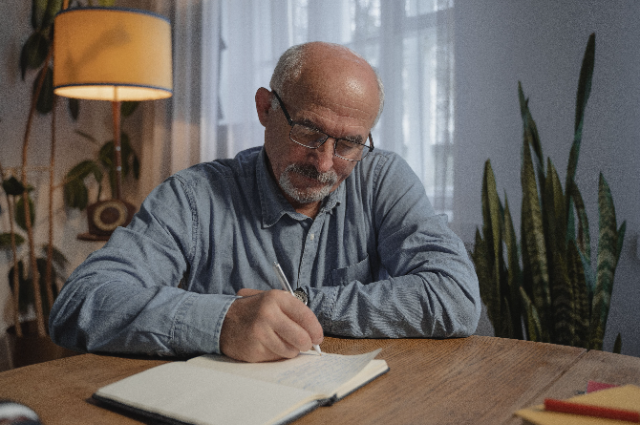
The cure did not come from a medical prescription or a sudden travel plan. It came from a simple, inexpensive black fountain pen and a ruled notebook I bought at a neighbourhood stationery shop.
I had not written anything creative in years. During my decades in government service, writing meant drafting administrative notes, auditing reports, and framing formal correspondence. It was a precise, impersonal language designed to eliminate ambiguity and suppress emotion.
That evening, sitting at the dining table after the dinner dishes had been washed, I uncapped the pen and placed the nib against the white page.
For a long time, nothing happened. The blank paper felt intimidating, almost accusatory. What did a retired accounts officer have to say to the world? Who would care about the thoughts of a man whose daily highlight was watering his potted lemon plants on the balcony?
Then, I wrote a single line about the way the afternoon light fell across the weathered wooden door of my childhood home in Bareilly fifty years ago.
I wrote about the smell of wet earth after the first monsoon rain on the tin roof of our school. I wrote about the specific, quiet dignity of an old watchmaker I used to visit in the city market who spent fifty years fixing tiny gears he could barely see.
As the black ink flowed onto the paper, something extraordinary occurred in the quiet room.
The heavy, suffocating ceiling of routine began to lift. The past was no longer just a collection of dusty photographs to be mourned; it became raw material to be examined, understood, and reshaped. More importantly, the present moment suddenly acquired a sharp, vivid texture.
I began to look at my daily walk not as a prescribed cardiovascular exercise, but as a field trip. I noticed the delicate, purple blossoms of a volunteer weed growing out of a hairline crack in the pavement. I listened to the specific cadence of two elderly men arguing over chess in the local park. I watched how the evening sun turned the dust motes in my hallway into floating, golden stars.
Writing did not make me younger. It did not fix my knee or erase the health reports sitting on my desk.
What it did was reawaken something far more vital: my capacity for wonder.
We are told by society that old age is a period of rest—a time to sit back, withdraw from the world, and quietly consume the days that remain. We are taught to measure our remaining years in terms of comfort, safety, and physical preservation.
But comfort without engagement is merely a waiting room.
Sitting at my desk late at night, watching the ink dry on a fresh page of manuscript, I came to a conclusion that turned my understanding of ageing upside down:
Perhaps old age does not begin when the body becomes weak. It begins when curiosity dies.
It begins on the day you look at a sunrise and feel nothing new, the day you stop asking questions about the world around you, the day you decide that you have seen everything, learned everything, and felt everything that you are destined to feel.
As long as you are curious—as long as you can look at a blank page, a new book, a passing stranger, or an unfamiliar idea and ask "Why?" or "What if?"—you are not merely surviving your later years; you are active within them.
I do not write to achieve fame, to secure a place in literary history, or to win the approval of critics. At sixty-seven, such ambitions feel delightfully unnecessary.
I write because the act of writing proves to me every single day that my inner world is still expanding, even as my outer circle shrinks. It proves that I am still capable of discovering a new thought, crafting a new sentence, and feeling a sudden, unexpected lump in my throat over a memory I thought I had forgotten forty years ago.
I am older now. My steps are slower, my medicine tray is a permanent feature of my side table, and my evenings are quiet.
But when I sit down with my notebook and uncap my pen, I am no longer just a retired officer counting his days. I am a man standing at the edge of an unexplored landscape, waiting with quiet, eager anticipation to see what the next line will reveal.
The man who was waiting for himself has finally arrived at his own desk.