
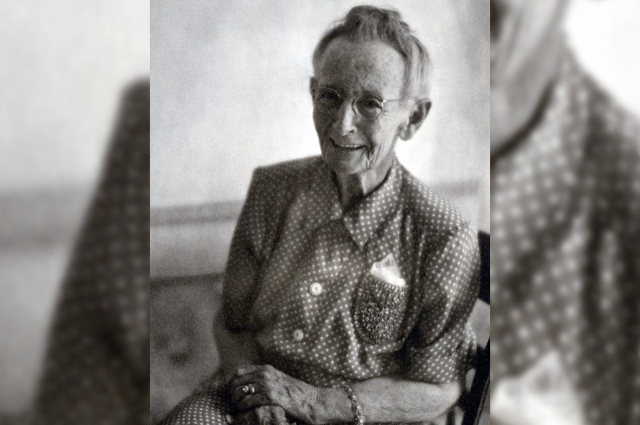
When One Door Closed, Another Opened
At an age when many people begin to believe that their most productive years are behind them, Anna Mary Robertson Moses discovered a new beginning.
She was seventy-seven when she began painting seriously. She had not attended an art school, had no professional connections in the art world and had spent most of her life working on a farm, raising children and managing the demands of a household. Art was not a career she had carefully planned for retirement. It emerged almost unexpectedly from a difficulty that threatened to take away one of her favourite activities.
Arthritis had made embroidery painful. For years, she had enjoyed creating colourful pictures with needle and thread, depicting the familiar scenes of rural life. When her hands could no longer manage the needle comfortably, she turned towards painting.
What began as a way to occupy her time would eventually bring her international recognition.
Her paintings travelled far beyond the countryside she knew. Galleries exhibited them, newspapers wrote about her, and reproductions of her work reached homes across America. The elderly farmwife became famous as Grandma Moses, one of the best-known American folk artists of the twentieth century.
Her story asks a question that becomes increasingly important as human life grows longer: Have we succeeded in adding years to life without learning how to make those years meaningful?
Grandma Moses’s answer was not expressed through scientific theories or philosophical lectures. She offered it through the simple act of beginning again.
A Life Shaped by Work and Responsibility
Anna Mary Robertson was born on 7 September 1860 in Greenwich, New York, in the United States. She grew up in a rural environment where work was part of everyday life and children learned practical skills early.
Her childhood was connected to farms, fields, animals and the changing seasons. Her father encouraged her to draw on scraps of newsprint, and she sometimes used berry and grape juices to add colour to her pictures. Although there was no formal artistic training in her future, the seeds of creativity had already been planted.
Like many women of her generation, however, her life was shaped less by personal ambition than by family responsibilities.
She left home young to work as a hired girl, helping with household tasks on neighbouring farms. In 1887, at the age of twenty-seven, she married Thomas Salmon Moses. The couple eventually settled on a farm in upstate New York after years of working in Virginia.
Together, they raised five children who survived infancy and worked to maintain their household and dairy-farming livelihood. Anna Mary made practical contributions to family income, including selling homemade foods and preserves.
Her days were filled with work that rarely attracted public recognition. Farming demanded patience and physical effort; family life required constant attention. The rhythm of the seasons determined much of what had to be done and when.
There was little room for the modern idea of retirement as a period devoted to personal interests.
Yet the creative impulse remained. She made needlework pictures and quilts, transforming memories of farm life into colourful designs. Her interest in art did not disappear during the years of responsibility. It simply remained one activity among many.
In 1927, her husband died. The loss marked a major change in her life. Her children were growing up, the familiar responsibilities of family life were shifting, and she was entering a stage that many people experience as a gradual withdrawal from the world.
But her story was not finished.
The Struggle to Find a New Beginning
Ageing often changes more than the body. It changes the structure of daily life.
For years, a person may know exactly what to do after waking up. There are meals to prepare, work to complete, people to care for and responsibilities that make the day feel necessary. When those responsibilities diminish, the resulting freedom can be accompanied by an unsettling question: what is now expected of me?
Grandma Moses faced a practical version of this problem. She had spent much of her life creating things with her hands, but arthritis made embroidery increasingly difficult.
She could have regarded this as the natural end of a small pleasure. Instead, painting offered another possibility.
It is tempting to portray such moments as sudden miracles, as though determination alone can remove every obstacle. Real life is rarely so simple. Arthritis does not vanish because someone discovers a new interest, and old age does not automatically bring confidence or opportunity.
What matters is the willingness to search for another path when the familiar one becomes difficult.
Painting suited her better than embroidery. It allowed her to continue creating images inspired by the world she knew: farmhouses, snow-covered roads, harvests, animals, community gatherings and the changing seasons.
Her early paintings were made with whatever materials she could obtain. She was self-taught, and her work did not follow the rules of conventional academic art. Her perspective and proportions could be unconventional, but her pictures possessed something that formal technique alone cannot guarantee: a strong sense of memory, movement and emotional familiarity.
She was not trying to prove that she could paint like somebody else. She was discovering how to express what she herself had seen and remembered.
Her work suggests that the later years of life need not be devoted exclusively to preserving what remains. They can also become an opportunity to discover what has not yet been attempted.
The World Begins to Notice
In 1938, when Grandma Moses was seventy-seven or seventy-eight, depending on how her age is calculated, her paintings were displayed at a local country fair and in the window of a pharmacy in Hoosick Falls, New York.
A New York art collector, Louis J. Caldor, noticed the pictures in the pharmacy window and bought them. He recognised something in their simplicity and distinctive portrayal of rural life.
This was an important turning point. Her work began moving beyond the local setting in which it had first appeared.
In 1940, art dealer Otto Kallir organised her first solo exhibition in New York. She was eighty years old.
The exhibition introduced her to a wider public. Her paintings attracted attention because they offered a distinctive view of American rural life, shaped by personal recollections rather than formal artistic training.
Her popularity grew. Hallmark licensed reproductions of her paintings for greeting cards, and magazines and newspapers helped turn her into a national figure. In 1953, she appeared on the cover of Time magazine.
The name Grandma Moses became familiar to people who might never have visited a fine-art gallery.
Her success was extraordinary not simply because she became famous late in life, but because she had begun without the conventional qualifications people often associate with achievement.
She had no prestigious degree, no established career in painting and no long record of exhibitions. She brought her own experience to the canvas and allowed the world to decide whether it had value.
In 1946, she painted Grandma Moses Goes to the Big City, a work that reflected her journey from the rural world she knew to the public attention her art had attracted. In a sense, the painting also represented a meeting between two versions of herself: the farmwoman whose life had been shaped by familiar routines and the artist whose imagination had carried her into an unexpected future.
Her recognition did not erase her earlier life. It gave that life a new expression.
What Her Paintings Tell Us About Time
Grandma Moses’s paintings often portrayed an America of rural traditions: people gathering for community events, farmers working in the fields, children enjoying winter activities and families participating in seasonal celebrations.
These scenes were not necessarily exact historical records. Memory and imagination shaped them, and the artist sometimes combined observation with recollections of earlier times.
Their appeal lay partly in the world they preserved—a world in which ordinary people occupied the centre of the picture.
Her art reminds us that a meaningful life does not always emerge from dramatic events. It may grow from close attention to ordinary experiences: the arrival of winter, the work of a farm, a gathering of neighbours or the pleasure of watching children play.
We frequently assume that achievement must involve something unprecedented or extraordinary. Yet human life is largely composed of repeated, familiar experiences. Their value depends on the attention we give them and the meaning we find in them.
Grandma Moses did not need to invent a new world. She returned to the world she knew and discovered that it still contained something worth expressing.
This is a powerful lesson for people entering old age. The past need not be a room in which we sit, surrounded by memories of what has ended. It can also be a storehouse of material from which new understanding and creativity emerge.
A lifetime of experience may become a resource rather than a burden.
That possibility matters in a society where longer lives are becoming increasingly common. According to the World Health Organization, improvements in public health and medicine have contributed to longer life expectancy across the world. But the number of years a person lives does not, by itself, tell us whether those years are healthy, connected or fulfilling.
The WHO also identifies social isolation and loneliness as significant public-health concerns. Meaningful participation, supportive relationships and opportunities to remain engaged are important aspects of well-being.
Grandma Moses’s experience cannot be treated as a universal prescription. Not everyone has the health, resources or circumstances that permit a late-life creative career. Nor should older people feel obliged to achieve fame to justify their lives.
Her story offers a more modest and more inclusive lesson: the possibility of beginning something meaningful should not be dismissed merely because a person has reached a particular age.
The Difference Between Growing Old and Becoming Finished
Grandma Moses continued painting into her nineties. Over her lifetime, she produced more than fifteen hundred works and remained creatively active until shortly before her death in 1961, at the age of 101.
Her long life covered an extraordinary period of historical change, from the nineteenth century into the modern world of television, commercial air travel and the space age.
Yet the most remarkable feature of her story may not be its length or even its fame. It is the fact that an important chapter of her public life began when many people would have considered their own stories almost complete.
Her achievement challenges a quiet prejudice against old age: the belief that a person's capacity for discovery steadily diminishes until little remains except the preservation of routine.
Of course, aging brings real limitations. Some people experience declining mobility, chronic illness, memory difficulties or the loss of loved ones. Such challenges should not be minimised with cheerful slogans.
But limitations do not make every possibility disappear. A person may no longer be able to work as before and yet discover a love of reading. Someone who has retired may begin mentoring younger people. Another may return to music, learn a language, cultivate a garden, write memories for grandchildren or develop friendships that were impossible during years of professional responsibility.
Some people may find meaning in caring for others; others may find it in receiving care with dignity. Some may undertake ambitious projects, while others may simply enjoy a peaceful routine.
Meaning has no single shape.
It also cannot be imposed from outside. Older people deserve the freedom to decide what matters to them, rather than being judged by how active, productive or inspiring they appear to others.
A meaningful life is not necessarily a famous life. It is a life in which a person retains, as far as circumstances permit, a sense of dignity, connection, choice and participation.
Grandma Moses happened to become internationally celebrated. Millions of other people will never have their names displayed in galleries or printed on magazine covers. Their lives can still be rich in significance.
The value of her story lies not in suggesting that everyone should become famous after seventy, but in reminding us that we cannot know in advance when a new source of meaning may appear.
The Light That Arrives Late
Imagine the difference between two statements.
The first says, “I am too old to begin.”
The second asks, “What is still possible for me?”
The difference is not merely a matter of language. The first closes a door before examining what lies beyond it. The second accepts reality without surrendering every possibility.
Grandma Moses did not escape the passage of time. She lived through bereavement, physical limitations and the ordinary demands of family life. Her late success did not make her younger or erase the difficulties she had faced.
It gave her another way to participate in the world.
That is perhaps the deeper meaning of her journey. Life does not have to remain meaningful for exactly the same reasons at every age. What sustains us at thirty may not sustain us at seventy. A career may end, a familiar role may disappear, or a physical ability may become difficult to maintain. Meaning may then need to be discovered in a different form.
The responsibility belongs partly to the individual, but it also belongs to society. Communities must create opportunities for older people to learn, contribute and connect. Families must recognise that affection involves listening as well as providing care. Public institutions must support health, accessibility and social participation.
Longevity is a collective achievement. Meaningful longevity must also be a collective commitment.
Anna Mary Robertson Moses died in 1961, but her paintings continue to invite people into the rural landscapes she remembered and imagined. They remain evidence that creativity can emerge from experience at a stage when the world may least expect it.
Perhaps old age is not the evening of life for everyone. For some, it is the hour when an undiscovered self finally receives the light of day.
We have learned to add years to the human lifespan. Our next task is to ensure that those years do not become empty spaces between medical appointments, family visits and memories of a distant past.
We must make room for curiosity, friendship, dignity and the freedom to begin again.
Because the real tragedy of ageing is not that the body changes or that time moves forward. It is the assumption that a person has nothing new left to become.
Grandma Moses reminds us that a life can hold an unfinished possibility long after the world believes the story has reached its final page.
The years we gain are a gift. The purpose we discover within them is what makes that gift come alive.