
On the night of 11–12 April 2011, a young Indian woman boarded a train with the ordinary anxieties and hopes of someone trying to build a future. She was Arunima Sinha, a national-level volleyball player from Uttar Pradesh, travelling to Delhi for an exam tied to her ambition to join the Central Industrial Security Force.
She had a sporting background, a disciplined mind and dreams that extended beyond the boundaries of her circumstances. She had not yet achieved national fame, but she had the determination of someone who believed effort could change her life's direction.
Then, in a few terrible moments, everything changed.
According to contemporary news reports, some men attempted to snatch her belongings, including her gold chain. When she resisted, she was pushed from the moving train. She fell onto the railway tracks and was struck by another train passing nearby.
The consequences were devastating. She suffered severe injuries, and doctors eventually had to amputate her left leg below the knee to save her life. The young athlete who had once depended on her physical strength to pursue her ambitions now faced an uncertain future with a prosthetic limb.
Imagine the suddenness of such a transformation.
One day, the future appears to be a road full of possibilities. The next, even the simplest movement becomes a challenge. The body that once carried us towards our dreams becomes a reminder of what we have lost.
For Arunima, the tragedy was not merely the loss of a leg. It was the sudden destruction of the life she had imagined for herself.
Yet the most important chapter of her story would begin after this terrible night.
Arunima was admitted to the All India Institute of Medical Sciences in New Delhi, where she underwent treatment and faced the long process of recovery.
Physical pain was only one part of her struggle. There was also the psychological burden of adjusting to a radically altered life. The loss of a limb can affect a person's independence, confidence, identity and sense of belonging. For an athlete, whose profession depends so heavily on physical capability, the challenge can be especially profound.
She had once measured her abilities through movement: how fast she could run, how high she could jump, how effectively she could perform on the volleyball court. Now she had to learn to move again, this time with a prosthetic leg.
She also had to confront the expectations of other people.
Society often looks at a person with a disability through the narrow lens of limitation. Sympathy may be well-intentioned, but it can unintentionally reduce an individual to the tragedy they have experienced. People begin to see the injury before they see the person.
Arunima later spoke about her desire to regain her life and demonstrate what she could accomplish rather than remain an object of pity. In an interview reported by NDTV, she described deciding during her recovery that she needed to do something extraordinary with her life.
Somewhere in that period of helplessness, an extraordinary thought took shape.
She would climb Mount Everest.
It was not a modest ambition chosen to suit her changed circumstances. It was one of the most physically demanding challenges imaginable, even for a person with no disability.
Why Everest?
Perhaps because she understood, consciously or otherwise, that merely returning to her previous life would not be enough to answer the questions that now surrounded her future. She wanted to discover the limits of her own possibilities.
Her decision did not erase her pain. It gave her pain a direction.
That distinction matters. Courage is not the absence of suffering. It is the decision to pursue a meaningful purpose while suffering remains a part of one's reality.
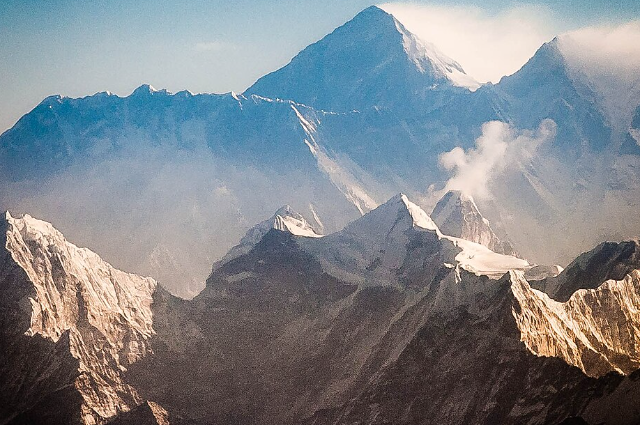
Mount Everest rises 8,848.86 metres above sea level. Its slopes expose climbers to freezing temperatures, thin air, unpredictable weather, dangerous ice formations and the constant risk of exhaustion.
For Arunima, the challenge was still greater.
She had to rebuild her physical strength, learn to use a prosthetic limb effectively and prepare her body for a demanding expedition. Her ambition could not be realised by determination alone. It required technical training, professional guidance, financial support and months of disciplined preparation.
She enrolled in a basic mountaineering course at the Nehru Institute of Mountaineering in Uttarkashi. She also approached Bachendri Pal, the first Indian woman to climb Everest, and trained under her guidance through the Tata Steel Adventure Foundation. In 2012, she climbed Island Peak in the Himalayas as part of her preparation.
Consider what this meant in practical terms.
Every step had to be learned again. Every climb demanded attention to balance, stamina and the behaviour of the prosthetic limb. Muscles that had weakened during recovery needed strengthening. Her body had to adapt to the particular demands of walking over rough, uneven and often slippery terrain.
And there was no guarantee that all this effort would succeed.
Training for Everest is not like preparing for an examination in which enough study may eventually secure a passing mark. Mountains do not reward ambition merely because it is sincere. They demand preparation, patience, sound judgement and respect for danger.
Arunima had to become both determined and disciplined.
This is where her story moves beyond the familiar language of inspiration.
We often celebrate extraordinary achievements as if they emerge from a single moment of courage. In reality, courage is frequently an accumulation of ordinary decisions: getting up when the body aches, practising when progress is slow, accepting instruction, correcting mistakes and returning to the task the next day.
The world might eventually witness a woman with a prosthetic leg standing on the highest mountain on Earth. But before that moment, there were countless hours in which nobody was watching.
Those hours were the real foundation of her achievement.
On 1 April 2013, Arunima began her Everest expedition with Susen Mahto, an instructor associated with the Tata Steel Adventure Foundation.
The expedition was a journey through an environment where human strength encounters the limits of nature. The climbers had to contend with altitude, cold, fatigue and the dangers of the mountain. Progress depended not simply on the desire to reach the summit, but on the ability to continue safely through changing conditions.
For Arunima, the prosthetic limb added another layer of difficulty.
A contemporary Press Trust of India report described her account of the challenges caused by her artificial leg during the expedition, including a problem with its gel lining that resulted in bleeding. She had to address the problem carefully before continuing her climb.
Such details reveal more than a general declaration of bravery ever could.
Imagine being thousands of metres above sea level, exhausted, cold and far from the comfort of home, when equipment on which your movement depends begins to cause injury. The natural response might be to question the entire undertaking.
Yet continuing does not mean blindly ignoring danger. On a mountain, perseverance must work alongside judgement, preparation and the support of others. The objective is not to prove that a human being is invincible, but to achieve something extraordinary while respecting the risks involved.
For Arunima, each stage of the climb represented another test of physical adaptation and mental endurance.
There must have been moments when the summit seemed impossibly distant. At high altitude, even small movements require effort. The mountain offers no sympathy for the climber's personal history. It remains indifferent to tragedy, ambition and hope alike.
That indifference is part of what makes the achievement so powerful.
The mountain did not become easier because Arunima had suffered. She had to become better prepared to face it.
And so she continued.
On 21 May 2013, at 10:55 a.m., Arunima Sinha reached the summit of Mount Everest. She became the first female amputee to climb the world's highest mountain. Guinness World Records records the achievement on that date, confirming that she reached the summit from the southern side with the aid of bottled oxygen.
For a moment, the distance between the railway tracks of 2011 and the summit of Everest seemed almost beyond comprehension.
Two years earlier, she had been fighting to recover from injuries that threatened to define the remainder of her life. Now she stood at the top of the world, having completed an expedition that demands extraordinary preparation even from experienced climbers.
The summit was not simply a geographical point. It was the culmination of a long process of physical rehabilitation, training, persistence and support.
It was also a statement about possibility.
The woman whom circumstances had forced to reconsider her future had accomplished something that very few people, regardless of physical ability, ever achieve.
Her victory did not mean that her lost leg had somehow become unimportant. Nor did it mean that disability was merely an obstacle that could always be overcome through willpower. People live with different bodies, circumstances and resources, and not every barrier can be removed by individual determination alone.
What her story demonstrated was something more grounded and more meaningful: a physical limitation does not automatically determine the full extent of a person's ambitions or contributions.
Her achievement also depended on the people and institutions that supported her training and expedition. The story of individual courage is not diminished by recognising this support. On the contrary, it reminds us that remarkable achievements often emerge when personal determination meets opportunity, guidance and collective effort.
At the summit, Arunima had not conquered every difficulty life could ever bring. She had accomplished one immense goal.
And that was enough.
An achievement of this magnitude could easily have become the final chapter of her story. She had demonstrated her courage to the world. She had earned recognition for an accomplishment that would be remembered long after the expedition ended.
But Arunima's aspirations extended beyond her own success.
The Government of India's account of her achievement records her intention to establish the Pandit Chandra Shekhar Vikalang Khel Academy, a free sports academy for underprivileged and differently abled people. In 2015, she received the Padma Shri, one of India's highest civilian honours, as well as the Tenzing Norgay National Adventure Award.
This aspect of her journey deserves attention.
When a person turns personal achievement into an effort to expand opportunities for others, the meaning of success changes. It is no longer measured exclusively by individual recognition. It begins to include the possibilities created for people who might otherwise remain overlooked.
For a young person living with a disability, Arunima's example may challenge an assumption that has quietly restricted ambition. For a family struggling to understand a child's changed physical abilities, her story may open a conversation about independence and opportunity. For society, it may expose the difference between offering sympathy and creating genuine access.
Inspiration becomes most valuable when it changes how we treat people.
We do not honour a person with a disability merely by praising their exceptional achievements. We honour them by recognising their dignity, making public spaces accessible, providing appropriate opportunities and allowing them to define their own lives.
Arunima's Everest ascent was extraordinary precisely because Everest is extraordinary. But the right to dream, work, learn and participate in society should not require an extraordinary achievement as proof of worth.
A person does not need to climb a mountain to deserve respect.
There is a temptation to read Arunima Sinha's story as a simple contest between a strong individual and a terrible fate: adversity arrived, courage defeated it, and triumph followed.
But real life is seldom so uncomplicated.
Her story contains violence, physical suffering, medical intervention, uncertainty, demanding preparation, institutional support and a remarkable achievement. It shows that a life-changing tragedy can have consequences that do not disappear simply because someone succeeds later.
What makes her journey meaningful is not that she was untouched by suffering. It is that suffering did not have the final word in determining what she attempted.
Each of us carries an Everest of a different kind.
For one person, it may be an illness that changes the shape of everyday life. For another, it may be the loss of a loved one, the collapse of a cherished ambition, a financial crisis or the quiet realisation that the future will not resemble the past.
Not every mountain can be climbed. Some losses cannot be reversed. Some wounds remain even after life has moved forward. We must be careful not to use inspirational stories to suggest that those who continue to suffer simply lack courage.
Yet Arunima's experience offers an important possibility: even when we cannot choose what happens to us, we may sometimes find a measure of freedom in choosing how we respond.
That freedom may not come immediately. It may begin with a small decision, an unexpected source of support or the willingness to imagine a future that initially seems absurd.
The first step need not be heroic.
It may simply be the decision to try again.
Perhaps this is the deepest meaning of her achievement. The mountain did not restore what the railway accident had taken from her. It allowed her to discover what remained possible.
And in discovering that possibility, she offered others a reason to question the boundaries they had accepted for themselves.
The Sky Was Never the Limit
When Arunima Sinha was pushed from a moving train in April 2011, she could not have known what the next two years would bring. The accident transformed her body and disrupted the future she had imagined. Yet, through rehabilitation, training, professional guidance and extraordinary persistence, she went on to reach the summit of Mount Everest on 21 May 2013.
Her story is not a promise that determination can solve every human problem. It is a reminder that the worst moment of a life does not necessarily reveal the full measure of that life.
A railway track became the setting of her tragedy. A mountain became the setting of her achievement. Between the two lay a journey that demanded far more than inspirational words could describe.
Perhaps we should not ask how a woman with an amputated leg managed to climb Everest. We should ask how often society mistakes a person's visible limitation for the boundary of their potential.
Arunima lost a leg, but she did not surrender the right to imagine a future larger than her injury.
Her story leaves us with a thought worth carrying beyond the final page:
Sometimes life takes away a part of our body, only to reveal the strength of the human spirit that we never knew existed.
And sometimes, when the road beneath our feet disappears, we discover that the horizon is still open.