
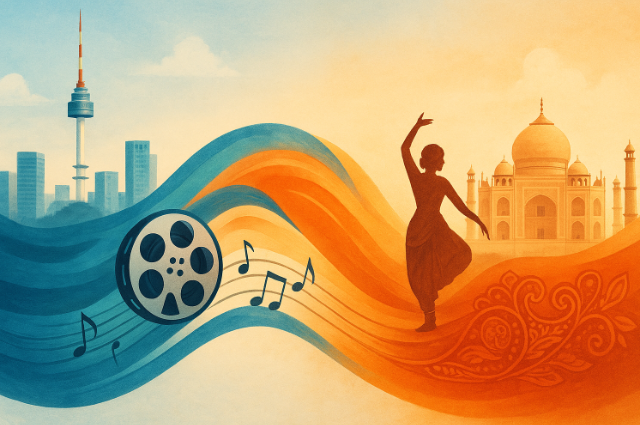
Over the past seven decades, East Asia has witnessed the rise of some of the fastest-growing developed economies—often referred to as the ‘Asian Tigers’. These include Singapore, Taiwan, Hong Kong, and South Korea. Among them, South Korea stands out not only as an economic powerhouse but also as a cultural superpower.
South Korea’s global cultural influence is evident. Its iconic song “Gangnam Style” was the first YouTube video to surpass 1 billion views. The South Korean TV series “Squid Game” became one of the most-watched shows globally, even inspiring Mr Beast’s most-viewed YouTube video. Bands like BTS and Blackpink are achieving international stardom, while K-dramas continue to gain global popularity. South Korean cinema is also earning critical acclaim—films like “Oldboy” and “Parasite” have garnered international awards, with Parasite making history as the first non-English language film to win the Oscar for Best Picture. But the question arises as to how this drastic change happened. Is South Korea’s cultural dominance a coincidence or the result of a carefully crafted strategy? An attempt has been made in this essay to find the answer to this question. Along with India, a country with significant diversity can learn from this country, has been analysed.
South Korea: A Story of Resilience and Global Rise
Korea has been under Japanese colonial rule since the time Japan surrendered in World War II on August 15, 1945. This day is celebrated as the National Liberation Day in both Koreas. At that time, Korea was one unified country. But following WWII, it was divided between the Soviet Union in the north and the United States in the south. The plan was to establish a temporary trusteeship for five years, after which Korea would reunify. However, Cold War tensions between the U.S. and USSR derailed this plan. In 1948, after failed attempts to hold elections in the north, South Korea proceeded with elections and adopted a new constitution. Thus, on August 15, 1948, the Republic of Korea (South Korea) was officially formed. The following month, North Korea was declared a communist state. But two years later, in 1950, North Korea invaded the South, sparking the Korean War, which lasted for three years. The war devastated the South, leaving it among the poorest nations in the world, with a GDP per capita lower than that of present-day Somalia or Haiti.
This journey of economic constraints wasn’t easy for Korea, as the country began rolling between political turmoil and authoritarian rule, like that of President Rhee Syngman, who stagnated the democratic sphere. Within months, General Park Chung-hee seized power through a military coup, establishing a military dictatorship that would shape South Korea’s trajectory for the next two decades.
Park Chung-hee ruled with an iron grip until his assassination in 1979. Under his leadership, South Korea transformed from one of the world’s poorest countries into an emerging industrial power. Between 1962 and 1989, the country's nominal GDP per capita skyrocketed from $104 to $5,438—a fiftyfold increase. This astonishing growth was driven by Park’s top-down economic planning. He nationalized private banks and centralized control over interest rates, foreign exchange, import-export policies, and tax benefits. A central pillar of Park’s strategy was the promotion of Chaebols—large, family-run conglomerates such as Samsung, Hyundai, and Daewoo. These corporations were protected from foreign competition and empowered to exploit domestic labor with minimal restrictions. In return, they became engines of industrial production, propelling South Korea into the global marketplace.
South Korea faced challenges familiar to other resource-poor countries: a small domestic market, low national savings, and few natural resources. But in order to tackle this, Korea internalized the strategy of export-oriented industrialization. The country focused on manufacturing a wide range of products—wigs, stuffed toys, ships, cars, electronics, chemicals, and semiconductors—for global markets. This strategy not only earned much-needed foreign exchange but also embedded competitiveness into the national psyche. But during 1997, South Korea was hit hard by the Asian Financial Crisis, which also rocked economies like Thailand and Indonesia. With global markets panicking over hidden vulnerabilities in Asian economies, South Korea turned to the International Monetary Fund (IMF) for a bailout. The IMF agreed—on the condition that the country reform its powerful Chaebol system, which was blamed for crony capitalism, insider trading, tax evasion, and opaque corporate structures. Among several regulatory reforms, one major change required Chaebols like Samsung and Hyundai to focus solely on their core businesses, forcing them to exit industries like film production. This unexpectedly opened space for independent creators and smaller studios to flourish.
Though the crisis severely impacted the economy, it became a cultural turning point. President Kim Dae-Jung, elected in 1998 and later awarded the Nobel Peace Prize in 2000, recognized the potential of culture as both an economic driver and a tool for global branding. His administration implemented the Basic Laws for the Cultural Industry Promotion Project in 1999, allocating $148.5 million to support media exports like K-pop and Korean cinema. Simultaneously, the government invested in cultural infrastructure—building concert halls, establishing arts departments in universities, and supporting grassroots platforms like noraebangs (karaoke bars). These efforts cultivated both artistic talent and public engagement with culture.
Kim also laid the digital foundation for Korea’s cultural rise. By promoting broadband access starting in 1998, South Korea became one of the world’s most connected nations by 2004. This digital push made it easier to distribute and consume Korean content globally. Most importantly, Kim dismantled the long-standing censorship regime, replacing it with a Western-style age rating system. Artists were finally free to tackle real-world themes like inequality and poverty. This freedom made masterpieces like Parasite possible—a film that not only won the Palme d’Or and the Oscar for Best Picture, but also resonated with global audiences for its universal message. Far from being controversial at home, it was celebrated as a symbol of Korea’s new cultural confidence.
Korea: The Making of a Cultural Powerhouse
During South Korea’s authoritarian years, cultural expression was tightly controlled. Park Chung-hee’s 1962 Motion Picture Law, revised multiple times, enforced strict censorship—filmmakers needed script approval and final edits had to align with state ideology. Allowed genres were limited to martial arts, melodramas, government propaganda, and even sexually explicit “hostess films,” while films tackling political or social issues were banned. In 1975, South Korea even blacklisted over 260 foreign songs, including Bob Dylan’s “Blowin’ in the Wind.” This repression continued until democratization in the late 1980s, which paved the way for a cultural reawakening. A key turning point came in 1993, when the government noticed that Jurassic Park had earned more than the equivalent of 1.5 million Hyundai cars, prompting a new appreciation for media as an economic force. That same year, Seo Pyeon Je, a film rooted in Korean tradition, broke domestic records—highlighting the export potential of Korean culture.
Following this realization, South Korea strategically embraced cultural production as a formal economic sector. In 1994, the Cultural Industry Bureau was established, and by 1996, the outdated censorship law was replaced with the liberal Film Promotion Law, unlocking creative freedom. Major Chaebols like Samsung and Hyundai invested in film, bringing professionalism and capital into the media industry. This resulted in big-budget hits like Shiri (1999), which outperformed Titanic at the Korean box office. Meanwhile, Korean dramas gained popularity for their rich cinematography, emotional depth, and socially resonant themes—helped in part by the fact that nearly 95% of K-drama screenwriters are women. The rise of K-pop paralleled this trend. SM Entertainment launched H.O.T. in 1996 using a Japan-inspired but uniquely Korean idol-training system. By 2012, PSY’s Gangnam Style became the first YouTube video to hit 1 billion views, signalling Korea’s global pop-cultural arrival. BTS and Blackpink now lead this wave, becoming global icons and ambassadors of Korean soft power.
The rise of the 386 Generation—liberal, globally exposed, and shaped by the democracy movement—further fueled the cultural transformation. Filmmakers like Bong Joon-ho (Parasite), Park Chan-wook (Oldboy), and Kim Ki-duk (Pieta) tackled themes of inequality, trauma, and justice, earning acclaim at Cannes and Venice. Meanwhile, Korean television dramas—starting with What is Love (1997), the first K-drama broadcast in China—sparked what is now known as Hallyu, or the Korean Wave. Today, Korean content dominates global platforms like Netflix (Squid Game), while its music, films, fashion, and food enjoy massive international followings. This success stems from deliberate policy, public-private collaboration, and a commitment to artistic freedom, proving that strategic investment in culture can transform national identity into global influence.
Lessons for India: Learning from South Korea’s Cultural Transformation
South Korea’s rise as a cultural superpower wasn’t accidental—it was the result of strategic reforms, investment, and vision. For India, with its unmatched cultural diversity and artistic talent, the Korean model offers valuable insights.
Dismantle Monopolies and Promote Fair Competition
The 1997 financial crisis in South Korea exposed how unchecked monopolies—like the Chaebols—stifle innovation and distort economic fairness. India faces a similar challenge. A few conglomerates dominate sectors like ports, telecom, and media, while smaller players struggle to survive. In cinema too, a handful of Bollywood studios monopolize screen space, making it difficult for independent and regional filmmakers to access mainstream theaters. Structural reforms are essential to level the playing field, break monopolies, and promote a diverse cultural economy.
Reform Censorship to Empower Storytelling
Much like Korea’s authoritarian past, India’s censorship regime often suppresses meaningful cinema while allowing commercial, often problematic content to pass unchallenged. Films such as Kissa Kursi Ka, India’s Daughter, and Udta Punjab faced bans or heavy edits, while sensational films with little artistic merit sailed through. Adopting a mature, age-based classification system—as Korea did—would enable artists to tell socially relevant stories without fear, and strengthen India’s democratic ethos.
Invest in Cultural Infrastructure and Decentralized Promotion
South Korea’s cultural renaissance was fueled by strong government backing—from building creative spaces to supporting broadband access and global outreach. India, with its rich state-level cultural identities, must adopt a similar approach. States like Manipur, Kashmir, and Haryana have unique traditions and cinematic voices, but they are sidelined by the national entertainment machinery. If Korea can create a K-Wave, India can foster regional waves like the Kumaoni Wave or Haryanvi Wave. This requires clear policy support:
- Reserve screens in public or regulated theaters for regional films
- Build small cinema halls for local language content
- Launch state-supported OTT platforms and streaming grants
- Fund 25–30 independent films per year in each linguistic region
- Organize regional film festivals and open talent auditions
India’s cultural diversity is not just a heritage to be preserved—it’s a resource that, if harnessed with vision, can generate employment, global influence, and national cohesion. It’s time to treat culture not as soft power alone, but as a strategic, socio-economic force.
South Korea’s cultural ascent is a compelling example of how a nation can transform adversity into global influence through vision, policy, and investment. From dictatorship to democracy, and from censorship to creative freedom, Korea strategically used culture as both an economic engine and a diplomatic tool. Its rise shows that soft power is not merely about entertainment but about national identity and international presence. India, with its vast cultural heritage and demographic advantage, holds even greater potential. But this potential remains underutilized without structural reforms, decentralization, and state-level support. Cultural monopolies must be dismantled, regional voices amplified, and authentic storytelling encouraged. Government-backed infrastructure, fairer media policies, and local investment are key. Korea’s path is not a model to copy, but a strategy to adapt. India’s moment can come—not by imitation, but by nurturing its own pluralistic power.
. . .
References and Bibliography:
- Rathee, Dhruv. How Korea Became a Cultural Superpower. YouTube, December 16, 2023 https://youtu.be/3-1Rc8jJ-ng?si=0ksEEnyx5Dvq1wfm https://youtu.be
- Young, Jin Yu. “How South Korea Became a Cultural Powerhouse, and What’s Next.” The New York Times, June 21, 2025. https://www.nytimes.com
- Kwon, Jake. “From Squid Game to Blackpink, How South Korea Became a Culture Powerhouse.” BBC News, December 29, 2024 https://www.bbc.com
- Kwon, Sung Jun. “Korea Cool: Resilient Peninsula, on the Rise.” FM Insights, June 18, 2025. https://www.fm.com
- Mishra, Sandip Kumar. “Soft Power in India-South Korea Relations and Role of Cultural and Popular Connections.” The Journal of Indian and Asian Studies 4, no. 2 (2023 https://www.worldscientific.com
- M, Amal. “India’s Need for an Iron Fist: Lessons from South Korea.” Diplomatist: Analysing International Relations, May 7, 2023 https://diplomatist.com