
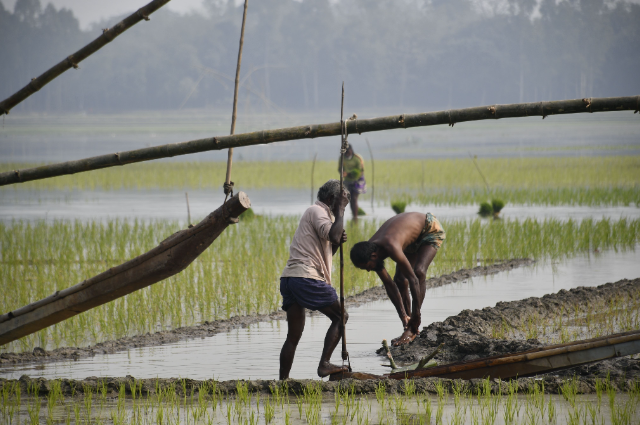
In the western districts of West Bengal, especially Purulia, Bankura and Birbhum, farmers grow little food, and the weather is very changeable. Rural life pushes many young people to leave their homes and interrupts their schooling. Programs such as the Integrated Watershed Management Programme (IWMP) and the Pradhan Mantri Krishi Sinchayee Yojana (PMKSY) try to bring worn-out land back into use, but we do not yet know how well they work over a long time. This paper asks how watershed management supports sustainable agriculture and how far it protects the lives and incomes of young people and young farmers. By reading official evaluations, field studies and recent reports from the region, it finds large gaps in keeping projects going after they close and in bringing local ideas into state plans, and these gaps hurt rural youth livelihoods. Watershed work often acts as a fix for structures, not as a lasting way to heal the environment. For climate resilience, the paper suggests building stronger technical skills, teaching young people environmental literacy, and forming watershed-level committees that young people help to run.
Water, Freedom and the Young
The economist Amartya Sen (1999) argues that development should be judged by the real freedoms people enjoy, not just by the money they earn. For a young person in a dry village, the first of these freedoms is a simple one: a reason to stay. It means land that gives a crop, water in the well and a school year that is not broken by the search for work. When the rain fails, these freedoms fall away together. This paper starts from that idea and asks whether watershed programmes, which are meant to hold rain on the land, also give young people a real choice between staying and leaving.
Chambers and Conway (1992) call a livelihood sustainable when it can recover from shocks and keep its assets without wearing down the natural base that supports it. Rainfed farming in the western districts of West Bengal rarely meets that test. A watershed, in simple terms, is the area of land from which rain drains to one common point, and in India it has become the standard unit for planning soil and water work in rainfed areas. Nationally, dryland farming covers about 55 per cent of the net sown area and supports around 40 per cent of the population, while about 65 million hectares of land are classed as degraded (Gaur & Milne, 2015).
The paper asks three plain questions. What do we know about how watershed work has changed farming in the dry west of the state? Where does it fall short, especially after a project ends? And how can young people be placed at the centre of the next phase? It is a desk-based study. It draws on Government of India documents, a field evaluation by the Agro-Economic Research Centre of Visva-Bharati (Sarkar et al., 2010), the World Bank’s institutional review of the programme (Gaur & Milne, 2015), the NITI Aayog evaluation (NITI Aayog & WAPCOS, 2021), peer-reviewed studies and recent reports from Purulia. The sections follow ideas rather than the usual order of a research report: the land, the thinking about water, the policy story, the evidence, the gaps and the role of youth.
A Thin Soil and an Uncertain Sky
Adger (2006) defines vulnerability as the mix of exposure to stress, sensitivity to it and the capacity to adapt. The western districts of West Bengal score high on the first two and low on the third. Government records from 2006 show that about 21.9 lakh hectares, or 28.51 per cent of the state’s non-forest area, suffer from some form of land degradation (Table 1). In Birbhum, Bankura and Purulia, the main problems are sheet erosion, an uneven surface and moisture stress, with gullies and mining added in Purulia. When the topsoil washes off, the exposed subsoil holds less water, so the land suffers drought and fails to recharge groundwater at the same time (Sarkar et al., 2010).
Table 1. Land degradation in the three western districts
District | Main problems | Area affected (ha) |
Birbhum | Sheet and rill erosion, undulating tract, moisture stress, gullies, sand deposition | 104,000 |
Bankura | Sheet erosion, undulating tract, moisture stress | 107,200 |
Purulia | Sheet erosion, undulating tract, moisture stress, mining, gullies | 146,200 |
West Bengal | All 18 affected districts (28.51% of non-forest area) | 2,191,300 |
Source: Sarkar et al. (2010), Table 1.2, citing the Soil Conservation Wing, Directorate of Agriculture, Government of West Bengal (2006).
The sky adds to the trouble. Purulia receives an average of about 1,300 mm of rain a year (Croke et al., 2015), which is not low, but reporting from the district describes it as arriving in short bursts, with around 60 per cent falling in a single fortnight (Mitra, 2026). Rain that comes this fast runs off the slope before the soil can drink it. About 83 per cent of the net cropped area is under kharif paddy, only about 15 per cent is multi-cropped, and nearly half of the cultivated land gives a single crop (Bagchi, n.d.; Mitra, 2026). Farms are small as well: across West Bengal, the average holding is about 0.77 hectares and 96 per cent of farm families are small or marginal (IWMI & ACIAR, n.d.).
The IPCC (2022) warns that rising heat and more erratic rainfall will add strain to rainfed farming in South Asia. For a farmer with half a hectare of upland paddy, that means more years in which a dry spell at a critical stage wipes out the season. This is how climate resilience should be understood here: not as a general global idea, but as the practical ability of a small farm and a young household to survive a bad year and still be there in the next.
Old Ideas about Water, New Words for Them
Holling (1973) brought the idea of resilience into ecology as the ability of a system to take a shock and keep its basic shape. Indian thought has an older and more practical version. The Arthashastra, attributed to Kautilya, treats rain as something to be measured and planned for: it gives rainfall figures for different regions, ties the choice of crops to rainfall, and makes the building and upkeep of reservoirs a concern of the state (Kangle, 1972). Farmers in Bankura and Purulia have long followed the same logic in their village tanks. In the four watersheds studied by Visva-Bharati, every irrigation pond had been dug before the project began (Sarkar et al., 2010).
Rabindranath Tagore gave the same concern a Bengali home. In 1922, he began the Institute of Rural Reconstruction at Sriniketan, near Santiniketan, with the agricultural economist Leonard Elmhirst, believing that villagers must lead their own revival through self-help, cooperation and practical learning (Elmhirst, 1975). Gandhi’s picture of self-governing villages in Hind Swaraj (1909) belongs to the same family of ideas, and it echoes in the modern rule that a village Watershed Committee should run the programme. It is fitting that the main West Bengal evaluation of watershed work came from a research centre of Tagore’s own university.
Western scholars reached similar lessons by a different road. Hardin (1968) warned that a shared resource is ruined when each person chases private gain. Ostrom (1990) answered with evidence that communities can look after commons for generations when they have clear boundaries, rules that fit local conditions, ways to watch each other and fair penalties. The Brundtland Commission (WCED, 1987) added fairness across generations: development must meet today’s needs without cheating the future. Folke (2006) and Adger (2000) bring these strands together and show that ecological and social resilience cannot be separated, because the strength of local institutions decides how well a landscape recovers.
Together these ideas give a three-part test for any watershed programme. Does the land recover, with more water held and less soil lost? Do the people recover, with steadier income and more choice? And can local people keep the system going after the outside money leaves? Most of what follows applies that test to West Bengal.
A Short Policy History: Muddling towards Watersheds
Lindblom (1959) described public policy as “muddling through”: a series of small corrections, not one grand plan. India’s watershed story fits that picture. Soil and water work on a watershed basis began in the early 1950s at the Central Soil and Water Conservation Research and Training Institute in Dehradun, and four operational research projects, including Sukho Majri in Haryana, started in 1974 (Sarkar et al., 2010). The Drought Prone Areas Programme (1973–74), the Desert Development Programme (1977–78) and the Integrated Wastelands Development Programme (1988–89) followed. By the end of the Tenth Plan, India had spent about US$3.2 billion on treating around 51 million hectares (Gaur & Milne, 2015). Yet when the Hanumantha Rao Committee reviewed the drought programmes in 1993, it found that two decades of work had not made a substantial impact (Sarkar et al., 2010).
Each correction brought more community involvement. Guidelines in 1994 and 2001 (the Warasa–Jan Sahbhagita guidelines) made watershed communities responsible for planning, running and maintaining the work through committees, user groups and self-help groups, and in 2003 the Hariyali guidelines gave Panchayati Raj Institutions a larger role (Sarkar et al., 2010). The Parthasarathy Committee’s 2006 report, From Hariyali to Neeranchal, led to the 2008 Common Guidelines, which asked for professional project staff, stronger local institutions and a “ridge-to-valley” approach. In 2009–10, the older schemes were merged into IWMP, which became the watershed component of PMKSY in 2015–16 (Gaur & Milne, 2015). The second phase, WDC-PMKSY 2.0, was approved on 15 December 2021 for 2021–26 with a target of 4.95 million hectares and a central outlay of ₹8,134 crore. By 2024, it had sanctioned 1,150 projects over 50.55 lakh hectares at a total cost of ₹12,388.58 crore, and it added the revival of springs (Rajya Sabha, 2023, 2024). A World Bank-assisted programme, REWARD, approved in December 2021, supports science-based watershed work for climate resilience (Ministry of Finance, 2025).
In West Bengal, the Soil Conservation Wing of the Agriculture Department leads this work. NABARD’s Watershed Development Fund has backed 34 projects worth ₹17.8 crore over 24,475 hectares in six districts, including Purulia, Bankura and Birbhum, and has supported micro-watershed projects on tribal land in Ranibandh block of Bankura that were expected to reach about 2,000 families (Sarkar et al., 2010).
What the Evidence Shows
Meta-analysis, which combines many small studies into one picture, gives the widest view. Joshi and colleagues (2008) reviewed 636 micro-watersheds in India and found that watershed programmes raised cropping intensity by about 35 per cent, cut run-off by about 45 per cent, saved 1.1 tonnes of soil per hectare each year and created roughly 151 person-days of work per hectare, with a mean internal rate of return of 27.4 per cent. An earlier review of 311 case studies put the mean benefit–cost ratio at 2.14 and found that results were best where people took an active part and where rainfall lay between 700 and 1,000 mm (Joshi et al., 2005). Programmes usually pay off, but how well depends on people and place.
For West Bengal, the closest study is by Sarkar and colleagues (2010). It compared 160 watershed and 160 non-watershed households in four watersheds, one of them (Kanduri, in Rampurhat-I block) in Birbhum, using data for 2001–02 and 2006–07. Table 2 sets out the main contrasts. Watershed households irrigated a larger share of their land, adopted more of the recommended practices and had higher literacy. Cropping intensity was higher on marginal and small farms, and 61 of 65 irrigation ponds in watershed areas were still working. Yet gross returns from rainfed crops were almost the same in both groups, which tells us that better water had not yet become better income.
Table 2. Watershed and non-watershed households in four West Bengal watersheds, 2007
Indicator | Watershed | Non-watershed |
Irrigated share of cultivated area (%) | 37.05 | 26.66 |
Adoption of recommended practices (%) | 32.95 | 27.68 |
Cropping intensity, marginal farms (%) | 178.7 | 163.6 |
Cropping intensity, small farms (%) | 150.4 | 114.2 |
Irrigation ponds working | 61 of 65 | 26 of 29 |
Literacy, all persons (%) | 73.75 | 62.22 |
Gross return, rainfed crops (₹, geometric mean) | 11,501 | 11,765 |
Gini coefficient of farm income | 0.44 | 0.42 |
Source: Sarkar et al. (2010), Volume II, Tables 1, 2, 3, 5, 8, 9 and 14.
Closer to the dry belt, a 2017–18 survey in the Karma micro-watershed of Purulia found that after IWMP, cropping intensity rose by 13.38 per cent, aman paddy output by 35.68 per cent and black gram output by 58.4 per cent, with yield gains of 73.4 per cent for aman paddy and 77.42 per cent for mustard (Koiri et al., 2025). The same study found that farmers’ knowledge of improved practices reached only 21 to 53 per cent and adoption only 24 to 42 per cent, and that what some farmers learned did not spread well to others. The gains were real, but they stood on a thin base of skills.
Departmental records for the Kanduri watershed in Birbhum, which covers 500 hectares and cost ₹22.5 lakh, report a benefit–cost ratio of 1:1.5, 11,526 person-days of work, 90 per cent survival of 20,500 agroforestry seedlings, and 15 hectares of new cultivated land and 18 hectares of new supplemental irrigation. Cereal yield is recorded as rising from 22.72 to 25 quintals per hectare (Sarkar et al., 2010). The same table gives an internal rate of return of 119.66 per cent, which is far too high to be trusted. These records come from the department that ran the project, so they are best read as signs, not proof.
Where the Promise Slips
Pressman and Wildavsky (1973) showed long ago that most of the distance between a good plan and a good result lies in implementation. The watershed record bears this out in four ways.
Structures before systems. The first gap is the habit of building first and healing later. The World Bank’s review found that most states spent mainly on water-harvesting structures, because they are visible and quick, while area treatment and biomass work stayed small and few states followed a true ridge-to-valley plan (Gaur & Milne, 2015). The Kanduri figures show the same thing at village scale: water-harvesting work reached about 110 per cent of its target, but run-off management and treatment of the upper and lower drainage lines recorded no achievement (Sarkar et al., 2010). Structures without treatment of the catchment above them tend to silt up. This is why such work behaves like a fix for buildings and not a way of healing the land.
Care after the project. The second gap is what happens when the project closes. The World Bank report notes that early gains in soil, water and yield often fail to last because assets are not maintained and further investment does not follow. Farmers look after structures on their own fields, but common structures fare worse (Gaur & Milne, 2015). The Visva-Bharati team saw this too: check dams were working well, yet some gully checks had been removed by villagers to build houses, and there was no clear sign that common structures were better cared for than private ones. Their advice was to train local institutions to maintain assets and to frame rules for groundwater use (Sarkar et al., 2010).
Who gains. The third gap is fairness. Kerr (2002) cautions that watershed work does not reduce poverty automatically; the effect depends on who gains access to the land and water that are improved. The World Bank found that, without special care, watershed work tends to favour landed farmers, and that women and the landless were represented only in a nominal way (Gaur & Milne, 2015). The West Bengal data point to the same conclusion. Net returns per farm in the Visva-Bharati study rose from 189.68 for marginal farms to 518.48 for small and 1,057.91 for medium farms, and the Gini coefficient of farm income was 0.44 in watershed areas against 0.42 outside them.
Skills, records and local knowledge. The fourth gap concerns skills and information. The World Bank found that capacity building followed menus and targets rather than local needs, that most fieldwork was done by understaffed government agencies, and that many villagers hardly knew of the plan prepared for their own watershed; even the best-performing state had spent under 65 per cent of its funds. In Birbhum, the departmental table for Kanduri records only three training events, while another table in the same report lists 25 planned and 25 completed. The NITI Aayog evaluation of 134 sample projects reported, for example, that water-table targets were not met in the sampled projects of Andhra Pradesh and Assam (NITI Aayog & WAPCOS, 2021). Local knowledge gets little room. The World Bank team saw upland field bunding used to expand paddy where millet-based mixed cropping had once been normal, and it urged a return to mixed and intercropping. Purulia’s 83 per cent paddy share suggests that this lesson matters here.
Young People at the Centre
Lee’s (1966) push–pull theory explains migration as a balance between pressures at home and attractions elsewhere, and Stark and Bloom (1985) add that poor households often send members away to spread risk, not only to earn more. Both ideas fit Purulia. Reporting describes a long history of seasonal migration, with some households moving several times a year, and says that distress has deepened as farming becomes less reliable and rural work schemes falter. Most migrants are unskilled, take poorly paid labour and have no fallback if work ends, while the elderly, women and children stay behind (Mitra, 2026). The FAO (2016) notes that distress migration is especially sharp among rural youth aged 15 to 24, the age at which schooling and early careers are decided. When a family moves in the lean months, or a teenage son leaves for a construction site, school is the first thing to give.
Bronfenbrenner (1979) pictured a young person’s development as nested circles, from family and school outward to community and policy. A watershed is one of those circles: a shared landscape that shapes family income, village life and the time young people have for study. If a programme works only on land and not on the people inside the circle, it misses half its purpose. Hart (1992) offers a ladder of participation, from token roles at the bottom to youth-led decisions at the top. The Common Guidelines, as summarised by the World Bank, name women and the poor but not young people as a group, and even those groups were represented only in a nominal way (Gaur & Milne, 2015). Departmental records for three other watersheds show falling rural labour migration after the project (Cooch Behar from 120 to 62, North 24 Parganas from 87 to 45, South 24 Parganas from 116 to 34), but the units are not stated, and the Birbhum entry is blank (Sarkar et al., 2010).
Freire (1970) held that people learn best when learning helps them read and change their own world. Orr (1992) used the term ecological literacy for the knowledge and habits that let a community live within its natural limits, and Dewey (1916) had argued earlier that young people should learn by doing. Together, they suggest that the best classroom for a young person in Bankura may be the village watershed itself. The World Bank (Gaur & Milne, 2015) calls for water literacy programmes on the science and economics of water, for community monitoring of wells, rainfall and run-off, and for near-real-time weather information for farmers. India’s National Education Policy 2020 also calls for vocational exposure in middle and secondary school, which opens a door to link schools with local watershed work (Ministry of Education, 2020).
Experience elsewhere shows what is possible. In the World Bank-supported Karnataka project, more than 80 per cent of some 6,000 self-help groups were still active after it ended, because members shared a money goal and followed rules of openness; household income from project activities rose by about 71 per cent, and field NGOs were paid for results rather than activity (Gaur & Milne, 2015). Dry-land horticulture, which raised and steadied net returns for marginal and small farmers in West Bengal (Sarkar et al., 2010), is another path a young person can enter with modest land.
A Way Forward: Three Proposals
The gaps above point to three linked proposals. None needs a new scheme; each can sit inside the present guidelines and the convergence with MGNREGS that they already encourage.
Technical skills. Train local young people, including young women, as watershed workers who can site and repair structures, run soil and water tests, keep rain-gauge and well records, raise nursery stock and advise on dry-land horticulture. Koiri et al. (2025) recommend seasonal, crop-specific training with regular follow-up, and the World Bank proposes trained Community Resource Persons to carry knowledge from scientists to farmers. Links with Krishi Vigyan Kendras, Industrial Training Institutes and MGNREGS works would give young people a local trade and give the watershed a lasting maintenance team.
Environmental literacy. Set up school and village watershed clubs where students map their own micro-watershed, record rainfall and well levels each week and present the results to the Gram Sabha. Painting the plan, budget and completed work on a village wall, as in Karnataka, makes information public and gives students something real to read. Lessons on water budgeting and climate risk should be drawn from this local data, not from textbooks alone.
Youth-run watershed-level committees. Add youth seats, with a fixed share for girls, to the Watershed Committee and user groups, and form a cluster-level committee that links several micro-watersheds with the Gram Panchayat. Give it a small upkeep fund, built on the 1 per cent corpus for the Watershed Development Fund that formed part of the project budgets in the Visva-Bharati sample, and ask it to publish yearly figures on water, crops and out-migration. Young people can also run the phone-based community monitoring that the World Bank suggests and that the Department’s own Bhuvan portal and Drishti app make possible (Lok Sabha, 2015).
Together, these steps answer the four gaps: skills for weak upkeep, literacy for the neglect of local knowledge, and committees for unequal gains and thin ownership. Three limits should be stated. The evidence here is secondary and partly old; departmental figures come from the implementing agency; and the proposals have not been tested in the field. A short survey of young people in a few watersheds of Purulia, Bankura and Birbhum is the natural next step.
Watershed programmes have given the dry districts of West Bengal more irrigated land, more cropping and, in places, more income, and national evidence says they usually repay their cost. But on the western plateau the gains are uneven, the work leans towards structures, common assets are poorly kept, and young people have no formal place in decisions. Sen’s idea of freedom supplies the right test: does a young person in Purulia now have a real choice to stay, study and earn? To answer yes, watershed work must grow from fixing structures into a lasting way of healing land and building skills. If technical training, environmental literacy and youth-led committees become part of every project, the coming years could give rainfed West Bengal not only more water but also a generation that knows how to keep it.
References:
- Adger, W. N. (2000). Social and ecological resilience: Are they related? Progress in Human Geography, 24(3), 347–364.
- Adger, W. N. (2006). Vulnerability. Global Environmental Change, 16(3), 268–281.
- Bagchi, J. (n.d.). In this West Bengal district, the elderly are left to battle climate stress alone. 101Reporters. https://101reporters.com (accessed October 2026).
- Bronfenbrenner, U. (1979). The ecology of human development. Harvard University Press.
- Chambers, R., & Conway, G. R. (1992). Sustainable rural livelihoods: Practical concepts for the 21st century (IDS Discussion Paper 296). Institute of Development Studies.
- Croke, B., Cornish, P., & Islam, A. (2015). Modelling the impact of watershed development on water resources in India. Australian National University. https://researchportalplus.anu.edu.au
- Dewey, J. (1916). Democracy and education. Macmillan.
- Elmhirst, L. K. (1975). Poet and ploughman. Visva-Bharati.
- Food and Agriculture Organisation (2016). Addressing rural youth migration at its root causes: A conceptual framework. FAO.
- Folke, C. (2006). Resilience: The emergence of a perspective for social–ecological systems analyses. Global Environmental Change, 16(3), 253–267.
- Freire, P. (1970). Pedagogy of the oppressed. Herder and Herder.
- Gandhi, M. K. (1909). Hind Swaraj or Indian Home Rule. Navajivan Publishing House.
- Gaur, S., & Milne, G. (2015). Improving operational effectiveness and impacts of the Integrated Watershed Management Program in India: Summary report. World Bank Agriculture Global Practice Discussion Paper. World Bank/PROFOR.
- Hardin, G. (1968). The tragedy of the commons. Science, 162(3859), 1243–1248.
- Hart, R. A. (1992). Children’s participation: From tokenism to citizenship (Innocenti Essays No. 4). UNICEF International Child Development Centre.
- Holling, C. S. (1973). Resilience and stability of ecological systems. Annual Review of Ecology and Systematics, 4, 1–23.
- IPCC (2022). Climate change 2022: Impacts, adaptation and vulnerability (Working Group II, Sixth Assessment Report). Cambridge University Press.
- IWMI & ACIAR (n.d.). Unravelling the water–energy–food nexus in West Bengal, India (fact sheet). https://research.aciar.gov.au/sdip
- Joshi, P. K., Jha, A. K., Wani, S. P., Joshi, L., & Shiyani, R. L. (2005). Meta-analysis to assess impact of watershed program and people’s participation (Comprehensive Assessment Research Report 8). ICRISAT.
- Joshi, P. K., Jha, A. K., Wani, S. P., Sreedevi, T. K., & Shaheen, F. A. (2008). Impact of watershed program and conditions for success: A meta-analysis approach (Global Theme on Agroecosystems Report 46). ICRISAT. https://oar.icrisat.org/2351
- Kangle, R. P. (Trans.). (1972). The Kautilya Arthaśāstra, Part II. University of Bombay.
- Kerr, J. (2002). Watershed development, environmental services, and poverty alleviation in India. World Development, 30(8), 1387–1400.
- Koiri, H., Patra, S. K., Ray, R., & Poddar, R. (2025). Assessment of soil and water conservation management interventions on agricultural sustainability: A case study in Karma micro-watershed of West Bengal, India. Journal of Soil and Water Conservation, 23(2). https://epubs.icar.org.in/index.php/JSWC/article/view/165411
- Lee, E. S. (1966). A theory of migration. Demography, 3(1), 47–57.
- Lindblom, C. E. (1959). The science of “muddling through”. Public Administration Review, 19(2), 79–88.
- Lok Sabha (2015). Unstarred Question No. 1923, answered 10 December 2015; (2024). Unstarred Question No. 1194, answered 30 July 2024. Ministry of Rural Development, Department of Land Resources.
- Ministry of Education (2020). National Education Policy 2020. Government of India.
- Ministry of Finance (2025). Notes on demands for grants 2025–2026, Demand No. 88, Department of Land Resources. https://www.indiabudget.gov.in
- Mitra, R. (2026, April 28). How changing climate is worsening Purulia’s migration crisis. The Wire (first published by IndiaSpend). https://thewire.in
- NITI Aayog & WAPCOS Ltd. (2021). Impact assessment of IWMP projects in India: Final report. Government of India.
- Orr, D. W. (1992). Ecological literacy: Education and the transition to a postmodern world. State University of New York Press.
- Ostrom, E. (1990). Governing the commons. Cambridge University Press.
- Pressman, J. L., & Wildavsky, A. (1973). Implementation. University of California Press.
- Rajya Sabha (2023). Unstarred Question No. 2019, answered 20 December 2023; (2024). Unstarred Question No. 2223, answered 9 August 2024. Ministry of Rural Development, Department of Land Resources.
- Sarkar, D., Chattopadhyay, K. S., Roy, D., & Biswas, R. (2010). Study on impact evaluation of national watershed development for rainfed areas envisaged as Warsa Jan Sahbhagita during Tenth Plan (2002–2007) (Study No. 160). Agro-Economic Research Centre, Visva-Bharati. https://visvabharati.ac.in
- Sen, A. (1999). Development as freedom. Oxford University Press.
- Stark, O., & Bloom, D. E. (1985). The new economics of labour migration. American Economic Review, 75(2), 173–178.
- World Commission on Environment and Development (1987). Our common future. Oxford University Press.