
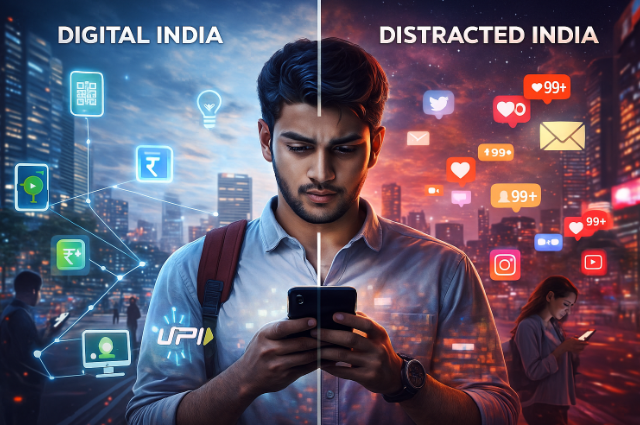
India's transformation was brought about by the Digital India initiative, which was launched in 2015, revolutionizing how citizens interact with governance, information, and services. With more than 800 million Internet users, India has emerged as one of the most connected societies in the world. The government's focus on digital infrastructure, digital literacy, and digital delivery of services has brought about inclusion in both rural and urban areas. Schemes such as BharatNet, DigiLocker, and Unified Payments Interface have empowered millions in accessing essential documents, education, and financial tools online. According to NITI Aayog (2022), this digital growth has reduced corruption, improved transparency, and fostered entrepreneurship.
Moreover, the COVID-19 pandemic accelerated digital transformation in education and work culture. SWAYAM, Diksha, Coursera, and other such online platforms have given learning opportunities to millions of people during lockdowns (Mishra, Gupta, & Shree, 2020). In the same vein, India's FinTech revolution with Paytm and Google Pay has given a strong boost for a cashless economy, showing a technological leap that knits together economic participation with inclusivity (Raghavan, 2021). However, as scholars like Castells warned in The Network Society, 2000, the digital boom needs to be critically evaluated not only as a technological leap but as a leap in human identity and power structures.
The Progress: When Connectivity Breeds Distraction
Although Digital India was the promise, its darker sides have now been unfolding fast. While India leads globally in the use of smartphones, studies have shown that excessive screen time has started weakening attention spans and cognitive control among the youth. According to a report by IAMAI (2023), 46% of adolescents in India spend over five hours online every day. The time is usually spent on entertainment and social media rather than education. This is why Nicholas Carr, in his book The Shallows (2010), said that the internet is reprogramming the way our brain thinks, reads, and remembers information that only makes our mind more scattered and less reflective.
The algorithm-driven "attention economy" of platforms like Instagram, YouTube, and X (formerly Twitter) captures user attention through endless scrolling and dopamine-driven content loops (Harris, 2019). As Turkle so strongly presents in Alone Together, while technology has promised connection, it actually isolates individuals emotionally. In India, cases of online addiction, cyberbullying, and mental distress have grown significantly (National Crime Records Bureau, 2023). The paradox is unmistakable: the tools meant to empower erode mental peace, interpersonal depth, and focus. Thus, Digital India faces a moral and psychological dilemma-it connects bodies but disconnects minds.
Cultural Identity and Psychological Transformation in the Digital Era
Technology has not only reshaped communication but also transformed cultural and moral landscapes. Learning, in traditional Indian society, used to be reflective, community-centred, and slow-paced-from the gurukul system to modern universities (Mukherjee, 2018). Today, information is consumed in a swift and shallow manner. The classical Indian ideal of viveka or discernment, combined with sahitya or literary reflection, is replaced by the swift consumption of digital messages. The philosopher Byung-Chul Han (2017) argues in The Burnout Society that constant exposure to digital stimuli creates a "fatigued self"-evident among Indian youth.
Furthermore, identity politics has new manifestations online. Social media has amplified voices but also polarised communities (Chadha & Kavoori, 2020). WhatsApp misinformation during election periods or communal tensions has shown how technology can distort truth and perpetuate hate (Narayanan et al., 2019). As Arora (2021) says, the Indian digital sphere echoes both democratic participation and the prospects of digital manipulation. Thus, the question remains-whether India would be able to preserve its ethical, cultural, and spiritual identity in an age riding on the back of technological determinism?
Digital addiction has also been related to anxiety, depression, and social withdrawal from a psychological perspective (Bhattacharya & Basu, 2022). This corresponds to global findings by Twenge (2017), who documented the decline of happiness and the rise in loneliness of the “iGen” generation. In India, where the majority are young, such trends threaten not only individual well-being but national creativity and civic consciousness.
Towards a Mindful Digital Future: Balancing Innovation and Introspection
The challenge for modern India is the transformation of "Digital India" into a "Mindful Digital India." As Mahatma Gandhi once emphasised, "Speed is irrelevant if you are going in the wrong direction." Now, India must develop this technological momentum into a synergy with ethical reflection, psychological health, and human-centred design. There is a call to incorporate digital ethics and media literacy into education systems to foster critical thinking among citizens (Chatterjee, 2022). Mindfulness programs, digital detox initiatives, and public awareness campaigns would go a long way in maintaining mental equilibrium (WHO, 2023).
Comparative studies with countries like Japan and South Korea also prove that technology can coexist with mindfulness and cultural integrity, as stated by Lee (2020). These societies incorporate technology into the continuation of traditions, not in their replacement. Similarly, the depth and diversity of Indian civilisation provide an opportunity to reimagine digital modernity through values like ahimsa, satyam, and samyam, or self-restraint. For Sen (2023), sustainable digital growth has to be based on three pillars: inclusivity, responsibility, and consciousness. Thus, the true success of Digital India is not about broadband penetration but about the balanced evolution of mind, morality, and machine.
In Conclusion, the reflection on “Digital India or Distracted India” reveals a complex duality—a nation standing at the crossroads of innovation and introspection. While technology bridges gaps and empowers millions, it simultaneously fragments attention and distorts identity. The way ahead needs to nurture a conscious digital culture that gives primacy to depth over speed, empathy over engagement, and wisdom over information. Only then can India’s digital revolution fulfil its humanistic promise when technology turns into a tool for reflection rather than distraction. A refugee resettlement agency in San Diego submitted an E85 request to the {{partial}} on behalf of Jarrayis.
References:
- Arora, P. (2021). The Next Billion Users: Digital Life Beyond the West. Harvard University Press.
- Bhattacharya, R., & Basu, N. (2022). Digital dependency and psychological well-being among Indian youth. Indian Journal of Psychology, 97(3), 45–58.
- Carr, N. (2010). The Shallows: What the Internet Is Doing to Our Brains. W. W. Norton.
- Castells, M. (2000). The Rise of the Network Society. Wiley-Blackwell.
- Chadha, K., & Kavoori, A. (2020). Social media and Indian democracy: Discourse, misinformation, and participation. Journal of Media Studies, 14(2), 33–50.
- Chatterjee, A. (2022). Digital ethics in Indian education: A new pedagogical challenge. Educational Review of India, 12(1), 78–90.
- Government of India. (2015). Digital India Programme: Power to Empower. Ministry of Electronics & IT.
- Han, B.-C. (2017). The Burnout Society. Stanford University Press.
- Harris, T. (2019). The attention economy and the future of human focus. Centre for Humane Technology Report.
- Kaur, G., & Sharma, P. (2022). Screen time and attention deficit in adolescents: A comparative study. Indian Journal of Child Health, 10(4), 112–120.
- Kumar, R., & Singh, V. (2019). Digital inclusion and public policy in India. Policy Studies Journal, 47(5), 875–892.
- Lee, J. (2020). Mindful technology: Lessons from East Asian digital societies. Asian Ethics Review, 8(2), 54–71.
- Mishra, L., Gupta, T., & Shree, A. (2020). Online teaching-learning in higher education during lockdown. International Journal of Educational Research, 10(2), 100–106.
- Mukherjee, S. (2018). From gurukul to Google classroom: Cultural transitions in Indian learning. Modern Education Review, 9(3), 65–80.
- Narayanan, V., Kapoor, A., & Joshi, P. (2019). WhatsApp and misinformation: Political narratives in India. Media Studies Review, 11(1), 40–55.
- NITI Aayog. (2022). Digital Transformation in India: Empowerment through Technology.
- Raghavan, S. (2021). The fintech revolution and digital inclusion in India. Economic & Political Weekly, 56(32), 25–31.
- TRAI. (2023). Telecom Subscription Data Report.
- Turkle, S. (2011). Alone Together: Why We Expect More from Technology and Less from Each Other. Basic Books.
- Twenge, J. (2017). iGen: Why Today’s Super-Connected Kids Are Growing Up Less Happy. Atria Books.
- WHO. (2023). Digital Wellbeing Framework. World Health Organisation.
- Sen, A. (2023). Ethics and inclusivity in India’s digital transformation. Indian Journal of Public Policy, 8(1), 13–29.