
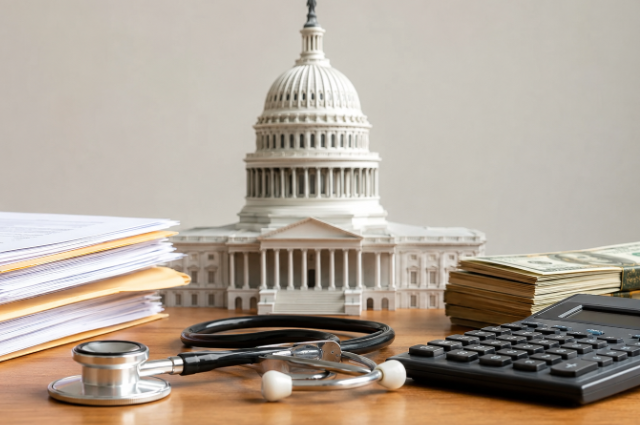
The structural health of American fiscal federalism has long rested on a delicate equilibrium: a complex network of shared financial burdens, matching formulas, and statutory mandates that bind the budgetary fortunes of Washington to those of fifty separate state statehouses. This historical arrangement, frequently termed "cooperative federalism," relies on the assumption that while federal guidelines establish baseline national safety nets, state mechanisms maintain administrative discretion bolstered by proportional federal matching funds. However, the enactment of the One Big Beautiful Bill Act (OBBBA) in mid-2025 fractured this core baseline, introducing an era of aggressive structural retrenchment and fiscal decoupling. By permanently extending the individual income tax code structures initially outlined under the Tax Cuts and Jobs Act (TCJA) of 2017, the federal legislative apparatus severely constrained long-term federal revenues. To balance these massive tax cuts within a highly contentious legislative framework, the OBBBA mandated sweeping, structural reductions across mandatory federal spending programs—most notably targeting Medicaid and the Supplemental Nutrition Assistance Program (SNAP).
As these federal budget shifts fully manifested throughout late 2025 and the first half of 2026, state governments found themselves thrust into a high-stakes fiscal crisis. The statutory machinery of the OBBBA did not merely reduce the top-line dollar amounts flowing from the federal treasury to local sub-agencies; instead, it fundamentally manipulated the administrative rules of engagement. By altering federal matching percentages, accelerating eligibility re-verification cycles, and introducing complex work mandates for older cohorts, the OBBBA effectively turned administrative procedures into financial walls. Consequently, states have been forced to navigate an operational landscape where maintaining historical service delivery models requires an unprecedented injection of localized revenues. This operational shock arrived at a time when macro-stabilization trends were already volatile, forcing state treasuries into deep systemic overhauls.
The academic objective of this paper is to analyze the multi-layered structural variations of state-level reactions to these OBBBA-induced fiscal disruptions. Rather than viewing the state responses as a uniform political monolith, this study reveals a deeply fragmented landscape characterized by divergent institutional capacities and contrasting partisan philosophies. To achieve this objective, the paper is organized across five core analytical sections. Section 2 delineates the constitutional and statutory baseline of the OBBBA, establishing the exact fiscal scale of the federal rollback. Section 3 investigates the operational crises and legislative counter-strategies implemented by states to combat the 12% reduction in overall federal Medicaid financing. Section 4 dissects the administrative burdens and financial strains imposed by the newly altered SNAP cost-split architectures. Section 5 evaluates
the highly specific fiscal relief—and subsequent macroeconomic distortions—produced by the OBBBA’s upward adjustment of the State and Local Tax (SALT) deduction cap to $40,000. Finally, Section 6 synthesizes these findings into an empirical framework of contemporary fiscal federalism, tracing how these combined dynamics alter the long-term viability of sub-national governance in an era of federal abdication.
The Statutory Framework of the OBBBA and the Fiscal Shock
To fully comprehend the magnitude of state-level structural adaptations in 2026, one must first deconstruct the legislative mechanics of the One Big Beautiful Bill Act (OBBBA) of 2025. The bill represents a fundamental ideological shift away from counter-cyclical federal stabilization policies toward a model of decentralized accountability. At its fiscal core, the OBBBA codified a permanent domestic tax architecture that heavily favors supply-side capital preservation, but it did so by inserting structural cost-containment measures directly into the statutory authorizations of the Social Security Act and the Food and Nutrition Act. The most disruptive mechanism utilized within the OBBBA is the permanent downward calibration of matching grant formulas, effectively altering the traditional Federal Medical Assistance Percentage (FMAP) and SNAP administrative cost-share paradigms that have governed state budgeting for generations.
The scale of the aggregate structural deficit imposed on state safety nets by these legislative maneuvers is historic in scope. According to analytical tracking metrics compiled by the Center on Budget and Policy Priorities (CBPP) and the Kaiser Family Foundation (KFF), the OBBBA mandates an overall reduction of $863 billion in federal Medicaid commitments over a ten-year horizon. Simultaneously, the reallocation of SNAP administrative cost splits represents an immediate multi-billion dollar shift in administrative overhead. To contextualize how these top-line reductions alter state-level fiscal mathematics, we define a basic behavioral model of sub-national safety net spending under the OBBBA framework. Let St represent total state safety net expenditures in fiscal year t, defined by the following structural relation:
St = α(Mt / Φt) + β(Ct × [γt / λt]) + ΔSALT
Where Mt represents the total volume of localized medical claims, and Φt represents the statutory federal FMAP matching scalar (which under the OBBBA drops uniformly across regional categories). The term Ct captures the raw administrative transaction cost of safety net enrollment, multiplied by the shifting administrative cost ratio γt / λt, where γt is the state-absorbed administrative percentage (moving from 50% to 75%) and λt is the shrinking federal baseline. The variable ΔSALT captures the secondary revenue elasticity injected into state income pools via the elevated deduction ceiling, acting as a partial, yet highly regressive, fiscal stabilizer. This equation illustrates that as the federal denominator Φt shrinks and the administrative coefficient γt climbs, the required state fiscal commitment St escalates exponentially unless states deliberately suppress enrollment through regulatory barriers.
Beyond the raw mathematical shifts, the OBBBA introduced severe legal and operational constraints that took effect throughout the first half of 2026. Chief among these is the elimination of retroactive federal reimbursement structures, meaning that any state expenditures incurred outside of strict pre-approved federal administrative boundaries cannot be recovered. This has altered state legislative behavior from proactive public health modeling to reactive risk management. Consequently, state treasurers and budget directors have been forced to treat federal funding streams not as dependable baseline assets, but as volatile variables subject to sudden regulatory audit. The resulting institutional friction has transformed state-level budgeting from a process of public resource allocation into a desperate search for structural optimization and cost-containment.
Medicaid Retrenchment: Administrative Attrition and Regional Bifurcation
The 12% contraction in federal Medicaid allocations under the OBBBA has induced the most severe structural strain observed in state budgets since the implementation of the Affordable Care Act. Rather than relying entirely on simple caps, the federal law achieved this retrenchment by embedding aggressive, high-frequency bureaucratic checks directly into the state-administered enrollment process. Specifically, the OBBBA mandated that all states transition from the traditional annual eligibility determination cycle to an intensive, bi-annual (every six months) re-verification model. Furthermore, the statute enacted strict, federally audited work requirements—amounting to 80 hours per month of documented employment or state-approved community service—for all non-disabled, working-age adult beneficiaries aged 19 to 64, with non-compliance resulting in immediate termination of benefits.
State Operational Responses to OBBBA Medicaid Mandates
The mandates have split state-level strategies along deep political and structural lines. In Cohort A states, such as Georgia and Texas, the state executive apparatus embraced the OBBBA guidelines as an opportunity to downsize state spending. By utilizing automated, algorithmic data-matching systems, these states processed re-verifications with minimal human intervention. If an automated check encountered conflicting address data or unverified wage stubs, the beneficiary's enrollment was terminated systematically. This "administrative attrition" successfully lowered state Medicaid expenditures, but it triggered an immediate spike in uncompensated emergency department claims, threatening the solvency of rural healthcare networks. In sharp contrast, Cohort B states actively resisted this trend by absorbing the massive administrative overhead required to conduct manual caseworker outreach, attempting to shelter vulnerable populations from dropping off the rolls due to purely bureaucratic hurdles.
The financial strain of maintaining coverage in these mitigation-focused states has been profoundly damaging to non-welfare budgetary lines. To prevent the disenrollment of hundreds of thousands of low-income families, states like California and New York have had to reallocate billions from capital infrastructure funds and higher education subsidies directly into their state Medicaid agencies. This shift represents a hidden consequence of the OBBBA: by forcing states to cover the federal funding shortfall out of their own pockets, the federal government has indirectly stunted long-term state-level public investments. The long-term macroeconomic outlook for states pursuing this defensive strategy is deeply concerning, as it sets up a structural conflict between public health preservation and the maintenance of basic public infrastructure.
The SNAP Cost-Split Crisis and the Strain on Social Infrastructures
While the Medicaid retrenchment represents the largest sheer volume of capital withdrawn from state ecosystems, the OBBBA’s adjustments to the Supplemental Nutrition Assistance Program (SNAP) have generated the highest concentration of immediate operational friction. Historically, the federal government absorbed 100% of the actual benefit disbursements under SNAP, while dividing the administrative and operational costs—such as eligibility software maintenance, caseworker salaries, and fraud detection units—on a strict 50-50 matching basis with the states. The OBBBA systematically rewrote this balance, scheduling a rapid transition that forces states to shoulder **75% of all administrative overhead**, leaving the federal contribution at a meager 25%. Simultaneously, the law extended strict work-reporting requirements to older adults up to age 65, expanding the administrative tracking burden significantly.
The institutional reality of this cost shift has triggered severe organizational crises within state departments of human services. Tracking employment data and volunteer hours for an older, often underemployed demographic requires an entirely different level of administrative surveillance than managing standard working-age cohorts. To prevent federal sanctions for "payment error rates"—which the OBBBA escalated into severe financial penalties levied against state treasuries—states have had to rapidly hire hundreds of compliance and verification officers. The following blockquote from an internal memorandum issued by the National Association of State Budget Officers (NASBO) in April 2026 highlights the hidden dimensions of this administrative trap:
"The administrative re-engineering required by the OBBBA has inverted the traditional efficiency models of state welfare agencies. State treasuries are now spending more capital on the technological architectures of surveillance and compliance tracking than they are saving through the mandated reduction of benefit rolls. We are effectively witnessing a structural transition where state public funds are being diverted away from direct nutritional assistance and into the expansion of a punitive bureaucratic state apparatus."
The consequences of this administrative crisis extend far beyond state agency ledger sheets; they have directly undermined the stability of local civil food systems and charitable networks. As thousands of individuals lose access to SNAP benefits due to minor reporting discrepancies or an inability to navigate complex online compliance portals, the pressure has shifted entirely onto municipal food banks and philanthropic foundations. Organizations like Feeding America and the Food Research & Action Center (FRAC) have recorded unprecedented demands for emergency food assistance across both urban and rural centers in early 2026. This reality exposes a fundamental flaw in the OBBBA's devolutionary philosophy: private philanthropy and local municipal budgets lack the systemic, counter-cyclical funding capacity needed to absorb structural federal cutbacks, leading to a visible fraying of localized social safety nets.
The SALT Cap Paradox: Regressive Relief and Fiscal Distortions
To secure the legislative votes necessary to pass the OBBBA through a highly fractured Congress in 2025, the bill's architects inserted a major structural concession targeting high-tax, high-population states: a substantial upward recalibration of the State and Local Tax (SALT) deduction cap. Since its implementation under the 2017 TCJA, the SALT cap had been frozen at a strict $10,000 per household, drawing intense opposition from state political leadership in regions with robust local tax bases. The OBBBA raised this deduction threshold dramatically to $40,000 for all households reporting an adjusted gross income (AGI) below $500,000. This policy mechanism creates a fascinating economic paradox within the broader landscape of the 2026 fiscal shock.
On an immediate macroeconomic level, the expansion of the SALT deduction cap has injected substantial liquid capital back into middle-class and upper-middle-class households located in states like California, New Jersey, New York, and Illinois. By allowing households to deduct up to $40,000 of their local property and state income taxes from their federal tax liabilities, the provision has cushioned these families from the broader inflationary and tax pressures embedded elsewhere in the bill. This newfound household liquidity has slightly elevated state sales tax revenues, providing an unexpected, short-term buffer for state revenues. However, econometric modeling reveals that this relief is highly regressive and structurally deceptive, as it fails to address the underlying fiscal deficits impacting low-income safety net programs.
Furthermore, the SALT expansion has introduced severe long-term distortions into state fiscal planning. By tying federal tax relief directly to local tax payments, the OBBBA has insulated wealthier suburban constituencies from the true cost of state public services, while doing absolutely nothing to alleviate the financial desperation of the lowest income quartiles who do not itemize deductions. This dynamic creates an unsustainable political environment within state legislatures: while upper-middle-class voters see their federal tax bills drop, the public programs intended for the state's most vulnerable populations face devastating structural cuts. The result is an increasing divergence within state economies, where localized tax relief for high earners masks a deep and systemic starvation of the public goods and health infrastructures that support the broader population.
The Contemporary Crisis of Fiscal Federalism
The structural transformations observed throughout late 2025 and the first half of 2026 confirm that the One Big Beautiful Bill Act (OBBBA) has initiated a profound crisis within American fiscal federalism. By combining aggressive federal welfare retrenchment with the deliberate devolution of administrative burdens, the law has effectively dismantled the historic baseline of cooperative federalism. In its place, a highly fragmented system has emerged—one where a citizen's access to basic health and nutritional security is determined almost entirely by the fiscal capacity and political orientation of their state of residence. The historical concept of a uniform national social safety net has been replaced by an unstable patchwork of localized policies designed to manage deficit spending rather than promote public welfare.
Ultimately, this research demonstrates that the OBBBA’s reliance on administrative hurdles to drive spending reductions creates a self-defeating cycle for state governance. States that choose to proactively cut their welfare rolls to save money are facing long-term economic damage in the form of failing rural healthcare systems and rising local poverty metrics. Conversely, states that attempt to insulate their populations by absorbing the missing federal funds are burning through their financial reserves, stalling long-term investments in education and infrastructure. As the United States moves further into 2026, these structural contradictions will likely worsen, pushing the relationships between federal and state governance to a critical breaking point. To prevent a permanent unraveling of sub-national public administration, future legislative frameworks must abandon punitive administrative mandates and restore a model of federal-state partnership built on fiscal equity, operational transparency, and a shared commitment to human welfare.
REFERENCES
- Center on Budget and Policy Priorities (CBPP). (2025). The Devolved Burden: Analyzing the Long-Term Fiscal Implications of the One Big Beautiful Bill Act (OBBBA) on State Safety Nets. Washington, DC: CBPP Research Press.
- Kaiser Family Foundation (KFF). (2026). Medicaid at the Crossroads: High-Frequency Re-Verifications, Work Mandates, and State Budget Caps under the OBBBA Framework. San Francisco, CA: KFF Policy Publications.
- National Association of State Budget Officers (NASBO). (2026). The Spring 2026 Fiscal Survey of States: Navigating the Federal Operational Rollbacks. Washington, DC: NASBO Publishing.
- Roberts, J. C. (2026). Learning Resources, Inc. v. Trump, 607 U.S. (2026). Syllabus and Majority Opinion of the Supreme Court of the United States. Washington, DC: Government Printing Office.
- Vance, E. R., & Hollander, M. (2025). The Structural Realignment of American Federalism: Imperial Presidencies, Statutory Overreach, and Sub-National Fiscal Resistance. Journal of Fiscal Federalism & Public Policy, 13(4), 312-345.