
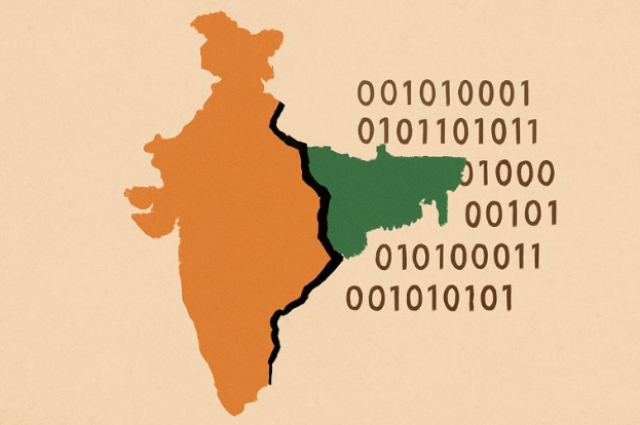
Image by ChatGPT
The Cartography of Contention in Post-Colonial India
The establishment of the Indian Republic in 1950 necessitated an unprecedented constitutional engagement with the country’s profound linguistic heterogeneity. While the democratic state promised to uphold regional cultures, the foundational ambition of a strong, unified nation often entailed a pursuit of linguistic uniformity, centered on Hindi. This inherent tension between centripetal nationalist aims and centrifugal regional identity claims has ensured that language remains the central axis around which administrative policy, cultural identity, and political mobilization revolve. The resulting language policies, often driven by an underlying centralist bias, have periodically generated crises requiring either forceful political negotiation or outright popular agitation to resolve.
A critical analysis of India’s approach to linguistic governance reveals that the success of its policies is frequently judged by their capacity to maintain national unity, rather than their fairness in accommodating diverse cultural claims and protecting group rights. This report seeks to provide an exhaustive examination of this complex history, detailing the contradictory constitutional design, analyzing a historical flashpoint involving the forceful separation and alleged mistreatment of Bengali-speaking populations during the State Reorganization period, and finally, scrutinizing the contemporary political processes that have led to the marginalization and securitization of the Urdu language community. The evidence demonstrates that when the state fails to acknowledge differentiated community claims, it risks transforming fundamental issues of linguistic identity into markers of political conflict and instability.
The Constitutional Crucible: Codifying Hierarchy and Managing Resistance
India's constitutional framework for language, enshrined primarily in Articles 343 and 351, along with the Eighth Schedule, was intended as a compromise between the demand for a national language and the necessity of multilingual federal governance. However, this settlement inadvertently institutionalized a linguistic hierarchy that continues to fuel regional political resistance.
The Official Language Dilemma: Hindi, English, and the 1965 Crisis
Upon the adoption of the Constitution in 1950, Article 343(1) declared Hindi in the Devanagari script as the official language of the Union. This provision represented the fulfillment of a nationalist aspiration for linguistic homogeneity at the central administrative level. Recognizing the immediate practical difficulties inherent in such a transition, Article 343(2) established a crucial provision: the English language would continue to be used for all official purposes of the Union for a period not exceeding fifteen years from the commencement of the Constitution. This set the administrative deadline for the full adoption of Hindi as the sole official language to January 26, 1965.
The approach of this 15-year deadline generated profound political resistance, particularly in the non-Hindi speaking states of South India. The impending move to abolish English as an official medium was perceived not merely as an administrative shift, but as a direct threat to the regional linguistic and economic security of non-Hindi populations. This fear necessitated an immediate political intervention to prevent widespread agitation.
In response to these anxieties, the Parliament enacted the Official Languages Act, 1963. This statute provided for the continued use of English, in addition to Hindi, for all official purposes of the Union, effectively extending the deadline indefinitely. Furthermore, the Act was amended in 1967 to make the use of English compulsory alongside Hindi in certain specified official communications, solidifying a de facto bilingual structure for the Union administration.
This sequence of events reveals a fundamental misjudgment by the framers of the Constitution regarding the intensity of linguistic nationalism. The initial constitutional structure had positioned Hindi as the ultimate official language, implicitly rendering all regional languages subordinate within the central administration. The political necessity of passing the 1963 Act and its 1967 amendment demonstrates that the government prioritized national stability over its ideological goal of swift linguistic homogenization. By requiring non-Hindi regions to actively mobilize to preserve English, the constitutional mechanism effectively created a political deadline that consumed significant political capital that might otherwise have been dedicated to regional development. This outcome aligns with theoretical models, such as the ethnic security dilemma, which explain why concentrated linguistic groups mobilize intensely when they perceive a state policy as a threat to their cultural existence or economic opportunities.
The Eighth Schedule: The Political Economy of Recognition
The Eighth Schedule to the Constitution provides the framework for recognizing languages officially, listing 22 recognized languages as of 2024. Inclusion in this schedule grants significant benefits, including ensuring cultural preservation, providing official recognition in administration and education, and securing increased funding and resources for language development.
Crucially, the constitutional provisions related to the Eighth Schedule are defined in Articles 344(1) and 351. While Article 344(1) established the initial set of 14 languages to be represented in the Official Languages Commission, Article 351 outlines the specific duty of the Union government regarding language promotion. Article 351 explicitly mandates that the Union must encourage the spread of the Hindi language to advance it as a medium of communication for all components of India’s composite culture. This duty includes safeguarding Hindi’s enhancement by integrating, without interfering with its genius, the style and expressions used in Hindustani and the other languages of India listed in the Eighth Schedule. The article further states that Hindi’s terminology should draw mainly upon Sanskrit and secondarily upon other Indian languages.
This constitutional directive establishes a mechanism of institutional linguistic appropriation. By mandating that the Union promote Hindi through the lexicon and cultural genius of the regional languages, the policy ensures that Hindi evolves in a way that is lexically robust and potentially more politically palatable across India. However, this framework simultaneously reinforces the hierarchy by positioning regional linguistic wealth primarily as derivative source material for the advancement of the designated official language. Though English remains essential for constitutional purposes—serving as the language of the Supreme Court and High Courts, and the authoritative text for all laws —it is notably excluded from the Eighth Schedule. This exclusion reflects its status as a necessary working language rather than an officially recognized Indian language worthy of cultural development funding, further complicating the pluralistic approach to language governance.
The Violent Birth of Linguistic States: The Separation and Struggle of Bengali Speakers
The period following independence was defined by massive public pressure for the reorganization of state boundaries based on linguistic criteria. This period led directly to the historical conflict concerning Bengali-speaking populations that were administratively attached to Hindi- or Odia-dominant regions, specifically addressing the user’s query regarding how Bengalis were segregated and mistreated, particularly in border areas like Manbhum.
Central Resistance and the Andhra Catalyst
In the immediate aftermath of 1947, the central government opposed the formation of states along linguistic lines, prioritizing national unity and administrative cohesion. The Dhar Commission, established in June 1948, published its report in December 1948, rejecting language as the primary parameter for dividing states. This position was reaffirmed by the JVP Committee (formed in 1948, reporting in 1949), comprising Jawaharlal Nehru, Vallabhbhai Patel, and Pattabhi Sitaramayya. The committee recommended that the reorganization of states should be delayed and pursued only based on national security, unity, and economic prosperity.
This resistance, rooted in the fear that linguistic demarcation would fragment the nascent nation, was ultimately overcome by intense public mobilization. In 1953, the agitation for the creation of Andhra State, separating Telugu-speaking areas from Madras State, reached a critical juncture with the death of Congress leader Potti Sriramulu after a 56-day hunger strike. This event forced the Government of India to concede and establish the first linguistic state, Andhra, in October 1953.
The creation of Andhra highlighted the need for a comprehensive policy, leading the government to establish the States Reorganisation Commission (SRC) in December 1953. The SRC, chaired by Justice Fazal Ali, with members K. M. Panikkar and H. N. Kunzru, submitted its influential report in September 1955. The Commission widely accepted language as the basis for reorganization, identifying four major factors for consideration: the preservation of the country’s unity and security, linguistic and cultural homogeneity, financial and administrative feasibility, and the planning and promotion of people’s welfare. Crucially, while accepting language as a basis, the SRC rejected the rigid "one language, one state" theory, advocating instead for the creation of 14 states and 6 Union Territories (UTs) on November 1, 1956, through the States Reorganisation Act.
The Dialectics of Dominion: Bengali-Odia Historical Context
The conflict in the border regions, particularly the demands of Bengali speakers for integration with West Bengal and the historical claims involving Odisha (formerly Orissa), must be viewed within the context of centuries of fluid administrative frontiers. Historically, boundaries between Bengal and Orissa, such as those in the Midnapur region, were political and military frontiers, constantly shifting jurisdiction through the medieval and Mughal periods. This fluidity established a precedent for contested control over border populations.
The historical tension between the communities is critical. Odisha was the first pre-independence state organized on the basis of a common language in 1936, a culmination of the Odia nationalist movement. This movement had been significantly catalyzed in the late 19th century by resistance to cultural imposition. Specifically, in 1868 and 1870 AD, the medium of instruction in Odia schools was forcefully enforced as Bengali. This effort to introduce Bengali in place of Odia as the teaching medium sparked a strong agitation among Odia intellectuals, including figures like Fakirmohan Senapati and Gourishankar Ray, who championed the survival and self-identity of the Odia language. This background demonstrates that cultural hegemony was dynamic, setting the stage for the later conflict where Bengali speakers would find themselves in the position of the repressed minority.
Case Study: The Manbhum Conflict and Administrative Suppression (1948–1956)
The separation of Bengali-speaking areas from Bihar, centered in the Manbhum District, provides the specific historical illustration of the alleged 'beating and separation' of Bengalis referred to in the user query. The Bengali Language Movement of Manbhum occurred between 1912 and 1956. When Bihar and Orissa Province was carved out of the Bengal Presidency in 1912, Bengali-speaking Manbhum was included in the new province. When Bihar and Orissa split in 1936, Manbhum remained with the Hindi-dominant Bihar Province.
The situation deteriorated sharply post-independence. In 1948, the Government of Bihar declared Hindi as the only official language throughout the province, including Manbhum, triggering immediate and widespread anger among the Bengali population. The subsequent state policies constituted systematic administrative repression designed to marginalize the Bengali community:
Linguistic Restriction: Hindi was mandatorily taught from primary classes, and the Bengali department in the local Zilla School was closed.
Administrative Marginalization: Bengali officers within the district administration were forcibly transferred to other districts of Bihar, weakening the community's presence in governance.
- Cultural Coercion: Compulsory installation of notice boards in Hindi was mandated for both schools and private business establishments.
- Identity Check: The most egregious measure was the mandatory presentation of a Domicile Certificate for the Bengalis of Manbhum District, a policy specifically targeting their belonging and citizenship rights within Bihar.
These repressive measures sparked the movement led by the Lok Sevak Sangha, established on June 14, 1948, to protect the Bengali language and demand the merger of the district with West Bengal. The movement’s leadership included key figures such as Atul Chandra Ghosh, Labanya Prabha Ghosh, and Bhajahari Mahato.
The escalation of conflict followed several key phases:
Satyagraha Andolan (1949–1951): Initiated after the Bihar government banned protest meetings and processions, this non-violent movement saw thousands of Bengali-speaking agitators arrested. The government aggressively suppressed the protest, leading to the imprisonment of the main leader, Atul Chandra Ghosh, 135 miles away in Hazaribagh Jail. The administrative and judicial suppression resulted in the death of activist Raghav Charmkar while under trial.
Tusu Satyagraha (1954): This unique act of cultural resistance centered on Tusu, a local folk song of Manbhum. The movement ran from January 9 to February 8, 1954, defying government bans by singing the song across the district. When satyagrahis were attacked and women leaders were subjected to lathi-charge (baton charge) in public meetings, leaders such as Bhabini Mahato and Labanya Prabha Ghosh voluntarily courted imprisonment. The police response involved seizing Tusu songbooks and looting the houses of activists, demonstrating the state’s effort to erase the cultural infrastructure of resistance.
The Final March (1956): The culmination of the agitation was a monumental 300-kilometer march led by the Lok Sevak Sangh to Kolkata, beginning on April 20, 1956. After 17 days, the procession reached Kolkata on May 6. This mass political statement forced the hand of the central government. The following day, May 7, satyagrahis besieged Mahakaran (the West Bengal secretariat), leading to 965 voluntary arrests.
The sustained and highly visible nature of the agitation compelled the States Reorganization Commission to address the boundary dispute. The subsequent legislative process resulted in the passage of the "Bengal-Bihar Border Boundary" Bill. The outcome was the split of the Manbhum district and the creation of the new Purulia District (covering 2,007 square miles), which was formally merged with West Bengal on November 1, 1956.
The Manbhum agitation demonstrates that the movement for linguistic states was often a struggle for fundamental civil and administrative rights against policies specifically designed to dismantle the social and economic foundations of a minority community within a state. The success of the non-violent resistance, particularly the Tusu movement, underscored the power of localized cultural resistance, confirming that linguistic nationalism is a potent political force when a minority group is regionally concentrated and thus able to leverage their geographic homogeneity into a successful claim for self-administration. The State Reorganization Act of 1956 thus became the primary mechanism for managing inter-ethnic conflict by using territorial adjustments to accommodate intractable linguistic demands.
Table 1: Phases of the Bengali Language Movement in Manbhum (1948–1956)
Phase/ | Years | Key Leaders & Action | Bihar Government’s Action/Result |
Hindi Imposition & Restriction | 1948 | Establishment of Lok Sevak Sangha | Hindi declared sole official language; mandatory Domicile Certificates for Bengalis |
Satyagraha Andolan | 1949–1951 | Non-violent protests; Arrest of Atul Chandra Ghosh | Banned protests; mass arrests; death of Raghav Charmkar under trial |
Tusu Satyagraha (Cultural Resistance) | Jan–Feb 1954 | Singing of banned local folk songs; voluntary imprisonment (Labanya Prabha Ghosh) | Police violence, seizure of Tusu song books, arrests of 40 satyagrahis |
Final March and Merger | 1956 | 300 km march to Kolkata; Siege of Mahakaran (May 7) | Parliament passed Bengal-Bihar Boundary Bill; Purulia District merged with West Bengal (Nov 1, 1956) |
Language as a Target: The Securitization of Urdu Identity
While the Bengali conflict represented a territorial struggle resolved by boundary delineation, contemporary linguistic politics in India have shifted towards the systemic marginalization and securitization of minority identities, particularly targeting Urdu speakers. The political rhetoric that links this community to security concerns or terms like "terroristr," as implied by the user query, reflects a deep-seated process of communalization where language is transformed from a cultural medium into a political liability.
The Communalization of Urdu and Identity Forfeiture
Historically, Urdu held a cosmopolitan status across large parts of the subcontinent, transcending religious boundaries. It served as a shared lingua franca read by Hindus, Sikhs, and Muslims alike, and underpinned the vibrant anti-colonial struggles and political journalism of the 19th and 20th centuries. The first Urdu newspaper, Jam-e-Jahan Numa, was published in Calcutta in 1822. Even today, Urdu is arguably the only language understood widely from North to South, with newspapers maintaining a broad reach from Hyderabad to Kolkata and Bhopal to Mumbai.
However, the mass politicization movements of the 1920s and 1930s pushed the focus of power towards provinces and districts, elevating the status of vernaculars. This shift, while democratizing political participation, simultaneously enabled rhetoric that drew explicitly on community themes, religious questions, and ethnic differences, which facilitated the communal marking of Urdu. Post-1947, Urdu journalism and the language itself became increasingly associated primarily with the Muslim minority, a political linkage that has proved costly.
This communalization has resulted in profound political marginalization. Many Urdu speakers report feeling that their patriotism is "ambiguously questioned," regardless of their efforts to prove loyalty. This perpetual need to perform patriotism consumes political energy and attention that could otherwise be dedicated to addressing genuine socio-economic concerns or advocating for the survival of the language. Furthermore, the lack of political space means that Urdu speakers, as a group, have struggled to generate a radical cultural imagination or effective political discourse, a failure that contrasts notably with the successful identity politics and mobilization seen among other marginalized groups, such as the Dalits, who utilize languages like Tamil or Hindi.
The decline of Urdu is, therefore, not simply a demographic or administrative shift, but a profound political forfeiture. Because the language is perceived almost exclusively as belonging to a religious minority, the political cost of associating with and advocating for its preservation often outweighs the administrative benefits of state patronage. This vulnerability makes the language easily targeted by populist majoritarian politics, ensuring that linguistic inequality persists across educational systems and governance mechanisms.
The Nexus of Securitization and Language
In the contemporary context, the political discourse surrounding certain linguistic communities has evolved from marginalization to outright securitization—the transformation of a political or cultural issue into a matter of national security. Geopolitical history demonstrates that this rhetorical strategy is highly effective: for instance, the government of Pakistan utilized security discourse, describing Baloch insurgents as "armed terrorists" and blaming external sponsors like India, to justify state actions against internal dissent in the 1970s. This practice of externalizing blame is used to justify emergency posturing against internal and external adversaries.
In India, the established communal marking of Urdu provides a ready-made platform for this securitization strategy. Given that Urdu is already viewed with suspicion and its speakers’ loyalty is routinely questioned , political actors find it expedient to conflate legitimate calls for linguistic rights, cultural preservation, or political mobilization with "latent separatism" or anti-national intent. By framing minority demands in security terms, the dominant political narratives minimize the legitimacy of cultural claims, transforming the struggle for linguistic recognition into a battle against perceived sedition.
This process has tangible impacts on political organization. The Muslim minority, particularly Urdu speakers, has shown mixed success in electoral politics. While they may achieve greater political cohesion and elect members where their population numbers are significant, they struggle to win elections in areas where their numbers are fewer. The political atmosphere fostered by securitization rhetoric discourages broader political integration within the general body politic. This is compounded by the fact that the political movement for Urdu has historically focused on seeking government support and patronage to ensure the language’s survival, rather than fostering self-reliant thriving. This dependency makes the community and its language policies highly vulnerable to shifts in political power and the prevailing securitization climate, contrasting sharply with the proactive, territorial defiance successfully employed by the Bengali speakers of Manbhum.
The geographical dispersal of Urdu speakers across major urban centers (Hyderabad, Kolkata, Mumbai) means they lack the regional concentration necessary to enforce territorial claims, as was successfully achieved in Purulia. Consequently, the community is constrained to seeking institutional, resource-based solutions, which are easier for the ruling establishment to curtail or securitize under pressure. The current political atmosphere, therefore, illustrates the persistence of linguistic inequalities across governance and education, where cultural identity is rendered a liability in the absence of territorial leverage or sufficient political power.
Implications for National Cohesion and Minority Rights
India's journey through language politics is defined by persistent friction between centralized nation-building and decentralized identity assertion. The constitutional design itself, while outwardly celebrating multilingualism through the Eighth Schedule, retains an intrinsic centralist bias through the specific mandate of Article 351 to promote Hindi.
The historical experience of the States Reorganization period, particularly the violent political struggle in Manbhum (1948–1956), serves as a critical lesson in governance. The case demonstrates that administrative overreach, exemplified by Bihar’s systemic attempts to suppress the Bengali language and enforce Hindi assimilation, inevitably triggers fierce resistance that threatens national cohesion. The ultimate resolution—the territorial reorganization leading to the creation of Purulia District in 1956 —proved that accommodating demands based on regional linguistic concentration is a necessary tool for managing inter-ethnic conflict and ensuring stability.
In contrast, the contemporary political landscape illustrates a more insidious form of marginalization: the securitization of linguistic identity. By conflating the Urdu language, and by extension the Muslim minority, with latent separatism or anti-national activity, political rhetoric transforms cultural preservation efforts into a national security issue. This strategy undermines democratic engagement and forces a community to divert resources into defending its loyalty rather than achieving political and economic development.
For the Indian Republic to fully realize its founding principles of equity and diversity, policy frameworks must rigorously address the "ethnic security dilemma" experienced by linguistic minorities. This requires moving beyond mere tolerance to actively strengthening multilingual governance and ensuring equitable access to economic mobility and education for speakers of all recognized and marginalized languages. Failure to fairly accommodate minority demands will continue to breed social tension, confirming that the repression of linguistic identity is fundamentally counterproductive to the long-term unity and integrity of the nation state. The legacy of conflict, from the streets of Manbhum to the securitized political discourse surrounding Urdu, confirms that language remains the fault line where the promise of Indian democracy is most acutely tested.
. . .
Sources used in the report:
- ciaotest.cc.columbia.edu
- Language Policy and National Development in India - Columbia International Affairs Online
- Opens in a new window
- constitutionofindia.etal.in
- 343. Official language of the Union. - Constitution of India
- Opens in a new window
- en.wikipedia.org
- Languages with official recognition in India - Wikipedia
- Opens in a new window
- thelawbrigade.com
- The Controversy Of The National Language In India - The Law Brigade Publishers (India)
- Opens in a new window
- iasgyan.in
- NATIONAL LANGUAGE - IAS Gyan
- Opens in a new window
- questjournals.org
- Many Languages, One Nation: Navigating Linguistic Diversity in India - Quest Journals
- Opens in a new window
- en.wikipedia.org
- Eighth Schedule to the Constitution of India - Wikipedia
- Opens in a new window
- byjus.com
- 8th Schedule of Indian Constitution – Official Languages - BYJU'S
- Opens in a new window
- en.wikipedia.org
- States Reorganisation Commission - Wikipedia
- Opens in a new window
- en.wikipedia.org
- States Reorganisation Act, 1956 - Wikipedia
- Opens in a new window
- prepp.in
- JVP Committee - Indian Polity Notes - Prepp
- Opens in a new window
- polsci.institute
- Linguistic Reorganization of States in India: The 1950s-1960s - PolSci Institute
- Opens in a new window
- prepp.in
- Fazl Ali Commission (States Reorganization Commission) - Indian Polity Notes - Prepp
- Opens in a new window
- quora.com
- What was the Dhar committee and JVP committee in India? - Quora
- Opens in a new window
- geeksforgeeks.org
- Linguistic Reorganization of States in India - GeeksforGeeks
- Opens in a new window
- jetir.org
- From Frontier to Boundary: Emergence of Borderline between Bengal and Orissa in Colonial Times - JETIR.org
- Opens in a new window
- magazines.odisha.gov.in
- Linguistic Movement of Odisha : A Brief Survey of Historiography - E-Magazine....::
- Opens in a new window
- en.wikipedia.org
- Bengali Language Movement (Manbhum) - Wikipedia
- Opens in a new window
- oxfordbibliographies.com
- Democracy and Minority Language Recognition - Political Science - Oxford Bibliographies
- Opens in a new window
- institute.aljazeera.net
- The Silent Death of Urdu Newspapers in India | Al Jazeera Media Institute
- Opens in a new window
- ull.es
- Rethinking Religion and Language in North India: The Hindi ... - ULL
- Opens in a new window
- bgsmcs.fu-berlin.de
- Soheb Niazi: "The Politics of Imagining (in) Urdu in Contemporary India" - Berlin Graduate School Muslim Cultures and Societies
- Opens in a new window
- researchgate.net
- A critical analysis of India and Pakistan's terrorism discourse in the context of geopolitics and imperialism - ResearchGate
- Opens in a new window
- bcn.cl
- India-Pakistan and the problem of terrorism - Observatorio Asia Pacífico
- Opens in a new window
- researchgate.net
- Language as a Tool of Minority Politics: Urdu, in Bihar, India, 1951–1989 - ResearchGate