
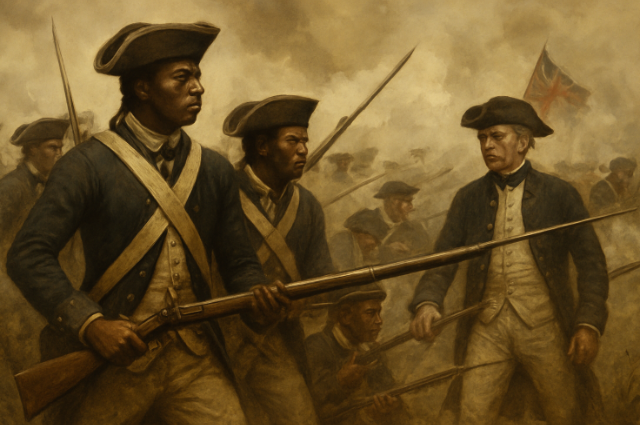
Introduction: Freedom Promised, Freedom Denied
The American Revolution was born out of a bold and world-shaking declaration—that “all men are created equal” and endowed with inherent rights to life, liberty, and the pursuit of happiness. Yet beneath this soaring rhetoric lay a stark and painful contradiction. The very society claiming to fight for human freedom was deeply entangled in the institution of slavery. Many of the Founding Fathers who championed liberty owned enslaved people, and the new nation that proclaimed universal rights denied them to hundreds of thousands of African Americans living within its borders. This tension between ideals and reality sits at the heart of the story of Black participation in the Revolutionary War.
Despite being excluded from the political community and denied basic human rights, Black men—both enslaved and free—played a crucial and often overlooked role in the struggle for American independence. They joined the war not because they believed in the perfection of the Patriot cause, but because they saw within the conflict a rare opening: the possibility of claiming freedom in a world that refused to grant it. Their courage and sacrifice helped shape the outcome of the war, even as the nation struggled to reconcile its principles with its practices.
Among the most remarkable examples of Black military service was the formation of the First Rhode Island Regiment, the first predominantly Black battalion in American history. Born out of political necessity and shaped by the hopes of enslaved men seeking liberation, this regiment challenged racial assumptions of the era and stood as a living contradiction to claims that Black people were unfit for military service or citizenship.
Their story reveals the central tension of the American Revolution: Black soldiers fought for a country that did not yet consider them citizens, striving for a freedom that would not fully arrive for generations.
Slavery, Race, and Politics in Pre-Revolution America
Long before the first shots of the American Revolution were fired, the thirteen colonies had developed societies fundamentally shaped and sustained by slavery. From New England’s maritime trade and rum distilleries to the tobacco plantations of Virginia and the rice fields of South Carolina, enslaved labour formed a crucial backbone of the colonial economy. The wealth that underpinned political influence, landownership, and social power often depended directly on the forced labour of African men, women, and children. Even in colonies with smaller enslaved populations, the economic system was intertwined with slavery through shipping, finance, and international markets. In short, colonial America was not simply a society that tolerated slavery—it was one that relied on it.
This dependence shaped more than the economy; it shaped ideology and culture. By the 18th century, racial beliefs had hardened into claims that Black people were inherently inferior—intellectually, morally, and physically. Such assumptions served to legitimise enslavement in a society that otherwise prided itself on notions of natural rights and liberty. Influential thinkers, ministers, and political leaders circulated arguments that Africans lacked the reasoning ability, discipline, or courage necessary for citizenship or military service. These racist beliefs were widely accepted, even by many who would later champion independence from Britain.
Such thinking translated directly into early military policy. Colonial militias—often considered the first line of defence—were reluctant to arm Black men, whether free or enslaved. Laws in many colonies restricted their participation, fearing that military training might empower them to resist or revolt. Even when wars broke out, including earlier conflicts like King George’s War and the French and Indian War, Black enlistment was sporadic and heavily regulated. The idea of giving weapons to enslaved men was viewed as dangerous, even unthinkable, by many white colonists.
Enslaved people, however, viewed the approaching Revolution through a very different lens. Unlike white Patriots or Loyalists, they were not driven by ideological attachment to republican ideals or monarchical authority. Instead, enslaved Africans saw war as an opening—a rare and unpredictable moment when power structures could shift, and the chance for personal freedom might emerge. They understood that whichever side offered the clearest path to liberation would attract their support. There was no inherent loyalty to either Britain or America; the cause was freedom, not politics.
This perspective created deep anxiety among Patriot slaveholders. On one hand, they feared the consequences of arming enslaved men, believing that doing so could inspire rebellion or set a precedent for claims to freedom. On the other hand, the realities of war were grim: the Continental Army suffered from chronic shortages of manpower, desertions, and casualties. As battles dragged on, the need for soldiers became increasingly urgent. Slaveholders found themselves trapped between their dependence on enslaved labour and their desperate need for military strength.
The tension between ideology and necessity reached a breaking point as the war progressed. Patriots who declared themselves defenders of liberty often resisted allowing Black men to fight beside them. Yet military pressure, British recruitment of enslaved people, and the moral contradiction of fighting for freedom while denying it to others made the issue impossible to ignore.
It was within this charged context—shaped by economic reliance on slavery, entrenched racist ideology, and the urgent demands of war—that the possibility of a Black battalion emerged. The story of the First Rhode Island Regiment cannot be understood without recognising the deep-rooted conflicts that defined pre-Revolution America: a nation striving for independence while built on the foundation of bondage.
Britain’s Strategy and Lord Dunmore’s Proclamation (1775–1776)
When the Revolutionary War began, Britain possessed a clear military advantage. As the world’s most powerful empire, it commanded a large, professional army and the globe’s strongest navy. The American colonies, in contrast, relied on hastily assembled militias, short-term enlistments, and volunteers with minimal formal training. Britain assumed that superior numbers, discipline, and resources would quickly overwhelm the rebellion. Yet the empire also recognised another strategic opportunity—one rooted in the social and economic structure of the colonies. The American economy depended deeply on enslaved labour. Disrupting that labour force by drawing enslaved people away from their Patriot masters would not only weaken the rebel economy but also destabilise their social order.
It was this calculation that led to one of the most consequential decisions of the early war: Lord Dunmore’s Proclamation of November 1775. Dunmore, the royal governor of Virginia, announced that any enslaved person owned by a Patriot who fled to British lines and agreed to bear arms for the Crown would be granted freedom. The declaration was revolutionary in its own right. It weaponised slavery against the colonists, transforming the enslaved population into a potential force for Britain.
The impact was immediate and profound. The promise of freedom spread rapidly across Virginia and beyond, carried by word of mouth among enslaved communities who had long sought a path to liberation. Within months, as many as 20,000 enslaved people fled to British protection across the colonies. Many joined what became known as Dunmore’s “Ethiopian Regiment,” emblazoned with uniforms bearing the motto “Liberty to Slaves.” For the enslaved, the choice was clear: Britain—not the Patriots—had offered them a tangible chance at freedom.
For the Patriot leadership, Dunmore’s proclamation created a crisis of both ideology and security. Economically, the loss of enslaved workers threatened farms, plantations, and industries. Politically, it struck at the heart of the Patriot narrative. The revolutionaries had claimed they were fighting for liberty, yet Britain was the one extending that liberty to enslaved African Americans. This contradiction embarrassed the Patriot cause on the world stage. Militarily, Patriot leaders feared that armed Black Loyalists might form powerful units capable of turning the tide of local battles or inciting widespread slave resistance.
In response, panic spread among slaveholding revolutionaries. Some tightened restrictions on enslaved people, increasing patrols and surveillance. Others began to reconsider their stance on Black enlistment—not out of moral awakening, but out of necessity. The British use of enslaved men highlighted the immense manpower potential the Patriots were ignoring. The fear of losing more enslaved workers to the British—and the dread of facing them as armed opponents—forced colonial leaders to rethink their rigid policies.
As Britain continued to recruit African Americans, Black Loyalist units became an important component of the imperial war effort. These units performed labour, fought in combat, gathered intelligence, and undermined the economic foundation of the rebel colonies. Their presence demonstrated that enslaved people were not passive observers but active agents seeking freedom wherever it was offered.
Lord Dunmore’s proclamation did not merely change the course of the war—it reshaped the moral and political landscape of the Revolution. It exposed the hypocrisy of a rebellion rooted in calls for liberty while sustaining slavery, and it pushed the Patriots toward decisions that would eventually lead to the creation of Black units like the First Rhode Island Regiment.
Washington, the Continental Army, and the Struggle Over Black Enlistment
The question of whether Black men—free or enslaved—should serve in the Continental Army was one of the most divisive issues in the early years of the American Revolution. At the centre of this conflict stood General George Washington. Although later celebrated as a unifying national leader, Washington in 1775 was still very much a Virginia plantation owner shaped by the slaveholding society in which he had lived his entire life. His initial instincts reflected that world: he opposed the enlistment of Black soldiers, fearing it would unsettle the institution of slavery and provoke resistance among Southern states whose support was essential to the war effort.
When Washington first took command of the Continental Army in July 1775, he discovered that New England regiments already contained free Black men who had enlisted during the opening battles of the conflict. Even so, Washington and his officers soon issued directives discouraging the recruitment of Black soldiers, whether free or enslaved. Many Southern delegates in the Continental Congress echoed these sentiments, arguing that arming Black men would spark slave uprisings and threaten the social order from which they derived power.
But the realities of war quickly challenged these ideological positions. By late 1776 and into 1777, the Continental Army suffered catastrophic losses, including desertions, disease, and defeat on major battlefields. Recruitment lagged badly. As enlistment numbers plummeted, Washington found himself commanding a force increasingly unable to meet the demands of a long war. This manpower crisis forced him to reconsider his stance.
At the same time, external pressures intensified the debate. Lord Dunmore’s Proclamation in 1775, which offered freedom to enslaved men who escaped to British lines, sent shockwaves across the colonies and demonstrated the strategic value of Black labour and military service. Thousands fled to the British, undermining Patriot economies and exposing the contradiction between the Patriots’ claims of liberty and their commitment to slavery. Some members of Congress, especially from the North, argued that refusing free Black volunteers only strengthened the enemy.
By late 1777, with battlefield losses mounting and political pressure rising, Washington quietly endorsed a compromise: free Black men would be allowed to enlist, but enslaved men would still be barred from service. This decision reflected both necessity and caution—Washington recognised the indispensable manpower Black soldiers could provide, yet he sought to avoid antagonising Southern slaveholders whose support remained vital.
Though limited, this shift marked an important turning point. It opened the door for thousands of free Black men to serve in the Continental Army, laying early groundwork for the more radical enlistment policies that would emerge in states like Rhode Island shortly afterwards.
Rhode Island’s Revolutionary Experiment: The Slave Enlistment Act of 1778
By 1778, Rhode Island found itself in a dire position. The state had suffered disproportionately heavy losses during the early years of the Revolution. British forces had occupied Newport since 1776, crippling local commerce and draining the state’s economy. Many white men who might otherwise have joined the Continental Army were already serving in militias, working in essential trades, or displaced by the occupation. As enlistment numbers fell and battlefield casualties mounted, Rhode Island struggled to meet its troop quotas. Added to this pressure was the voice of General George Washington, who repeatedly urged states to find new ways to fill their ranks as the war entered a dangerous stalemate. To Patriot leaders, the situation was becoming unsustainable.
Against this tense backdrop, Rhode Island took a radical step. In February 1778, the state legislature passed what became known as the Slave Enlistment Act, a law unlike anything in the rest of the colonies. This act allowed enslaved men to enlist in the Continental Army with one profound guarantee: their service would grant them immediate and permanent freedom. Upon enlistment, they were declared no longer the property of their masters. To ease resistance from slaveowners, the law also promised financial compensation—up to £400 for each enslaved man who joined. It was a bold attempt to solve the manpower shortage while addressing, however imperfectly, the question of slavery that lay beneath the Revolution’s promise of universal liberty.
The response was swift and significant. Within a matter of months, between 130 and 200 enslaved men enlisted under the new provision. This was an extraordinary number for such a small state, and it created a nearly full battalion of African American soldiers—the first instance in American history of a large, organised Black military unit. For the men who enlisted, the law represented a once-in-a-lifetime opportunity to exchange bondage for freedom, and many seized it with determination, despite the risks of war and the uncertainty of their future.
But while the act offered hope to the enslaved, it unleashed fury among many slaveholders and conservative legislators. They argued that the law violated property rights, undermined social order, encouraged slaves to demand liberation, and placed too much financial strain on the state treasury. Rumours spread that the law would lead to the mass emancipation of enslaved people across the colony. Under this intense political and economic pressure, Rhode Island’s legislature quickly retreated. By June 1778—barely four months later—the Slave Enlistment Act was effectively reversed, halting further recruitment of enslaved men.
Yet the damage—or the progress, depending on perspective—was done. Enough men had already enlisted to form a cohesive fighting unit under the Continental Army. These soldiers would become the heart of the First Rhode Island Regiment, later known as the “Black Regiment.” Although white officers led the regiment, the enlisted ranks were predominantly African American during its early years—a highly unusual sight in the armies of the 18th century. Their very existence challenged entrenched racial beliefs and forced the colonies to confront the contradictions of their revolutionary ideals.
The Slave Enlistment Act of 1778 remains one of the most radical policies of the Revolutionary era. For a brief moment, Rhode Island attempted to align its military needs with the broader promise of liberty embedded in the Declaration of Independence. While short-lived, the act created the first substantial Black battalion in American history, demonstrating both the possibilities and the limitations of revolutionary ideals in a nation still struggling to define freedom.
Formation and Composition of the First Rhode Island Regiment
The First Rhode Island Regiment—often called the “Black Regiment”—emerged in 1778 as the direct result of Rhode Island’s bold but short-lived Slave Enlistment Act. Though the law was repealed within months, enough men enlisted under its provisions to form one of the most distinctive units in the Continental Army: a regiment whose enlisted ranks were predominantly Black, commanded by white officers, and composed of a diverse mix of African American, Indigenous, and formerly enslaved soldiers.
From its inception, the regiment’s structure reflected both military necessity and racial hierarchy. The Continental Army maintained white officer leadership throughout, with Colonel Christopher Greene and, later, Jeremiah Olney overseeing the unit. Enlisted men—many of whom had just gained their freedom by enlisting—constituted the backbone of the regiment. While about 130–200 Black soldiers joined during the brief window of legal emancipation, the unit also included Indigenous men from tribes such as the Narragansett and Wampanoag, along with free people of colour who had served since the war’s early years. This racial diversity made the regiment unlike any other in the revolutionary forces.
In terms of equipment and appearance, the First Rhode Island Regiment was outfitted similarly to other Continental units but with distinguishing details. Soldiers received standard-issue muskets, bayonets (when available), cartridge boxes, and powder horns, though shortages often meant irregular supplies. Their uniforms were noted for their dark blue coats trimmed with white, giving the regiment a visual cohesion on the battlefield. Training followed the Continental Army’s evolving drill system, heavily influenced by Baron von Steuben’s reforms in 1778. Recruits were drilled in close-order marching, firing in volleys, maintaining formations, and executing bayonet charges—skills essential for functioning as a disciplined fighting force.
Daily life for the soldiers of the First Rhode Island Regiment mirrored the hardships common across the Continental Army: long marches, scarce rations, disease, exposure, and rigorous discipline. Yet the unique composition of the regiment created an environment where shared adversity forged unity. Many accounts describe strong camaraderie within the ranks, bolstered by a sense of pride in their distinctive role. Their morale was further sustained by the meaning their service held, particularly for those who had only recently secured their own freedom.
For Black soldiers, motivation was deeply personal and profoundly political. Enlistment offered immediate emancipation, a rare path to dignity and self-determination in a society built on racial bondage. Military service promised not only freedom from enslavement but the possibility of proving one’s worth and claiming a rightful place in the new nation struggling to define itself. Even free Black men viewed service as a chance to assert equality, challenge racist assumptions, and participate fully in the cause of independence. Many hoped that their sacrifices would force the nation to confront its contradictions and honour the universal ideals it proclaimed.
The formation of the First Rhode Island Regiment thus represented more than a military necessity—it embodied the aspirations, resilience, and agency of Black and Indigenous men seeking freedom and recognition during America’s struggle for liberty.
The Regiment in Combat: Bravery on the Battlefield
The true legacy of the First Rhode Island Regiment was forged not in legislation or political debate but on the battlefield—most famously at the Battle of Rhode Island in August 1778. This engagement became the defining proof of the regiment’s discipline, courage, and military value, directly contradicting the racist assumptions that had long kept Black men out of colonial armies.
During the battle, the regiment was positioned on the northern end of the American defensive line on Aquidneck Island. Their task was critical: hold a key redoubt and prevent elite Hessian troops from breaking through the Continental Army’s retreating forces. The position was not merely symbolic—it was strategically essential. If the Hessians broke through the line at this point, the entire American force could collapse during its withdrawal to the mainland.
As dawn broke on August 29, 1778, the Hessians advanced in disciplined formation. These soldiers, hired by the British and renowned for their battlefield ferocity, launched a series of three determined assaults on the American defences. The First Rhode Island Regiment bore the brunt of the attack.
According to contemporary reports, the regiment responded with remarkably steady volley fire, maintaining formation under pressure and executing their drills with precision. When Hessian troops attempted to break through with close-quarters combat, the Black regiment met them with fierce bayonet defence, repelling each assault despite being outnumbered. The intensity of the fighting left the earth littered with casualties.
American officers, often sceptical of Black soldiers, offered unusually strong praise for the regiment’s actions. General John Sullivan wrote that the regiment “behaved with distinguished gallantry,” and other officers noted the “extraordinary valour” of the men who held the line long enough for the Continental Army to complete its retreat. Their steadfast defence prevented a tactical disaster and earned the unit a respected place in military accounts of the war.
But the regiment’s contributions did not end there. In the years following the Battle of Rhode Island, the First Rhode Island Regiment continued to serve with resilience and professionalism in a variety of capacities. They performed garrison duty, guarding vulnerable outposts and maintaining the security of strategic locations throughout New England. They endured the misery of winter encampments, sharing the same hunger, disease, and cold that afflicted the entire Continental Army. At times, their strength dwindled due to casualties, disease, and the expiration of enlistments, yet they remained an integral part of the army’s structure.
By 1781, the regiment was consolidated with other depleted units, but its core remained intact and continued to see action. Some soldiers participated in the southern campaigns and later operations in New York. Even when officially merged with other regiments, the identity and cohesion of the Black soldiers remained strong, reflecting the shared purpose that had brought them into service.
The battlefield experiences of the First Rhode Island Regiment carried implications far beyond military records. Their performance directly undermined the widespread colonial belief that Black men lacked the discipline, intelligence, or courage required for effective military service. In standing firm against seasoned Hessian troops, they disproved the racist ideology that had justified their exclusion from civic and military life. Their success demonstrated that ability, not race, determined a soldier’s worth.
On the fields of Rhode Island and beyond, these men fought not only the British but the deeply entrenched prejudices of their own society. Their bravery forced America—however reluctantly—to reconsider its assumptions about race, freedom, and citizenship.
After the War: Freedom Promised, Freedom Withheld
When the Revolutionary War ended in 1783, the Black soldiers of the First Rhode Island Regiment returned home expecting to claim the freedom and dignity they had fought for. Many had risked their lives under the clear promise of emancipation. And while some were indeed granted freedom, the reality for many others was far more painful and unjust.
In several documented cases, formerly enslaved soldiers were re-enslaved by their previous owners or by other white citizens who refused to recognise the legality of their emancipation. The rapid overturning of the Slave Enlistment Act had created confusion that slaveholders exploited. Some insisted that military service did not nullify property rights; others simply seized veterans by force, knowing that courts were unlikely to intervene on behalf of a Black man. A number of soldiers were forced back into servitude quietly, their wartime service erased by the very society they had defended.
Even those who remained free faced a harsh postwar landscape. The new nation was economically unstable, and Black veterans entered a labour market shaped by discrimination. Many struggled to find stable work or earn fair wages. Promised land grants often failed to materialise, and when they did, they were typically small, isolated, or of poor quality. Poverty became a common reality, not because these men lacked skill or discipline, but because freedom without resources offered little stability.
The pension system became another battleground for recognition. To receive a military pension, veterans had to provide documentation of service—an impossible requirement for many Black soldiers who were formerly enslaved and had no personal records. Others needed white witnesses to testify to their service, a process often hindered by prejudice or indifference. Yet dozens of pension petitions survive today, revealing the long and often humiliating effort these men undertook merely to have their service acknowledged by the government they helped create.
White society’s general silence regarding the contributions of Black soldiers added to this injustice. While the heroism of white officers and militia units was celebrated in public monuments, parades, and speeches, the Black veterans of the First Rhode Island Regiment were largely ignored. Their bravery at the Battle of Rhode Island—once praised by commanders—was quickly forgotten in peacetime, when acknowledging their contributions would have challenged the racial order on which early American society continued to depend.
Individual stories reveal the depth of these injustices. Some veterans, like Pero Paget, won their freedom only to spend the rest of their lives in poverty. Others, like Prince Greene, fought for decades to secure a pension, eventually receiving one only in old age. A few, such as Thomas Nichols, appear in court records documenting attempts to re-enslave them. Each case stands as a testament to a broken promise.
For many Black veterans, the end of the Revolution did not bring the liberation they envisioned. It simply marked the beginning of a new struggle—this time, against the nation they had helped to win.
Legacy, Memory, and Historical Significance
The legacy of the First Rhode Island Regiment reaches far beyond the battlefields on which its soldiers fought. At its core, the regiment stands as a direct challenge to the racial ideology that shaped early America. In an era when many white colonists insisted that Black people lacked discipline, courage, or loyalty, the regiment shattered these assumptions through lived experience. Their disciplined formations at the Battle of Rhode Island, their endurance in winter encampments, and their unwavering service demonstrated that military capability was not bound to race. They forced early Americans to confront a contradiction that would echo for generations: a nation founded on liberty was willing to deny liberty to the very people who had helped secure it.
The regiment also occupies a foundational place in the long tradition of African American military service. Their example reverberated into the 19th century, influencing the formation of Black units such as the United States Colored Troops during the Civil War. Later generations of Black soldiers—from the Buffalo Soldiers to the Tuskegee Airmen—continued the struggle for recognition and equality in military service, drawing on a legacy first shaped by the men of Rhode Island’s Black battalion. The regiment’s story is thus not just a chapter in Revolutionary War history, but a cornerstone of the broader African American fight for citizenship, dignity, and participation in national defence.
In the past several decades, this history has finally begun to receive the attention it deserves. Reenactors have worked to bring the regiment’s story to life at public events, dressing in accurate uniforms and educating audiences about their forgotten contributions. Museums and historical societies, especially in Rhode Island, have curated exhibits focusing on the regiment’s formation, combat role, and postwar struggles. Scholars have revisited pension records, military reports, and personal accounts, reshaping the academic understanding of Black participation in the Revolution.
The question remains: why was this history neglected for so long? Part of the answer lies in the uncomfortable truth it exposes. Acknowledging Black soldiers’ bravery would have forced early Americans—and later generations—to confront the hypocrisy of slavery and racial exclusion. Erasing their story made it easier to maintain a national narrative centred on white heroism and political ideals untainted by contradiction.
Today, recovering the history of the First Rhode Island Regiment is crucial not only for historical accuracy but for national identity. Their service speaks directly to contemporary conversations about race, citizenship, military service, and the meaning of equality. In honouring them, we acknowledge both the depth of America’s contradictions and the power of those who fought to push the nation closer to its ideals.
Conclusion: The Unfinished Promise of the American Revolution
The story of the First Rhode Island Regiment reveals the central contradiction at the heart of the American Revolution: a war fought in the name of universal liberty relied on the service of men who were denied liberty themselves. These Black soldiers stepped onto the battlefield with the same courage, discipline, and resolve as their white counterparts, yet the nation they defended refused to see them as equals. Their lives expose the tension between the ideals proclaimed in 1776 and the realities of a society built on slavery and racial hierarchy.
These soldiers fought for a country that did not yet fight for them. They risked everything—life, limb, and what little freedom they possessed—not out of blind loyalty, but in pursuit of something greater: dignity, self-determination, and the hope that their sacrifice might force the United States to live up to its own promises. For many, that hope was not realised in their lifetimes. Freedom was unevenly granted; recognition was delayed or denied; equality remained a distant dream. Yet their struggle did not disappear into the silence of the past. It became part of a larger, ongoing fight for justice that would be carried forward by future generations.
The legacy of the First Black Battalion reminds us that liberty is not secure merely because it is written on parchment. It must be defended, demanded, and lived. These men stood on the front lines of a revolution that was unfinished in their time—and, in many ways, remains unfinished in ours. Their courage challenges us to continue the work of turning the nation’s founding ideals into a lived reality for all.
References & Sources
1. “America’s First Black Regiment Gained Their Freedom by Fighting the British” — History.com
- Offers a readable modern summary of the regiment’s formation under the Slave Enlistment Act of 1778, the Battle of Rhode Island, and the regiment’s significance.
2. “Life, Liberty, and the Moral Dilemma of Slavery: Uncovering the History of Rhode Island’s Black Soldiers during the American Revolution” — U.S. National Park Service (NPS)
- Provides an authoritative overview of why the Act was passed, enlistment statistics, and insight into state-level politics.
3. “1st Rhode Island Regiment” — World History Encyclopedia
- Covers origins, composition (Black, Indigenous, and white soldiers), troop numbers, and overall service history.
4. “‘Negro, Mulatto, or Indian man slave[s]’: African Americans in the Rhode Island Regiments, 1775–1783” — American Battlefield Trust
- Details enlistment policies, integration of Black and Indigenous soldiers, recruitment controversies, and structural changes.
5. Primary Source: “1st Rhode Island Regiment Roll Book (1781–1783)” — Rhode Island State Archives
- A primary-source muster roll containing soldier descriptions, status (free/enslaved), origin, and service data.
6. “First Rhode Island Regiment” — BlackPast.org
- Provides an accessible and concise overview of the regiment’s formation, backlash, enlistments, and long-term historical impact.