
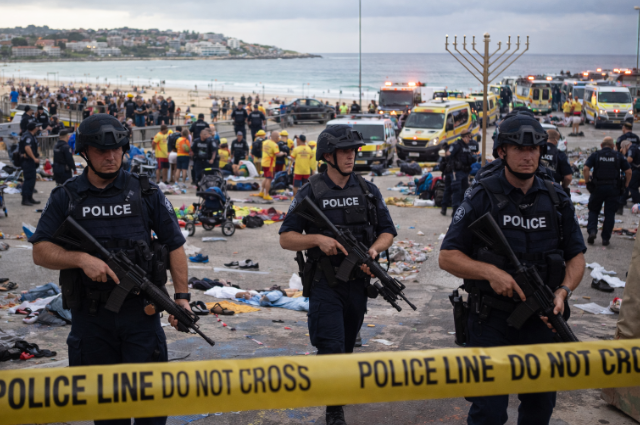
Introduction: A Nation Confronts the Unthinkable
On the evening of December 14, 2025, Australia was shaken by an act of violence that many believed belonged to another era or another country. At Bondi Beach in Sydney—one of the nation’s most iconic and crowded public spaces—two gunmen opened fire on a Hanukkah celebration, killing 15 people and injuring dozens more. In a matter of minutes, laughter, music, and prayer gave way to panic, bloodshed, and disbelief. What unfolded was not only a mass shooting, but the deadliest terrorist attack in Australia’s history, and the worst gun massacre since the 1996 Port Arthur tragedy.
Bondi Beach has long symbolised the Australian ideal: openness, leisure, and multicultural coexistence. It is a place where tourists and locals mingle freely, where families gather without fear, and where diversity is not merely tolerated but visibly celebrated. For decades, Bondi represented a quiet national confidence—that Australia, unlike many other countries, had largely insulated itself from large-scale gun violence through strict firearm laws and social cohesion. The attack shattered that assumption in the most public way possible.
The timing of the violence deepened its significance. The shooting occurred during Hanukkah, a festival that commemorates resilience, faith, and survival in the face of persecution. The event, “Chanukah by the Sea,” was meant to symbolize light overcoming darkness. Instead, it became the site of targeted antisemitic terror. For Australia’s Jewish community, the attack struck at both physical safety and collective identity. For the nation as a whole, it raised unsettling questions about rising extremism and imported ideological violence.
This event marked a historical rupture in Australia’s modern security narrative. Since Port Arthur, mass shootings had been exceedingly rare, reinforcing a belief that comprehensive gun control and strong institutions were sufficient safeguards. Bondi challenged that belief. It revealed vulnerabilities in intelligence, licensing systems, and the protection of public gatherings, even in a country often cited as a global model for gun regulation.
This article confronts the difficult questions that follow such a tragedy: How did this happen in Australia? Why was a community celebration turned into a battlefield? And what must change now—legally, socially, and morally—to prevent such an event from happening again?
Setting the Scene: Bondi Beach and “Chanukah by the Sea”
Bondi Beach occupies a singular place in Australia’s cultural imagination. More than a stretch of sand on Sydney’s eastern edge, it is a national symbol of openness, leisure, and everyday freedom. Locals jog along its promenade at dawn, tourists crowd the shoreline by midday, and families gather in the adjacent parks as the sun sets over the Pacific. Bondi’s appeal lies not only in its beauty but in its accessibility: it is public, communal, and proudly multicultural. For generations, it has embodied the idea that shared space can foster shared identity.
Just inland from the sand lies Archer Park, a modest but well-used green space framed by residential streets and pedestrian walkways. On the evening of December 14, 2025, the park hosted “Chanukah by the Sea,” a community celebration organised by Sydney’s Chabad-Lubavitch network. The event was designed to be inclusive and family-friendly, combining religious observance with public festivity. A temporary stage had been erected, lights strung across the park, and food stalls set up for attendees. The lighting of the menorah—central to the Hanukkah tradition—was scheduled to mark the spiritual heart of the evening.
Sydney’s Jewish community, numbering roughly 120,000 people, is one of the largest and most visible in the Asia-Pacific region. Concentrated primarily in the city’s eastern suburbs, it is diverse in religious practice, ethnicity, and political outlook. Public celebrations such as “Chanukah by the Sea” reflect a long-standing confidence in expressing Jewish identity openly within Australian society. Unlike in many parts of the world, such events have historically required minimal security, reinforcing a sense of belonging rather than isolation.
That expectation of safety was not naïve—it was built on decades of experience. Community festivals across Australia, whether religious, cultural, or civic, typically rely on informal crowd management and limited police presence. The assumption has been that public spaces, especially iconic ones like Bondi, are inherently safe. Attendees on that evening arrived with children, grandparents, prams, and picnic blankets. Many were tourists or passersby drawn in by the lights and music.
In the moments before the attack, the atmosphere was unremarkably joyful. Children played near the stage, families chatted in small groups, and the sound of waves mixed with music and laughter. It was a scene defined by normalcy—precisely what made the violence that followed so profoundly destabilising.
Timeline of the Attack: Eight Minutes That Changed Australia
The attack began shortly after 6:40 p.m., when the evening light was fading, and Archer Park was at its busiest. Witnesses later reported seeing a silver hatchback slow near the perimeter of the park before stopping along a nearby access road. From the vehicle emerged two men, later identified as a father and son. They were carrying long firearms and bags that appeared to contain additional ammunition. Their movements were purposeful rather than hurried, suggesting prior planning and familiarity with the location.
The attackers split almost immediately. The younger man moved toward an elevated pedestrian bridge that overlooked Archer Park, a vantage point offering a clear line of sight across the gathering. The older man lagged briefly, adjusting his weapon. This separation would shape the early moments of the attack—and, crucially, its interruption. Before the older attacker could reach the bridge, he was confronted by two unarmed civilians who sensed something was wrong. A struggle ensued. In an extraordinary act of courage, one of the bystanders managed to wrest a long gun from the attacker. Both men were shot during the confrontation and later died from their injuries, becoming the first victims of the massacre.
Gunfire erupted moments later. From the bridge, the younger attacker began firing into the crowd below, while the older man moved toward the park itself, discharging a shotgun as he advanced. The weapons used were not automatic firearms but a mix of shotguns and rifles, including a straight-pull bolt-action rifle capable of a higher rate of fire than traditional bolt-action designs. The effect was devastating, though the attack remained relatively brief compared with mass shootings elsewhere in the world.
As shots rang out, confusion spread faster than comprehension. Many initially mistook the sounds for fireworks or mechanical noise. That illusion collapsed within seconds. People screamed and ran in all directions—toward the beach, into nearby streets, behind food stalls and trees. Parents grabbed children; some fell while trying to flee. Others froze, unsure where the danger was coming from. The openness that had defined the space moments earlier now offered little protection.
The violence escalated when the older attacker entered the park itself. At this point, another civilian—Ahmed al-Ahmed, a local shop owner who had observed the unfolding attack—charged the gunman. Despite being unarmed, he tackled the attacker and wrestled the shotgun away, forcing him to retreat. This intervention almost certainly saved lives, limiting the attacker’s ability to continue firing at close range. The older gunman fled back toward the pedestrian bridge, where the two attackers briefly regrouped.
Police units, already patrolling nearby due to the area’s popularity, arrived within minutes of the first emergency calls. Officers advanced toward the bridge under active fire. The older attacker was shot and killed during the confrontation. The younger attacker was wounded and taken into custody, ending the shooting approximately eight to ten minutes after it began.
What followed was a scene of profound chaos. The park and surrounding streets were strewn with the injured, discarded shoes, overturned tables, and abandoned strollers. Lifeguards from Bondi Beach ran inland, using surfboards as improvised stretchers. Off-duty medical professionals among the crowd provided first aid, applying pressure to wounds and trying to comfort the dying. Ambulances flooded the area, and hospitals across Sydney activated mass-casualty protocols.
In the immediate aftermath, Archer Park became both a crime scene and a triage zone. Helicopters circled overhead as police secured the wider area, fearing additional threats. Families searched desperately for loved ones, phones ringing unanswered amid sirens and shouted instructions. In less than ten minutes, a peaceful community celebration had been transformed into a national trauma—one whose consequences would reverberate far beyond Bondi Beach.
The Victims: Human Cost Beyond Statistics
In the days following the Bondi Beach shooting, numbers dominated the headlines: 15 dead, more than 40 injured. Yet those figures, necessary for record-keeping and historical comparison, conceal the profound human loss at the heart of the tragedy. The victims ranged in age from just 10 years old to 87, reflecting the multigenerational nature of the gathering. Children attending with parents, teenagers volunteering at the event, adults celebrating with friends, and elderly community members drawn by tradition were all among the dead and wounded. The diversity of ages and backgrounds underscored that the attack was not directed at individuals, but at the community itself.
Several victims carried deep symbolic weight. Among the dead was Alex Kleytman, an 87-year-old Holocaust survivor who had immigrated to Australia from Ukraine decades earlier. His presence at the celebration represented survival, renewal, and the belief that Australia was a safe haven from the hatred that had once consumed Europe. That his life ended in an antisemitic attack during Hanukkah sent shockwaves far beyond Sydney, resonating with Jewish communities worldwide. The deaths of children further intensified the national grief, reviving painful memories of other mass-casualty events where innocence was irreversibly violated.
For families, the impact was immediate and devastating. Parents were left to identify children in hospitals; spouses lost partners in a space that had been associated with joy and routine. The trauma extended outward, affecting classmates, coworkers, neighbors, and entire congregations. Schools in the eastern suburbs brought in counselors, synagogues increased security overnight, and community centers became spaces for collective mourning. The sense of safety that had allowed open celebrations of faith was replaced by anxiety and hypervigilance.
Amid this grief emerged an ethical question that often follows acts of mass violence: how should society remember such events? Many community leaders and commentators argued that the focus should remain firmly on the victims rather than the perpetrators. Naming, contextualizing, and honoring the lives lost—rather than amplifying the notoriety of the attackers—was seen as a moral imperative. This approach sought to deny extremists the attention they seek while restoring dignity to those whose lives were taken.
Memorials and vigils quickly appeared across Sydney and beyond. Candles lined the promenade at Bondi; flowers, handwritten notes, and menorahs filled Archer Park. Interfaith services drew thousands, transforming grief into solidarity. These acts of remembrance served not only to honor the dead but to reaffirm shared values—life, coexistence, and resilience—in the face of hatred.
The Perpetrators: Background, Radicalization, and Motive
Australian authorities identified the attackers as Sajid Akram, aged 50, and his son Naveed Akram, aged 24. Both were residents of Sydney and had lived in Australia for many years. Public records and early investigations indicated that, on the surface, they did not stand out as obvious threats: neither held a prominent criminal profile, and both appeared outwardly integrated into everyday life. This apparent normalcy, however, masked a deeper process of ideological radicalization that unfolded largely out of public view.
The father–son dynamic proved central to understanding the attack. Investigators and counterterrorism experts emphasized that radicalization within families is particularly dangerous, as it reinforces beliefs through trust, authority, and emotional loyalty. In this case, evidence suggested that Sajid Akram played a dominant ideological role, acting as both mentor and validator for his son’s worldview. Rather than a younger individual independently radicalizing online, the pattern pointed toward intergenerational transmission of extremist beliefs, where grievance, identity, and perceived injustice were shared and intensified within the household. Such dynamics reduce the likelihood of external intervention, as radical views are normalized in private spaces.
A critical element in the investigation was the pair’s travel history. Authorities confirmed that both men had traveled in recent years to parts of Southeast Asia, including regions in the southern Philippines known for the presence of Islamic State–affiliated groups. While travel alone does not indicate criminal intent, intelligence agencies noted that these regions have long functioned as ideological incubators and training grounds for extremist networks. The trips raised concerns about exposure to radical preaching, operational guidance, or peer reinforcement, even if no direct organizational command structure could be established.
Material evidence recovered after the attack reinforced the ideological nature of the crime. Police found homemade Islamic State flags and propaganda materials, as well as improvised explosive devices, in the attackers’ vehicle. These items pointed to a worldview rooted in global jihadist narratives rather than personal grievance alone. Officials stated that the attack bore the hallmarks of Islamic State–inspired terrorism: symbolic targeting, public spectacle, and the deliberate selection of a religious minority during a sacred festival. The choice of a Hanukkah celebration was not incidental; it aligned with longstanding antisemitic themes embedded within extremist jihadist ideology.
Antisemitism played a central role in motivating the violence. Global jihadist movements have consistently framed Jews as collective enemies, blending religious distortion with modern conspiracy theories. In recent years, such narratives have been amplified by geopolitical conflicts, social media radicalization, and online echo chambers that collapse global events into local justifications for violence. For the attackers, the Jewish community at Bondi Beach became a symbolic stand-in for a broader ideological enemy, transforming a local celebration into a stage for global hatred.
The Bondi attack also challenges the persistent “lone-actor” myth often invoked after acts of mass violence. While Sajid and Naveed Akram acted without direct operational orders from a known terrorist organization, their actions were not ideologically isolated. They drew inspiration, validation, and tactical ideas from a transnational extremist ecosystem that operates across borders and platforms. This form of decentralized terrorism—where individuals act locally but think globally—has become one of the defining security challenges of the modern era.
Understanding the perpetrators, therefore, requires moving beyond simplistic explanations. The Bondi Beach shooting was not the product of sudden madness or personal despair alone. It emerged from a convergence of family influence, ideological indoctrination, antisemitic hatred, and exposure to global extremist narratives—factors that together transformed belief into mass violence.
Weapons, Access, and Australia’s Gun Law Reality
For nearly three decades, Australia has been cited internationally as a model for effective gun control. In the wake of the 1996 Port Arthur massacre, the federal government introduced the National Firearms Agreement (NFA), a sweeping reform that banned civilian ownership of automatic and semiautomatic rifles, imposed mandatory licensing and registration, required genuine reasons for firearm ownership, and introduced a national gun buyback scheme that removed hundreds of thousands of weapons from circulation. The reforms fundamentally reshaped Australia’s relationship with firearms and dramatically reduced mass-casualty shootings.
Yet the Bondi Beach attack revealed an uncomfortable truth: strict gun laws reduce risk, but they do not eliminate it.
Australia’s firearms framework is federal in principle but administered at the state and territory level, resulting in variations that can create vulnerabilities. In New South Wales, where the attack occurred, individuals may legally own firearms for approved purposes such as sport shooting, hunting, pest control, or occupational use. While background checks and licensing requirements exist, there is no national cap on the number of firearms an individual may own, and waiting periods can differ depending on weapon category and prior ownership. Over time, incremental regulatory relaxations and administrative gaps have diluted the original rigor of post-Port Arthur reforms.
Central to the Bondi shooting was the use of straight-pull bolt-action firearms, a category that has grown in popularity since semiautomatic rifles were banned. Unlike traditional bolt-action rifles, which require the shooter to lift and rotate the bolt manually, straight-pull designs allow the bolt to be cycled with a simple back-and-forth motion. While still legally classified as non-semiautomatic, these firearms enable a significantly higher rate of fire, particularly in trained hands. Their legality reflects a broader pattern in firearms regulation: when one category is banned, technological adaptations often emerge to occupy the space just below the legal threshold.
Investigators confirmed that at least some of the weapons used in the attack were legally acquired under existing licensing rules. The perpetrators held valid firearm licenses, exposing the limits of compliance-based systems that focus on criminal history rather than ideological risk. Radicalization, unlike past violent behavior, is difficult to detect through conventional background checks, especially when it occurs privately or within family networks. There was no evidence that the attackers had been flagged as immediate threats prior to the shooting.
Comparisons with the immediate post-Port Arthur period are instructive. In the late 1990s, the NFA was accompanied by strong political consensus, aggressive enforcement, and a sense of national urgency. Over time, that consensus softened. Gun ownership slowly increased, oversight became more fragmented, and public confidence in the system grew—perhaps excessively. Bondi demonstrated that policy success can breed complacency, particularly when rare events are assumed to be impossible rather than improbable.
The lesson of Bondi is not that Australia’s gun laws failed entirely, but that no legal framework is absolute. Firearms regulation must evolve alongside technology, ideology, and social change. The attack forced a reckoning with the limits of prevention through legislation alone and reignited debates about licensing thresholds, weapon categories, intelligence sharing, and whether public safety demands renewed national coordination.
In confronting these realities, Australia faces a familiar but difficult task: preserving lawful firearm use while acknowledging that even the strongest safeguards require constant scrutiny in an increasingly complex security environment.
Civilian Courage and First Responders
Amid the terror and confusion of the Bondi Beach shooting, acts of extraordinary courage emerged from ordinary people. Before police arrived, unarmed civilians were the first to confront the attackers, responding not out of obligation but instinct. Two bystanders challenged the older gunman as he attempted to reach an elevated position overlooking the park. Their intervention delayed the attack at a critical moment, disrupting the shooters’ plan. Both men were fatally wounded, but their actions almost certainly reduced the scale of the massacre. Their courage represented the highest form of civic responsibility—choosing to act in defense of others at the cost of one’s own life.
One individual came to symbolize this moral bravery. Ahmed al-Ahmed, a local fruit shop owner who witnessed the shooting from nearby, ran toward the sound of gunfire rather than away from it. Seeing the older attacker firing into the crowd, Ahmed tackled him and wrestled away his shotgun. Unarmed and exposed, he forced the gunman to retreat, limiting further close-range casualties. Authorities later stated that his intervention saved many lives. Ahmed did not act as a hero in the cinematic sense; he acted as a human being refusing to remain passive in the face of violence.
Equally vital were the rapid responses of lifeguards and medical professionals, many of whom were off duty at the time. Bondi’s surf lifesavers ran inland from the beach, carrying injured victims on surfboards when stretchers were unavailable. Doctors, nurses, and paramedics who happened to be among the crowd immediately began triage, applying pressure to wounds, improvising tourniquets, and offering reassurance to the injured and dying. Their actions bridged the critical minutes before full emergency services could establish control.
These spontaneous rescue efforts profoundly shaped the outcome of the attack. While police ultimately neutralized the threat, it was civilians who absorbed the first shock, disrupted the attackers’ momentum, and prevented further loss of life. Their actions highlighted a reality often overshadowed in discussions of security and policy: community response matters.
Ethically, the heroism displayed at Bondi invites reflection. Such courage should never be expected or normalized; no society should rely on civilians to confront armed attackers. Yet when systems momentarily falter, human solidarity can become the final barrier between chaos and survival. The bravery shown at Bondi Beach stands as a testament to the capacity for moral action even in humanity’s darkest moments.
Law Enforcement and Intelligence Response
The law enforcement response to the Bondi Beach shooting unfolded under intense pressure, in a densely populated public space already in chaos. Police units were dispatched within minutes of the first emergency calls, aided by the fact that Bondi Beach is routinely patrolled due to its high volume of visitors. Officers advanced toward the sound of gunfire, prioritizing the neutralization of the attackers over perimeter containment—a tactic consistent with modern active-shooter doctrine. Within approximately eight to ten minutes, the threat was brought to an end: one attacker was fatally shot by police, and the other was wounded and taken into custody.
Despite the rapid response, the environment posed extreme challenges. Archer Park and the surrounding beachfront are open, porous spaces with multiple access points, making crowd control exceptionally difficult. Thousands of people fled simultaneously toward the beach, residential streets, and commercial areas, complicating efforts to distinguish victims from potential suspects. Officers were forced to make split-second decisions amid poor visibility, screaming crowds, and incomplete information, all while ensuring there were no additional attackers or secondary devices.
In the aftermath, attention quickly turned to intelligence blind spots. Authorities acknowledged that neither perpetrator had been under active surveillance prior to the attack. While they were legally licensed firearm owners, there was no record of criminal behavior that would have automatically triggered intervention. The case highlighted the difficulty intelligence agencies face in identifying radicalization that occurs privately, within family units, or through encrypted online spaces. Travel to extremist-prone regions, while later deemed significant, had not crossed thresholds requiring monitoring at the time.
A critical early decision was the classification of the attack as terrorism. Within hours, officials publicly described the shooting as an ideologically motivated terrorist act inspired by Islamic State. This swift designation allowed counterterrorism frameworks to be activated, including federal investigative powers and intelligence-sharing mechanisms. It also signaled a clear rejection of narratives that might have minimized the ideological nature of the violence or framed it solely as a criminal or mental-health incident.
Post-incident, multiple reviews were launched at both state and federal levels. These included assessments of firearm licensing procedures, intelligence coordination between agencies, and security protocols for public events involving identifiable communities. Parliamentary inquiries and independent oversight bodies were tasked with evaluating whether warning signs were missed and how similar attacks might be prevented.
While law enforcement succeeded in stopping the immediate threat, Bondi exposed the limits of reactive policing. The challenge now facing Australian authorities is how to strengthen early detection and prevention without eroding civil liberties—a balance that will define the next phase of the country’s counterterrorism strategy.
Political, Legal, and Policy Aftermath
The Bondi Beach shooting prompted an immediate and unusually unified response from Australia’s political leadership. Prime Minister Anthony Albanese addressed the nation within hours, describing the attack as “an act of hatred aimed at the very fabric of Australian society.” He emphasised that the targeting of a Jewish community celebration during Hanukkah constituted terrorism and vowed that the government would respond “with strength, clarity, and resolve.” New South Wales Premier Chris Minns echoed this sentiment, calling the attack “an assault on multicultural Australia” and praising the courage of civilians and first responders while acknowledging systemic failures that demanded urgent review.
In the days that followed, attention turned to firearms regulation. Although Australia’s post-Port Arthur gun laws remained intact, federal and state officials proposed targeted reforms aimed at closing identified gaps. These included introducing a national cap on the number of firearms an individual may own, tightening the criteria for “genuine reasons” for firearm possession, and reinstating longer mandatory waiting periods for additional weapon purchases. Lawmakers also signalled interest in reviewing the legal status of straight-pull bolt-action firearms, which, while compliant with existing law, had demonstrated mass-harm potential.
Another major policy response focused on terrorist symbolism and hate crimes. The discovery of homemade Islamic State flags and propaganda materials at the scene accelerated legislation banning the public display, possession, or promotion of symbols associated with proscribed terrorist organizations. Several states moved to strengthen hate-crime statutes, particularly those addressing religiously motivated violence, with harsher penalties and clearer thresholds for prosecution. These measures were framed not as restrictions on belief, but as safeguards against incitement and intimidation.
Public event security also underwent rapid reassessment. Federal authorities announced increased funding for protective services at religious and cultural gatherings, including visible police presence, vehicle barriers, and risk-based intelligence briefings for event organizers. Community leaders were consulted to balance safety with accessibility, aiming to avoid transforming public celebrations into fortress-like environments.
These initiatives, however, reignited a familiar debate: how far should the state go in the name of security? Civil liberties advocates warned against expanding surveillance powers or criminalizing symbolic expression too broadly. Others argued that the scale and nature of the Bondi attack justified stronger preventive measures, even at the cost of increased state authority.
The policy aftermath of Bondi thus became a test of Australia’s democratic resilience—challenging lawmakers to respond decisively to terror while preserving the freedoms that define the society the attackers sought to undermine.
Media Coverage, Public Discourse, and Social Media
Media coverage of the Bondi Beach shooting shaped public understanding of the event almost as quickly as the violence itself. In Australia, major news outlets largely framed the attack within the context of terrorism, antisemitism, and national security, emphasising the ideological motive and the symbolic targeting of a Jewish religious celebration. Broadcasters and newspapers were notably cautious about naming the perpetrators repeatedly, reflecting lessons learned from previous mass-violence reporting and an effort to center victims rather than attackers.
International media coverage, particularly from the United States and Europe, adopted a more comparative lens. Many outlets highlighted the attack as an anomaly within Australia’s strict gun-control landscape, contrasting it with frequent mass shootings elsewhere. This framing sometimes oversimplified the narrative, focusing narrowly on firearms rather than exploring the deeper ideological and social dimensions of the attack. In some cases, the event was portrayed as evidence that “gun laws don’t work,” a claim contested by Australian officials and researchers who emphasised the rarity of such incidents.
A key fault line in public discourse was the tension between terrorism and mental health narratives. While authorities quickly classified the attack as ideologically motivated terrorism, some commentators cautioned against overlooking mental health factors. Others warned that defaulting to mental illness explanations risked obscuring extremist ideology and unfairly stigmatising people with psychological conditions. The debate revealed broader discomfort with confronting ideological violence when it emerges from within national borders.
Social media amplified both fear and solidarity. In the immediate aftermath, unverified reports of additional attackers and secondary explosives spread rapidly, intensifying panic and confusion. False claims and manipulated images circulated widely before being corrected, demonstrating the ongoing challenge of crisis misinformation. At the same time, digital platforms became spaces for collective mourning and resistance to hatred. Hashtags honouring victims, messages of interfaith support, and fundraising campaigns for affected families spread quickly, countering narratives of division.
The risk of communal backlash was a central concern. Community leaders and journalists urged restraint, emphasising the distinction between extremists and broader religious or ethnic groups. Responsible reporting and public messaging played a crucial role in preventing retaliatory violence or widespread stigmatisation.
Ultimately, the media response to Bondi illustrated the power—and peril—of modern information ecosystems. In moments of national trauma, the stories told, shared, and amplified can either deepen fractures or help societies process grief with clarity and compassion.
Antisemitism in Australia: Context and Consequences
The Bondi Beach shooting did not occur in a vacuum. In the months preceding the attack, Australia experienced a marked rise in antisemitic incidents, including vandalism of synagogues, harassment of Jewish students, online threats, and the circulation of conspiracy-driven propaganda. Jewish advocacy organisations reported record numbers of complaints, reflecting a climate in which antisemitic language and symbolism had become increasingly normalised in public and digital spaces. While most incidents were nonviolent, their cumulative effect was to erode the sense of safety long enjoyed by Jewish Australians.
Global conflicts played a significant role in shaping this environment. Events in the Middle East—particularly highly publicised cycles of violence—often reverberated far beyond their geographic boundaries. In Australia, as in many Western democracies, these conflicts fueled emotionally charged protests, polarised discourse, and a blurring of lines between political criticism and religious or ethnic hostility. For some extremists, global narratives were simplified into moral binaries, allowing distant conflicts to be weaponised against local communities with no direct connection to the events themselves.
Within Sydney’s Jewish community, concerns about security had been growing well before December 2025. Schools, synagogues, and community centers increasingly relied on private security, controlled access points, and police coordination for even routine events. While these measures were effective, they also carried a psychological cost, reinforcing a sense of vulnerability and separation. Public celebrations like “Chanukah by the Sea” were cherished precisely because they symbolised openness and trust—a refusal to retreat from shared civic space. The attack shattered that illusion, forcing a reassessment of what public visibility now entails.
The broader implications extend beyond the Jewish community alone. Antisemitism functions as an early warning indicator of social fracture; when one group becomes a target, others often follow. The Bondi attack raised difficult questions about the resilience of Australia’s multicultural model, which relies on mutual respect, legal equality, and the assumption that cultural expression can occur without fear. If religious identity becomes grounds for violence, the foundations of that model are weakened.
In response, political leaders and community organizations emphasized solidarity and collective responsibility. Interfaith vigils, public condemnations of hatred, and renewed educational initiatives aimed to counteract division. The challenge moving forward is not only preventing violence, but addressing the conditions that allow prejudice to intensify unchecked. Bondi underscored a sobering reality: multicultural coexistence is not self-sustaining—it requires constant vigilance, dialogue, and moral clarity.
Global Comparison: Where Bondi Fits in Mass-Shooting History
The Bondi Beach shooting inevitably invited comparison with other mass-casualty attacks, both within Australia and internationally. Domestically, the closest historical parallel remains the 1996 Port Arthur massacre, which led to Australia’s landmark gun reforms. While Port Arthur was carried out by a lone individual with no clear ideological motive, Bondi differed sharply in intent. It was not only an act of mass violence, but a targeted terrorist attack aimed at a specific religious community, carried out in a highly symbolic public space.
Internationally, Bondi bears closer resemblance to the 2019 Christchurch mosque shootings in New Zealand and the 2011 Oslo–Utøya attacks in Norway. Like Christchurch, Bondi involved ideological extremism, religious targeting, and an effort to terrorize a broader community beyond the immediate victims. Both attacks forced countries with relatively low rates of gun violence to confront the reality that extremist ideology can penetrate even societies with strong social cohesion. Oslo similarly demonstrated how a single, motivated actor—or small cell—can exploit open societies to devastating effect.
Comparisons with the United States reveal further distinctions. Mass shootings in the U.S. occur with far greater frequency and often lack a coherent ideological framework, blending personal grievance, mental distress, and easy firearm access. Bondi, by contrast, was rare, deliberate, and symbolically timed. Its perpetrators sought not just to kill, but to send a message rooted in global jihadist narratives. This combination places Bondi at the intersection of terrorism and mass violence rather than within the broader category of indiscriminate gun crime.
One of Bondi’s historical distinctions lies in how exceptional it was. Australia had gone nearly three decades without a mass shooting of this scale. That rarity intensified national shock and forced a reassessment of long-held assumptions about immunity from such attacks. It also highlighted the evolving nature of threats—from domestic criminal violence to transnational ideological extremism.
International policy responses offer clear lessons. Christchurch prompted immediate gun bans and registry reforms; Norway restricted semi-automatic weapons; Australia is now reevaluating licensing and extremist prevention frameworks. Bondi reinforces a critical insight: terrorism and mass shootings require overlapping but distinct responses. Treating ideologically driven violence as mere criminality risks missing its broader societal and security implications.
Long-Term Implications: Security, Society, and Memory
The Bondi Beach attack is likely to reshape Australia’s security culture in subtle but lasting ways. Public events—once defined by informality and openness—are already undergoing reassessment. Religious festivals, cultural gatherings, and large community celebrations may increasingly feature visible police presence, controlled access points, and advance risk assessments. While these measures can enhance safety, they also risk altering the character of public life, introducing an undercurrent of vigilance into spaces traditionally associated with ease and trust. The challenge ahead lies in protecting citizens without transforming everyday civic experiences into securitized zones.
Beyond physical security, the psychological impact of Bondi may prove more enduring. Australians have long viewed mass-casualty violence as a largely foreign phenomenon, something that happens elsewhere. Bondi punctured that belief. For many, particularly minority communities, the attack reinforced a sense of vulnerability in public spaces. For others, it produced a quieter anxiety—an awareness that no place, however familiar or symbolic, is entirely immune. National trauma does not always manifest as fear alone; it can also appear as cynicism, withdrawal, or diminished trust in shared narratives of safety.
Trust in institutions will be a central factor in how this trauma is processed. Public confidence depends on transparent investigations, accountability for failures, and credible policy responses. If authorities are perceived as evasive or reactive, the attack may fuel skepticism about the state’s ability to anticipate and prevent extremist violence. Conversely, clear communication and evidence-based reforms can help restore faith that institutions are capable of learning and adapting under pressure.
How Australia remembers Bondi will also shape its long-term meaning. Nations construct memory through memorials, anniversaries, education, and public discourse. The danger lies in allowing the event to fade into abstraction or, worse, spectacle. Centering victims, acknowledging community resilience, and preserving historical accuracy are essential to ensuring remembrance serves understanding rather than fear. Memory, when handled responsibly, can become a tool for prevention rather than paralysis.
Perhaps the greatest long-term risk is the normalization of violence. When attacks are absorbed into routine news cycles, societies risk lowering their moral alarm thresholds. Bondi stands as a warning against that drift. Its legacy will depend on whether Australians treat it as an aberration to be understood and prevented—or as a grim but accepted feature of modern life. The choice between those paths will define not only security policy, but the ethical character of the nation itself.
Conclusion: Light After Darkness
The Bondi Beach attack left scars that statistics cannot measure. Lives were lost in a place associated with joy, openness, and belonging, turning a moment of celebration into one of grief. Yet alongside the loss emerged stories of courage, compassion, and solidarity—ordinary people who acted under extraordinary pressure, communities that refused to retreat into fear, and a nation that paused to mourn together. In this contrast between brutality and humanity lies the clearest lesson of Bondi: darkness may strike suddenly, but it does not have the final word.
The tragedy also places a moral responsibility on both society and the state. Governments are obliged to confront uncomfortable truths—about extremism, security gaps, and social tensions—without denial or political convenience. Society, in turn, bears responsibility for resisting hatred in all its forms, for challenging dehumanizing narratives, and for refusing to let fear harden into suspicion of entire communities. Prevention is not only a matter of laws and policing; it is equally a matter of education, dialogue, and ethical clarity.
Bondi underscores the fragile balance between freedom, vigilance, and unity. Open societies depend on trust, yet trust cannot survive without protection. Excessive security risks eroding the very freedoms it seeks to defend, while complacency leaves those freedoms exposed. Navigating this balance will define Australia’s response long after headlines fade.
Ultimately, remembrance is itself a form of prevention. To remember Bondi truthfully is to honor the victims not as symbols of terror, but as individuals whose lives mattered. It is to ensure that their loss strengthens collective resolve rather than collective fear. If Australia can carry that memory with honesty and purpose, then even in the wake of profound darkness, a measure of light can endure.
References
Gun Laws, Weapons, and Policy (Australia)
- Australian Institute of Criminology – Firearms in Australia
- Parliament of Australia – National Firearms Agreement
- NSW Police – Firearms Registry & Licensing
- Kalesan, M. et al. (2018). Firearm legislation and mass shootings
Terrorism, Radicalization, and Extremism
- Australian Security Intelligence Organisation (ASIO) – Annual Threat Assessments
- United Nations Office of Counter-Terrorism – Radicalization pathways
- Institute for Strategic Dialogue – Online Extremism & Lone-Actor Terrorism
- Europol – Terrorism Situation and Trend Reports
Antisemitism & Hate Crimes (Australia & Global)
- Executive Council of Australian Jewry – Antisemitism Reports
- Anti-Defamation League – Global Antisemitism Index
- Australian Human Rights Commission – Racism and Religious Hate
- United States Holocaust Memorial Museum – Contemporary Antisemitism
Media, Misinformation, and Crisis Reporting
- Reuters Institute – Journalism, Terrorism & Ethics
- Dart Center for Journalism & Trauma
- World Economic Forum – Misinformation during crises
Comparative Mass Violence & Case Studies
- Port Arthur Massacre – National Museum of Australia
- Christchurch Mosque Attacks – Royal Commission Report (NZ)
- Oslo & Utøya Attacks – Norwegian Government Report
- Gun Violence Archive (U.S. comparison data)
Public Memory, Trauma, and Collective Resilience
- National Academies of Sciences – Trauma & Social Resilience
- World Health Organization – Psychological impact of violence
- UNESCO – Memory, violence, and prevention