
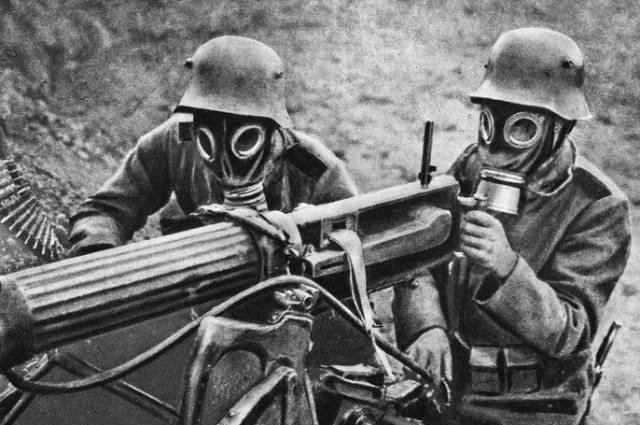
Introduction: A New Kind of Horror
World War I introduced the world to industrialised killing on a scale never seen before, and nowhere was this more evident than on the battlefields of the Western Front. Soldiers lived for months in narrow trenches carved into mud, surrounded by rats, lice, and the constant thunder of artillery. Death could come from sniper fire, machine-gun bursts, collapsing dugouts, or diseases that thrived in the filth. Yet amidst all these dangers, the men at the front soon encountered something even more terrifying—something silent, drifting, and utterly unfamiliar.
On the evening of 22 April 1915, near the Belgian town of Ypres, German forces released a strange yellow-green cloud from thousands of cylinders along their front line. As it rolled slowly toward French and Algerian troops, many assumed it was smoke from a new kind of bombardment. Within seconds, however, soldiers began choking violently. Some clutched at their throats, others collapsed in convulsions, and many fled blindly, coughing up froth as their lungs filled with fluid. It was the world’s first large-scale chlorine gas attack, and it changed the nature of warfare forever.
Poison gas was not the deadliest weapon of the war—artillery, disease, and machine guns claimed far more lives. But gas was, without question, the most feared. It attacked invisibly, drifting into trenches without warning. It scarred bodies, blinded eyes, burned lungs, and left survivors with lifelong agony. Its terror lay not only in what it did, but in the helplessness it created.
The Ypres attack opened the door to an entirely new form of combat—one that blurred the boundaries between military innovation and moral transgression. Chemical warfare horrified the world, reshaping battlefield tactics, public opinion, and ultimately the laws of war that sought to prevent such suffering from ever occurring again.
Background: Why Gas Emerged in WWI
By late 1914, the Western Front had solidified into a vast and immovable line of trenches stretching from the North Sea to Switzerland. Early hopes of a quick war had vanished. Instead, both sides faced a brutal stalemate defined by barbed wire, entrenched machine guns, and relentless artillery. Traditional offensive tactics—mass infantry charges across open ground—proved catastrophic in the face of modern firepower. As months passed without meaningful breakthroughs, military leaders began searching desperately for a new weapon that could shatter the deadlock.
Germany, with the world’s most advanced chemical industry, saw an opportunity. Firms like BASF, Bayer, and Hoechst dominated global dye and chemical production, giving Germany unparalleled access to toxic industrial gases and the expertise to weaponise them. Influential chemists, including the famed Fritz Haber, argued that poison gas could force enemy troops out of their trenches, opening gaps that infantry could exploit. This vision appealed to military strategists frustrated by the war’s stagnant front lines.
Yet chemical weapons were not born without controversy. Even before WWI, the international community had debated their morality. The Hague Conventions of 1899 and 1907 explicitly prohibited the use of “poison or poisoned weapons” and banned projectiles designed to spread asphyxiating gases. However, these agreements left loopholes—especially regarding gas released from cylinders rather than fired in shells. Each nation interpreted the restrictions differently, and in the race for battlefield dominance, legal ambiguities often gave way to military necessity.
Before chlorine clouds engulfed Ypres in 1915, both sides had already experimented with milder agents. The French used small quantities of ethyl bromoacetate, a tear gas, in late 1914. The Germans responded in early 1915 with xylyl bromide, another lachrymatory agent, though cold weather hindered its effectiveness. These early attempts revealed that chemical irritation could disrupt enemy positions, but they lacked the decisive punch needed for a breakthrough.
The stage was set for escalation. The technological capability existed, the legal restraints were weak, and the strategic pressures were immense. In this climate, it was almost inevitable that the warring powers would unleash something far deadlier—a weapon that promised tactical advantage but introduced a new dimension of horror to modern warfare.
The First Major Gas Attack: Ypres, 22 April 1915
In the spring of 1915, the medieval town of Ypres became the centre of a decisive confrontation between Allied and German forces. The Second Battle of Ypres marked Germany’s attempt to test a new weapon on a large scale and break the stalemate that had gripped the Western Front. The Ypres Salient—a vulnerable bulge in the Allied lines—was held by a mix of French, Algerian, and newly arrived Canadian troops. It was here that the German High Command chose to unleash a weapon that they believed might finally deliver the elusive breakthrough.
At around 5:00 p.m. on 22 April 1915, German troops opened thousands of steel cylinders embedded in their forward trenches. From them poured 168 tons of chlorine gas, drifting silently across no man’s land in a low, pale green cloud nearly six kilometres wide. The light evening breeze carried the deadly vapours directly toward the unsuspecting Allied positions. Many soldiers watched its approach with curiosity, mistaking the cloud for smoke or a harmless ruse.
Within moments, the horror became clear. Chlorine reacts violently with the moisture in human lungs, forming hydrochloric acid. As the gas enveloped the trenches, men began coughing, choking, and clawing at their throats. Witnesses described troops collapsing in heaps, their faces contorted in agony. Others stumbled blindly, their eyes seared by the gas. Some fled in panic, froth dripping from their mouths as their lungs filled with fluid. Algerian riflemen broke ranks, retreating in chaotic waves, while French territorials fought to breathe as the chlorine stripped the air from their lungs.
The effect was devastating: entire sections of the line crumbled within minutes, leaving a massive four-mile gap in the Allied defences. The Canadians, positioned near the edge of the gas cloud, rushed in to prevent a complete collapse. Fighting through coughing fits and burning eyes, they mounted desperate counterattacks to stabilise the front, often without proper protection.
Ironically, the Germans themselves seemed unprepared for the magnitude of their success. Shocked by the unprecedented level of devastation—and lacking reserves ready to exploit the breach—they hesitated. Many German soldiers feared entering the still-lingering gas cloud, unsure of its effects on their own troops. By the time they advanced tentatively into the abandoned Allied trenches, the opportunity for a decisive breakthrough had largely passed.
Eyewitness accounts from the attack are haunting. One Canadian officer described seeing “men dying on the ground like fish out of water.” Another wrote of bodies “turned greenish-yellow, the colour of the gas itself.” The surreal image of blinded soldiers stumbling toward medical stations, hand on the shoulder of the man in front, became an enduring symbol of the war’s brutality.
The chlorine attack at Ypres shocked the world. Though only the first of many chemical assaults during the war, it demonstrated instantly that gas could reshape battlefield tactics and instil terror far beyond its immediate casualties. Overnight, nations realised that the rules of warfare had changed—and a new arms race in chemical weaponry had begun.
The Science of Death: Types of Poison Gases Used in WWI
Chemical warfare in the First World War relied on a range of toxic substances that attacked the human body in profoundly different ways. While the public often imagined gas as a single, uniform threat, soldiers quickly learned that each type had its own unique colour, smell, and horror. From choking agents that dissolved the lungs to blister agents that burned the skin, poison gas became a signature weapon of psychological terror—made more effective by uncertainty and the limits of early protection technology.
- Chlorine Gas
Chlorine was the first truly destructive agent used on a large scale. A yellow-green gas, heavier than air, it seeped downward into trenches, dugouts, and shell holes—places where soldiers instinctively sought cover. Its sharp, bleach-like smell gave only a moment’s warning before the real damage began.
When chlorine enters the lungs, it reacts with moisture to form hydrochloric acid. This acid destroys respiratory tissue, causing violent coughing, burning in the chest, and eventually a buildup of fluid that leads to pulmonary oedema—effectively drowning the victim from the inside. Accounts from survivors describe a sensation of suffocation so intense that many tore off their masks in panic. At lethal concentrations, death could come in minutes.
Tactically, chlorine offered an initial shock advantage. Its visibility and distinctive colour created dramatic panic among unprepared troops. But the same properties also limited its usefulness. Chlorine was highly dependent on wind direction; shifts could blow the gas back onto the attacking forces, a risk seen at Loos in late 1915. It also dispersed quickly in open terrain. Once gas masks became standard issue, chlorine’s ability to cause mass casualties was greatly reduced, though its psychological impact remained strong.
- Phosgene
If chlorine introduced the world to chemical warfare, phosgene perfected it. Responsible for an estimated 70–85% of all gas-related deaths in WWI, phosgene was far deadlier and far more insidious. Unlike chlorine, phosgene is nearly colourless, with only a faint smell resembling “musty hay.” Soldiers often inhaled a fatal dose without realising it.
Phosgene’s most terrifying characteristic was its delayed effect. Victims frequently showed little or no immediate symptoms; they could even walk, talk, or return to duty. But within 24 to 48 hours, fluid began to fill the lungs as capillaries ruptured internally. Soldiers who appeared unharmed at first would later collapse, choking and gasping as their lungs failed. This delay made phosgene extraordinarily effective—it created confusion, delayed treatment, and increased fatality rates.
In tactical terms, phosgene could be delivered by artillery shells, making it far more flexible than chlorine clouds. It also worked well in combination with chlorine: the visible chlorine forced soldiers to don their masks, while the nearly invisible phosgene penetrated defective or poorly fitted equipment. By 1916, phosgene had become the primary choking agent of the war, feared far more than chlorine because of its stealth and lethality.
- Mustard Gas (Blister Agent)
While chlorine and phosgene attacked the lungs, mustard gas (sulfur mustard) struck the body’s exterior. Introduced by Germany in 1917, it was not primarily designed to kill but to incapacitate, maim, and cause prolonged suffering. A powerful blister agent, mustard gas, caused large, painful burns on any skin it touched. Even tiny droplets could create blisters the size of coins or larger. When inhaled, it burned the throat and lungs; when it entered the eyes, it caused temporary or permanent blindness.
Unlike choking agents, mustard gas was persistent—a quality that made it uniquely devastating. Heavier than air and volatile at low temperatures, it could linger in soil, water, and clothing for days or even weeks. Contaminated ground became unusable, bunkers became death traps, and soldiers entering affected zones could suffer burns simply by brushing against exposed surfaces.
The agent also had a delayed onset. Symptoms often appeared 4 to 12 hours after exposure, catching soldiers long after they believed the danger had passed. Medical units were overwhelmed by the sheer number of casualties, as mustard gas injuries required intensive, long-term care. Even though its lethality was lower than phosgene, its ability to incapacitate tens of thousands made it one of the most strategically disruptive weapons of the war.
Other Agents & Combinations
Beyond the major agents, armies deployed a range of other chemicals. Tear gases, such as xylyl bromide and chloroacetone, were used to irritate the eyes and respiratory passages, often forcing soldiers to remove or adjust their masks—leaving them vulnerable to deadlier gases released moments later.
Armies also experimented with binary mixtures, combining gases to maximise their effects. The chlorine-phosgene blend was most common, using chlorine to alert the enemy and drive them into their masks while invisible phosgene slipped through mask filters or mask leaks. Later shells incorporated irritants with choking agents, or even smoke to mask gas delivery and confuse defenders.
By the final years of the war, chemical agents had evolved into layered systems of attack—designed not simply to kill but to demoralise, confuse, and overwhelm the enemy. The diversity of gases deployed underscored the industrial scale and scientific ambition behind chemical warfare, transforming poison gas from a crude experiment into one of WWI’s most feared innovations.
Gas on the Battlefield: Deployment, Tactics & Technology
When poison gas first appeared on the Western Front in 1915, its delivery was crude and unpredictable. The Germans’ initial method at Ypres—releasing chlorine from thousands of cylinders buried along the front line—relied entirely on the wind. This “cylinder discharge” approach had the advantage of releasing enormous volumes of gas at once, but it also posed severe risks. If the wind shifted suddenly, the gas could drift back onto friendly troops, a danger that became horrifyingly real during the Battle of Loos in September 1915. There, British forces released chlorine clouds only to have the wind change direction, blowing the gas back over their own trenches and causing significant casualties. Experiences like Loos exposed the limitations of early gas deployment and convinced all armies that more controlled methods were necessary.
By 1916, military engineers began shifting from cylinder releases to artillery-based gas delivery, which revolutionised chemical warfare. Gas shells allowed armies to target specific positions, maintain secrecy, and deploy gas even in unfavourable weather. Shells also produced less visible clouds, making detection harder for the enemy. Phosgene and later agents became especially effective when delivered by artillery because they could be fired deep behind enemy lines—into reserves, command posts, or areas where soldiers had removed their masks.
Another major innovation was the Livens projector, developed by British officer William Livens. Resembling a large, buried mortar tube, it could launch huge drums of gas-filled explosives over considerable distances. Multiple projectors could be fired simultaneously, creating an instantaneous wave of gas far more concentrated than cylinder releases. Livens projectors proved especially effective in large coordinated assaults, saturating enemy trenches with chemicals just before the infantry advanced.
In addition to projectors, both sides used light trench mortars to fire small gas bombs into enemy positions. These allowed localised gas harassment, especially at night or during raids. Mortar-based attacks often combined smoke and irritants with lethal agents, creating confusion among defenders and making it harder for them to determine which gas had been used.
As the war progressed, gas became fully integrated into major offensives rather than being treated as an experimental or standalone weapon. At the Somme, Arras, Passchendaele, and Cambrai, gas shells were used to weaken enemy defences before infantry attacked. Mustard gas, with its ability to contaminate the ground for days, became a strategic tool for shaping the battlefield. It was frequently used to deny access to supply routes, choke points, and assembly areas, forcing enemy troops to disperse or fight from less favourable positions.
Even when gas caused few fatalities, its psychological impact was enormous. Soldiers lived in constant fear of invisible clouds drifting toward them. Gas alarms—bells, rattles, horns—could spark panic instantly. Troops were trained to put on masks within seconds, and even minor delays could mean death. The mere hint of gas—an unusual smell, mist, or shell burst—could halt an attack or disrupt an entire sector. Enemy commanders often used gas to exhaust troops, forcing them to wear uncomfortable masks for hours, reducing efficiency and morale.
By 1917–1918, chemical weapons had become an indispensable part of the tactical vocabulary of the war, shaping operations on every front. While they rarely produced decisive breakthroughs, their integration with artillery, infantry movements, and battlefield psychology ensured that gas remained one of the most feared components of industrial warfare.
Human Experience: Firsthand Accounts & Psychological Impact
Despite its relatively limited lethality compared to artillery, poison gas became one of the most psychologically devastating aspects of the First World War. Unlike bullets or shells, gas was insidious—silent, drifting, and invisible at times. Its effects unfolded inside the body, turning a soldier’s own breath against him. Eyewitness accounts from British, Canadian, French, and German troops capture the raw terror better than any strategic analysis.
British soldiers described the first chlorine attack at Ypres as a strange, ghostlike cloud rolling slowly across no man’s land. Many initially watched with curiosity rather than fear. Then the smell hit—an acrid, metallic scent “like pepper and pineapple,” as one Canadian recalled. Within seconds came the choking. Men began coughing uncontrollably, their lungs burning as chlorine reacted with moisture inside the body to form acid. “It felt like my chest was being crushed,” wrote a French African soldier. “You try to breathe, but it is the gas breathing for you.”
A British private remembered seeing comrades fall “as if struck by an invisible hammer.” Others clawed at the earth, gasping for air that would not come. Some ran blindly into machine-gun fire, preferring bullets to suffocation. One German soldier, present during a later Allied attack, described watching men “turning greenish-yellow, vomiting, stumbling like drunkards,” the gas clinging to their clothes and skin.
Many accounts speak of temporary madness. The combination of suffocation, burning eyes, and overwhelming panic caused men to scream, tear off their clothing, or try to bury their faces in the mud for relief. Gas stripped soldiers of the illusion of control. “With shells, at least you hear them,” wrote a Canadian officer. “With gas, you don’t know you’re dying until you’re already dead.”
The visual trauma of gas attacks was captured most famously in John Singer Sargent’s painting Gassed (1919). It depicts a line of blinded soldiers, each placing a hand on the shoulder of the man ahead, shuffling slowly toward a dressing station. The powerful golden light contrasts with the horrific imagery—rows of men stumbling in bandages, their eyes swollen shut from mustard gas. This painting became an emblem of the human suffering inflicted by chemical warfare.
Such scenes were common on the Western Front, especially after mustard gas appeared in 1917. Unlike chlorine or phosgene, mustard gas attacked the skin and eyes. Victims developed enormous blisters the size of coins or even fists. Eyes burned and fused shut. Some soldiers awoke unable to open their eyelids, trapped in darkness for days. The smell of mustard gas—often described as garlic or horseradish—spread panic instantly through trenches. Troops knew that even a tiny drop on the skin could incapacitate them for weeks.
Evacuation lines after gas attacks were among the war’s most haunting sights. Witnesses described long columns of injured men, guided by orderlies or one another, some vomiting, others whimpering softly as their lungs filled with fluid. There were cases of entire platoons being marched back nearly blind, keeping formation only by physical contact. One medic wrote of “endless human chains, hands on shoulders, shuffling toward the rear, the sound of their coughing echoing like wind through dead trees.”
Beyond the front, gas generated widespread civilian fear. As German Zeppelins began bombing British cities, rumours spread that they might drop chemical agents on London or Paris. Newspapers published diagrams of how gas might settle in city streets. Families purchased improvised gas hoods; some slept in basements with buckets of water nearby, thinking moisture would neutralise the poison.
Governments capitalised on this anxiety. Posters warned dramatically: “There are two kinds of men in a gas attack: the quick and the dead.” Propaganda portrayed gas as a barbaric enemy weapon, reinforcing outrage and moral condemnation. The psychological dimension of gas warfare thus extended far beyond the trenches, shaping public opinion, fueling hatred, and contributing to demands for post-war bans.
Ultimately, gas’s greatest power lay not in killing but in terrifying—altering how soldiers saw the battlefield and how civilians imagined modern war. The memory of choking clouds and blinded columns lingered long after the armistice, haunting a generation that had breathed death itself.
Medical Consequences & Long-Term Health Effects
The medical consequences of chemical warfare in the First World War were immediate, devastating, and often overshadowed by the long shadow of chronic illness that followed survivors for decades. Unlike bullets or shrapnel, poison gas maimed in ways that were invisible at first but relentlessly destructive within hours. Doctors in front-line aid posts frequently described gas casualties as the most difficult to treat—not only because of the physiological complexity of chemical exposure, but because 1914–18 medicine lacked the tools to counter the damage effectively.
Immediate injuries varied depending on the agent.
Chlorine and phosgene attacked moist tissues instantly: the eyes, nose, throat, and especially the lungs. Soldiers staggered back from the line, coughing up frothy, pink, blood-stained fluid as their lungs filled with oedema—essentially drowning while still on land. The tightness in the chest, the inability to take a full breath, and the rising panic were common symptoms recorded in medical diaries. Blindness was also frequent, though often temporary; swollen eyelids could seal shut within minutes.
Mustard gas, however, inflicted a different kind of agony. As a blister agent, it didn’t usually kill outright, but its effects were grotesque. Within hours, exposed skin erupted into yellowish, weeping blisters. The armpits, groin, and lungs—moist, warm areas—suffered the worst damage. Victims could be covered in raw burns so extensive that medics stated the wounds “could not be bandaged,” because any pressure tore the skin further. Mustard gas also caused internal blistering when inhaled, leading to choking, chronic coughing, and slow suffocation days after exposure.
Long-term health effects became tragically apparent after the war. Soldiers who had inhaled chlorine or phosgene often developed chronic bronchitis, emphysema, and severe lung scarring. Many were later susceptible to tuberculosis, a disease that preyed upon weakened respiratory systems. Some survivors lived with what modern medicine would classify as chemical-induced pulmonary fibrosis, leaving them breathless for the rest of their lives.
Mustard gas survivors endured decades of recurrent skin infections, chronic eye damage, and scarring that tightened over joints, limiting mobility. Many reported coughing fits every winter, recurring lesions, and persistent throat pain. The chemical’s ability to penetrate clothing and remain active for hours meant deep tissue injuries were common, often becoming lifelong disabilities.
Medical science during the First World War simply could not counter these effects. There were no antibiotics, limited respiratory therapies, and only rudimentary burn treatments. As a result, even non-lethal exposures condemned thousands to lifelong suffering—silent casualties of a war that ended, but never really left their bodies.
Defences & Countermeasures: Gas Masks, Alarms & Innovations
When poison gas first drifted across the trenches in 1915, the Allies had no prepared defences. The earliest countermeasures were improvised, desperate, and often only marginally effective. Soldiers instinctively covered their faces with whatever they had—handkerchiefs, sandbags, even shirt sleeves. Officers soon recommended soaking cloths in water or urine, as ammonia helped neutralise chlorine. Others applied bicarbonate-soaked pads to buffer the inhaled gas. These makeshift protections bought minutes at best, but they were all that stood between life and horrific injury in those early months.
The first true innovation came from a Canadian doctor, Cluny Macpherson, who devised a simple but revolutionary protective hood. Made from flannelette and coated with chemical-absorbing solutions, the “smoke hood” covered the head entirely with a one-way mica eyepiece. It was crude, claustrophobic, and quickly became saturated—but it saved lives. The hood marked the transition from improvisation to systematic protective gear.
As gas warfare intensified, the British introduced one of the most important defensive tools of the war: the Small Box Respirator (SBR) in 1916. This respirator combined a tight-fitting rubberised mask with a flexible hose and a filter box containing layers of charcoal and chemical absorbents. It was far more reliable than previous hoods, offering real protection against chlorine, phosgene, and many other agents. By 1917, it had become standard issue, dramatically reducing lethality—even amid massive gas bombardments. German forces developed their own variants, equally effective and continuously refined.
Protection extended beyond infantry. Because gas drifted unpredictably across the battlefield, armies distributed masks to horses, mules, messenger dogs, and even carrier pigeons. Equine casualties had been catastrophic during early gas attacks, threatening transport and logistics. The surreal sight of entire lines of horses in snout-fitted masks became a common feature of the Western Front.
Detection and early warning were equally crucial. Front-line positions installed gas alarm systems—gongs made from spent shell casings, wooden clappers, church bells, rattles, whistles—anything loud enough to cut through artillery fire and chaos. Once the alarm sounded, soldiers had mere seconds to don their respirators. Drill routines mandated constant readiness to the point where men slept with masks within arm’s reach.
The Germans developed another clever tactic: using tear gas shells to force soldiers to remove or adjust their masks, making them vulnerable to deadlier agents that followed. The Allies quickly learned to resist the impulse to unmask, but even mild irritants could create panic during combat.
Despite these defences, gas remained a weapon of fear. Masks made survival far more likely, yet the psychological terror persisted—every hiss of wind or strange smell could trigger instant dread. Protective gear saved countless lives, but it never eliminated the possibility of failure, nor the haunting knowledge that one mistake could be fatal.
Casualties & Statistical Reality: Gas vs. Other Weapons
Despite its horrifying reputation, poison gas was never the primary killer of the First World War. Across all fronts, chemical agents caused an estimated 1.3 million casualties, but only 90,000–100,000 deaths—a tiny fraction compared to the millions killed by artillery, machine guns, and disease. Statistically, gas accounted for roughly 3% of total battlefield deaths, yet its psychological impact far exceeded its numerical toll.
This disparity created a paradox: gas was a “high-casualty, low-fatality” weapon. It wounded far more soldiers than it killed, and many of those injuries were crippling rather than immediately lethal. Mustard gas, for instance, incapacitated troops for weeks or months, overwhelming medical services with victims suffering from blisters, infections, lung damage, and temporary blindness. Armies quickly realised that gas could demoralise opponents and disrupt logistics more effectively than it could annihilate enemy forces.
Several factors prevented gas from becoming a decisive battlefield weapon. First, the widespread adoption of effective gas masks by mid-1916 drastically reduced lethality. Second, gas was heavily dependent on weather conditions, especially wind direction and humidity, making it unreliable during offensive operations. Third, chemical shells lacked the immediate destructive power needed to break entrenched positions—unlike artillery bombardments, which remained the dominant tactical force of the war.
Moreover, as both sides improved their defensive systems, gas attacks increasingly resulted in mutual suffering, providing no strategic advantage. By 1918, poison gas was a regular component of warfare, but never a war-winning tool. Its legacy was defined less by battlefield results than by the fear, trauma, and long-term health effects it inflicted on millions.
Ethical Debate & International Legal Response
The first large-scale chlorine attack at Ypres in April 1915 provoked an immediate wave of global condemnation. Newspapers across Europe and North America described the event as a horrifying escalation—an act that violated long-standing expectations of civilised warfare. While the First World War had already introduced unprecedented brutality, the deliberate use of poison against human beings struck a uniquely visceral moral chord. Even many German officers privately questioned the morality of employing what critics soon labelled the “coward’s weapon,” a method of killing that bypassed traditional notions of courage, skill, and direct combat.
Throughout the war, public anger continued to grow. The suffering of gas victims—blinded soldiers being led in chains, men coughing up pieces of lung tissue, or lying helpless as their skin peeled away—became symbolic of an enemy willing to breach not just treaties but basic humanity. The outrage was not confined to the Allies; neutral nations also condemned chemical warfare as a violation of the Hague Conventions of 1899 and 1907, which had prohibited the use of poison or poisoned weapons. Germany argued that the treaties banned only projectiles specifically designed to spread gas, not gas released from cylinders, but this legal distinction convinced few observers.
After the war, the ethical debate intensified. The creation of the League of Nations provided a forum where diplomats, scientists, and military officials grappled with the future of chemical weapons. Many argued that gas was uniquely cruel, causing prolonged agony rather than swift death. Others feared that technological advances could lead to far deadlier agents, potentially capable of mass extermination. The shocking images and testimonies from 1915–1918 gave these warnings an undeniable force.
These deliberations culminated in the 1925 Geneva Protocol, which prohibited the use of asphyxiating, poisonous gases and bacteriological methods of warfare. Although celebrated as a moral victory, the agreement had major limitations. It banned use but not stockpiling, allowing nations to continue producing vast chemical arsenals. Several states adopted “retaliation clauses,” pledging not to use gas unless attacked first—creating loopholes that weakened its deterrent power.
Nevertheless, the Geneva Protocol represented a turning point: a formal, international acknowledgement that gas warfare was morally unacceptable. While imperfect, it established the foundation for later, stronger arms-control treaties and reflected humanity’s determination to prevent a repeat of the chemical horrors witnessed in World War I.
Post-WWI Legacy: From Memories to Modern Chemical Weapons Policy
The legacy of World War I’s gas warfare extended far beyond the armistice of 1918. The shocking sight of blinded soldiers, the long-term suffering of mustard gas victims, and the sheer unpredictability of chemical agents collectively forged a powerful global taboo against their use. Unlike other weapons of the Great War, poison gas became universally associated with cruelty, dishonour, and betrayal of civilised norms. Veterans carried the physical scars and psychological trauma into the public sphere, shaping political debates, literature, and cultural memory for generations.
Despite the 1925 Geneva Protocol, which outlawed the use of chemical weapons, the interwar years and the 20th century witnessed several violations. One of the earliest was Italy’s use of mustard gas in Ethiopia in 1935, where aerial bombardment against civilians demonstrated how chemical agents could be exploited in colonial warfare. The taboo was shattered again during the Iran–Iraq War of the 1980s, when Saddam Hussein’s forces repeatedly used mustard gas and nerve agents, including against Kurdish civilians at Halabja. These events highlighted the persistent danger that states—or regimes—might break international norms when accountability is weak.
Culturally, the memory of gas warfare permeated art, literature, and memorial traditions. Works such as Wilfred Owen’s “Dulce et Decorum Est” and John Singer Sargent’s painting “Gassed” immortalised the horror of choking victims and blinded soldiers stumbling in line. Films, memorials, and novels of the interwar period reinforced the message that chemical weapons represented a uniquely inhumane form of conflict. These cultural artefacts played a crucial role in shaping public attitudes and reinforcing the postwar taboo.
The horrors of WWI also informed modern doctrine and preparedness policies. International agreements like the Chemical Weapons Convention (1993) finally banned not only the use but also the production and stockpiling of chemical agents, creating stronger verification regimes. Today’s policies reflect lessons learned a century ago: that chemical warfare, even if militarily limited, leaves moral, psychological, and humanitarian damage that endures long after the guns fall silent.
Conclusion: The Unforgettable Shadow of Gas Warfare
Poison gas became one of the most enduring symbols of the First World War—not because it killed the most soldiers, but because it revealed the terrifying extremes to which modern warfare could descend. In an age already defined by artillery barrages, machine-gun fire, and industrialised slaughter, gas introduced a new dimension of horror: invisible, unavoidable, and agonising. It transformed the battlefield into a place where even the air itself could not be trusted. Soldiers lived with the knowledge that a single breath, taken a second too late, could cost them their sight, their lungs, or their lives.
More than any other weapon of the war, poison gas forced societies to confront difficult questions about suffering, technology, and the ethics of combat. It marked a turning point in public consciousness, showing that scientific progress could be twisted into instruments of pure torment. The images of blinded men being led by a comrade, the stories of soldiers drowning in their own lungs, and the long-term suffering of mustard gas victims reshaped global attitudes toward what was acceptable—even in war.
Today, the shadow of WWI’s gas attacks still influences international policy. Modern treaties, verification regimes, and chemical weapons conventions exist not merely as diplomatic agreements, but as moral commitments born from the trenches of Ypres and the fields of the Somme. Even in an age of advanced military technologies, the world continues to treat chemical weapons as uniquely abhorrent—proof that the lessons of a century ago have not been forgotten.
Ultimately, the legacy of gas warfare stands as a warning: that technological power must be guided by ethical restraint, and that some boundaries must never be crossed again.
References & Sources
First large-scale chlorine gas attack – Ypres, 22 April 1915
- “Germans introduce poison gas” — HISTORY.com (details the release of ~168 tons of chlorine gas at the Second Battle of Ypres)
Gas warfare as a new form of industrial chemical weapons in WWI
- “Chemical weapon” overview — Britannica
- Chemical Warfare history — National Library of Medicine (NLM) archival resources (explains development, early uses, and global reactions)
Phosgene gas: deadlier than chlorine & responsible for the majority of WWI gas deaths
- “A Brief History of Chemical War” — Science History Institute
- General WWI chemical warfare overview — LiveScience (discusses delayed symptoms, colourless nature, and lethality)
Mustard gas (blister agent) and long-lasting injuries
- Mustard gas history in WWI — MilitaryHistoryNow.com (covers burns, blisters, blindness, soil contamination, long-term suffering)
WWI gas casualty statistics
- Public health and historical casualty analysis — Oxford Academic Journal of Public Health (supports ~1.3 million casualties; ~90,000–100,000 deaths)
Deployment evolution: cylinders → artillery shells
- WWI chemical weapons deployment history — warpp.info (explains why gas-shell artillery became the preferred method)
Post-WWI legal response (Geneva Protocol, 1925)
- Treaty and disarmament history — UN Office for Disarmament Affairs (use banned, but stockpiling and retaliation clauses allowed)