
Forgotten Lives: The Silent Suffering of India’s Roadside People
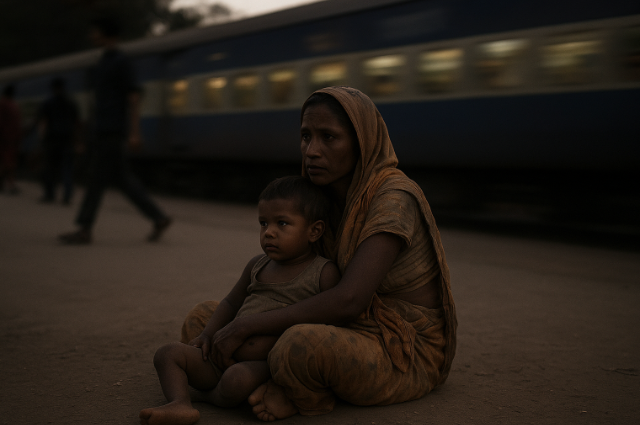
When I was returning from Gujarat to Kolkata after attending an ICSSR conference on Social Instability, I paused for a moment at Ahmedabad Junction, where evening trains kept arriving one after another. In that restless rush of passengers, my eyes caught something no research paper had ever prepared me for: not one person, not two, but an entire cluster of families huddled beneath the dim station lights, murmuring in a dialect that appeared in no book, no census report, no linguistic documentation. Their language, like their lives, was unrecorded voices without archives, people without acknowledgment. And in that moment, a painful truth struck me: there are corners of India where life is so fragile it arrives without celebration and disappears without grief, places where no child hears “Happy Birthday” because birthdays lose meaning when hunger is your first memory, places where no death is mourned. After all, sorrow requires time and dignity, luxuries the pavement cannot offer. Among those families was a mother barefoot, thin as a shadow, her saree torn like a forgotten page from history, holding her little son close, trying to silence his hungry cries; his stomach swollen but his eyes still carrying a question life never answered: “Why do we have nothing?” She searched the ground for a handful of stale scraps to feed him, while just a few feet away, a well-dressed boy climbed into a shining AC car, throwing away half-eaten food without a second glance.
To one child, food was something to waste; to the other, it was the difference between life and death. That moment felt like a wound two children born on the same land yet living in two different universes: one walking to school with polished shoes and a bag full of books, the other learning the alphabet of survival from a dustbin; one dreaming of vacations and tours, the other’s entire world contained within a six-foot patch beside the road. For families living under the open sky, birthdays are never celebrated because every day is a battle to stay alive, not grow older. When someone dies, there are no candles, no rituals, no mourning; their deaths pass like a fading sigh, unnoticed, uncounted, unmourned in a community where no one is excited about your birth and no one is heartbroken at your death.
Their shelter is a torn plastic sheet tied to a broken pole, their nights spent inches away from speeding trucks and bikes, every roar of an engine bringing the fear that one sudden skid, one drunk driver, one burst of speed could erase their entire existence in a second; their life runs parallel to the road, and one wrong turn can end everything. Their belongings fit into a single torn bag, their kitchen is a corner of the footpath, their playground is the space between dustbins and traffic, their clothes are stitched from discarded fabric, and their dreams are smaller than the cracks on the pavement. And yet despite the hunger, the danger, the invisibility, they continue to breathe, they continue to wait, they continue to exist in a world that refuses to acknowledge they are even here.
Historical and Social Context:
They did not arrive on the roadside in one sudden fall; they were pushed there slowly, painfully, like a son being forced to leave his mother’s lap even while his fingers still clutch her saree. Their villages once warm like a mother’s embrace, began to betray them as the soil dried, the wells shrank, and the crops withered into dust. Hunger became the first wind that blew them away from home. Many families walked out of their villages with the same heartbreak as someone escaping a burning house, not because they wanted to leave, but because staying meant dying slowly. Government reports quietly admit that millions flee their villages because the land that once held them gently now lets them go like a tired mother too weak to protect her children.
But the cities they run to greet them not with opportunities, but with indifference. They build our metros, malls, flyovers, and luxury apartments, yet the city treats them like invisible labour—wanted only for their hands, never for their humanity. Contractors use them for a day and forget them by night; wages vanish without warning; a single unpaid week can push an entire family from a rented room to a plastic sheet under a bridge. Natural disasters only deepen the wound: floods swallow their huts, droughts break their farms, cyclones tear away whatever is left. Reports say millions are displaced every year, but very few receive the rehabilitation promised on paper. The rest arrive at railway stations with trembling hope, only to discover that the station platform becomes their new home.
Urban planning pushes them even further. Slums are demolished for “beautification,” pavements cleared for convenience, as if the poor were stains on the city rather than its backbone. Skyscrapers rise like glittering towers of success while the people who built them are pushed to the edges, into the shadows, onto the pavement. And behind all this lies an older wound, caste, class, and generational neglect chains so old they feel like destiny. For many communities, poverty is not a phase but an inheritance, passed down like an unwanted surname.
So these families did not end up on the roadside because of fate; they ended up there because every door closed on them the village, the farm, the contractors, the system, the city. Now they live inches away from roaring trucks, not because they choose danger, but because danger is the only shelter India has left for them. This is not migration. This is exile. This is not homelessness. This is forced invisibility—written slowly across generations like a wound that never stops bleeding.
Life at the Roadside: The Daily Struggle
A glimpse of a morning from the night:
A roadside family does not wake up to alarms; they wake to noise—honking, shouting, the metal roar of buses passing inches from their heads as a child opens his eyes the way a wounded bird tries to fly, slowly and painfully, bruised by the pavement beneath him. The first thing he sees is dust, not sunlight, because for him, morning is never a beginning; it is a warning. Before her children wake, the mother has already woken her fear, checking their bodies for mosquito bites, rats, and ants, tucking a torn shawl around them like a shield that cannot protect before stepping out to search for food her footsteps the quiet footsteps of guilt, knowing hunger will greet her children before she can. According to a 2023 street-survival survey, nearly 68% of pavement families skip at least one meal a day, and cooking is a luxury they cannot afford; they do not cook, they hunt. A father waits behind a restaurant like a silent shadow for the waiter to throw away yesterday’s leftovers, gathering scraps gently as if lifting broken pieces of his dignity, while children line up near dustbins the way others line up at school gates that is their morning routine. Women breathe fear the way we breathe oxygen: constant, invisible, inescapable. They avoid parked trucks, strange voices, dark corners, and sleep beside their children like a broken wall they know they cannot stop everything, but they still try. One NGO report notes one in four homeless women faces harassment weekly fear becomes their second skin. By noon, the sun turns into their enemy, forcing them to run toward the shade of flyovers, abandoned buses, and half-built shops where shade becomes not comfort but survival, and heatstroke according to urban health reports, kills more pavement dwellers each year than winter cold. For their children, there is no school only survival; while other children carry bags and tiffins, roadside children carry plastic water bottles and sacks for collecting waste. Their school is the pavement, their playground is traffic, their teacher is struggling, and when a school bus stops nearby, they stare as if watching a world built for everyone except them. Evening deepens their fear as the road becomes a threat every speeding bike a nightmare, every drunk driver a storm, and a mother clutches her children tighter with every passing truck because one wrong wheel can erase an entire family in seconds. Night does not bring rest; it brings danger. They do not sleep they collapse under flickering streetlights that hang like dying guardian angels while dogs roam, drunk men shout, and vehicles rush without mercy; many families sleep with their shoes on, ready to run if the night turns against them. And so the cycle continues, without pause, without relief; their day does not end it simply repeats, like a wound that opens every morning and never gets the chance to heal.
Children of the pavement:
Children on the pavement do not carry balloons in their hands; they carry broken plastic bowls, held out to strangers like silent questions life has never answered. While other children run toward school with bags bouncing on their shoulders, roadside children run toward garbage piles, searching for bottles, metal scraps, and half-eaten food their childhood replaced by the alphabet of survival. According to a 2022 Save the Children report, nearly 1.5 million homeless children in India have never entered a classroom, and for these young ones, school is not a memory lost; it is a dream never permitted to begin. They stand at traffic signals with palms raised, not in play but in plea, their tiny hands learning to beg before they learn to write. The sun paints their faces with dust instead of glow, and their toys are not cars or crayons but rusted cans and discarded wrappers, the ruins of another child’s joy. A little girl who should be drawing butterflies sits near a drain, drawing circles in the mud, waiting for a passerby to drop a coin; her laughter has become a visitor she barely remembers.
Their bodies carry the signatures of poverty infected wounds, swollen bellies, cracked lips, signs of malnutrition that UNICEF notes affect over 35% of homeless children in urban India. Illness for them is not an event but a companion; cough, fever, skin disease, diarrhoea, worms, conditions that could be cured easily become lifelong shadows because hospitals do not open their doors to children who have no address. While other children are protected by walls, roadside children are protected only by chance. Their nights are loud with danger: trucks, dogs, drunken voices, and the cold. Fear becomes their bedtime story.
And yet the greatest tragedy is not hunger or illness, but the theft of childhood. Their games last only until a car honks. Their curiosity has to compete with traffic. Their innocence is forced to grow up before their height does. They learn the world not through cartoons or bedtime stories but through begging bowls, torn sacks, and the sharp edges of survival. A childhood is meant to be a soft place but theirs is the pavement, a ground that bruises everything it touches. And in a country of millions, they remain unseen, unheard, and uncounted children born in a nation, but raised by the road.
Women at risk:
She lives a life without doors, the only woman in the city who cannot close anything behind her. No walls, no lock, no room; only the open sky acting as a ceiling that never protects. Her saree becomes her only shield, a thin piece of cloth trying to perform the duty of curtains, walls, armour, and dignity all at once. She uses it to hide her tears, to guard her daughter, to wrap her newborn, to cover herself from the eyes that stalk her steps. For her, harassment arrives like dust everywhere, every day, settling on her without warning, without pause. Men slow their bikes, boys stare too long, drunk voices float towards her like poisoned air. None of it is loud enough to record, but every bit of it is loud enough to terrify. A Delhi-based 2023 homelessness report found that nearly 47% of pavement-dwelling women face daily harassment, but numbers cannot measure how she shrinks her body each time a stranger walks too close.
Hygiene is not her routine; it is a battlefield she crosses with trembling hands. She bathes behind unfinished buildings with water stored in an old Sprite bottle, looking over her shoulder every few seconds. She waits for the whole street to sleep before changing a cloth during her period privacy becomes a commodity she can never afford. Her womb itself becomes an open battlefield: a child growing under the sky, while she has no clinic, no checkup, no shade, not even a clean place to sit. She carries pregnancy like a fragile earthen pot that could crack under hunger, heat, or exhaustion. Many women like her give birth right on the pavement, labour pains drowned by truck horns, newborns arriving in a world where their first blanket is a torn saree. UNICEF estimates thousands of such unrecorded births every year, babies entering life without silence, without safety, without a roof.
When the sun sets, night does not fall; night hunts. Fear replaces sleep; danger replaces darkness. She curls around her children like a broken wall, trying to stand between them and the world. She keeps her shoes on even while sleeping, ready to run at the smallest noise. The road watches everything but protects nothing. And yet she endures, carrying fear like a purse, courage like a whisper, and survival like a second skin, living a life the city uses every day but never sees.
Why Society Ignores Them:
Although these people live on the same roads we walk every day, society behaves as if they exist in a different world altogether. The distance is not physical; it is psychological. Social researchers call this phenomenon “social invisibility”, a state where individuals are seen but not acknowledged. A 2023 report by the Centre for Equity Studies found that more than 63% of urban homeless individuals feel that people look “through” them rather than “at” them, proving that invisibility is not just symbolic but deeply emotional.
One major reason for this invisibility is middle-class discomfort. Most regular citizens want to maintain mental peace and stability. When they see someone living on the streets, someone hungry, unprotected, or neglected, it creates an uncomfortable reminder of inequality. According to a survey by the Azim Premji University (2022), 74% of middle-class respondents admitted that poverty makes them feel “uneasy or guilty”, which leads them to avoid eye contact or interaction. Ignoring becomes a coping mechanism.
This discomfort gets reinforced by stereotypes attached to poverty. Many people are taught directly or indirectly that roadside dwellers are lazy, dangerous, addicted, or responsible for their own suffering. These stereotypes are not based on reality but on fear, misinformation, and a desire to justify inequality. In fact, government data contradicts these ideas: the National Urban Livelihoods Mission (2021) reported that more than 80% of homeless people are employed in informal work, but still cannot afford housing due to low wages, unstable jobs, and rising living costs. So, the stereotype that they “don’t work” collapses immediately when the data is examined.
At the heart of this issue lies the emotional hypocrisy of society. People post about kindness online but refuse to offer even simple humanity on the street. They call themselves compassionate, but cross the road to avoid a poor child. It’s not that society lacks empathy; it’s that empathy is selective. We are willing to feel for disaster victims far away, yet we remain silent towards those suffering right beside us.
This emotional contradiction creates a wall, not a real wall, but a mental one. And that invisible wall is the reason the poorest remain unseen, unheard, and uncared for, even when they stand in the middle of our daily lives.
Government Policies & Their Failures
India has no shortage of welfare schemes on paper, especially those aimed at housing, food security, and urban shelter. Yet the people living on footpaths remain outside every circle of benefit. The gap between policy design and policy delivery becomes clearest when examined through the lives of roadside dwellers.
The Pradhan Mantri Awas Yojana (PMAY), launched to ensure “Housing for All,” promises pucca homes with basic amenities. Government data shows lakhs of houses sanctioned across states. But the scheme collapses for homeless people at its very first requirement: documentation. PMAY needs Aadhaar, bank accounts, proof of residence, and often land records documents that no roadside family possesses. An activist from a Delhi-based NGO, Safar India, explains: “A home cannot be claimed by someone who has no address to write on the form.” This structural irony is why PMAY rarely touches the truly shelterless.
Urban homeless shelters, mandated under the National Urban Livelihoods Mission (NULM), face similar shortcomings. Cities are advised to build one shelter per lakh population, yet multiple surveys (including those by independent civil groups) show shelters remaining inadequate, poorly maintained, or unsafe for women. In several metro cities, homeless shelters operate at half capacity, not because fewer people need them, but because the facilities lack sanitation, privacy, and basic safety. Many roadside women avoid these spaces, claiming harassment cases inside shelters go unreported. The infrastructure exists, but without accountability or sensitivity, it remains unused.
On the food front, schemes like the Public Distribution System (PDS) and PM Garib Kalyan Anna Yojana (PMGKAY) provide subsidised grains to crores of households. But eligibility again depends on ration cards, another document that homeless people do not have. While the One Nation, One Ration Card (ONORC) system has improved portability for migrants, the scheme does not cover those who have never been registered. Street families often end up relying on leftover food, charity, or irregular NGO distributions. As one volunteer from “Seva Bhoj Foundation” states: “We have food for the poor, but the poorest are missing from our lists.”
Corruption and poor implementation widen the gap. Funds meant for shelters remain underutilised; construction delays stretch for years; and monitoring systems are weak. Many state governments submit compliance reports that look perfect on paper, while the ground reality shows significant shortages. Additionally, administrative bias plays a role — roadside dwellers are frequently treated as “encroachers,” not citizens in need. This perception influences how officials treat them and whether their applications, if attempted, are taken seriously.
Ultimately, the government claims it has built nets to catch the falling poor PMAY for housing, PDS for food, NULM shelters for safety, but for roadside families, those nets feel like ropes that never reach their hands. PMAY promises a pucca house, yet every form demands an address, a document, proof that things a pavement family does not have. It is like asking a bird for land papers before allowing it to build a nest. The city’s homeless shelters, designed to protect them, often become locked fortresses; a woman sleeping under a flyover says, “The shelter has walls, but I am the one still sleeping outside.” Food schemes like PDS and NFSA promise rations to all, yet the ration card demands the one thing they cannot give: stability. A migrant who moves from city to city in search of work cannot explain to the system why his address changes like the seasons. So the schemes exist on paper like rainclouds that thunder but never rain over the pavement. According to housing rights audits, barely a fraction of the urban homeless are registered in any welfare database; they are people who live in full view of the nation yet are invisible in every official list. And when corruption, middlemen, and documentation hurdles block their path, the roadside poor realise that the state has built a staircase out of policies, yes, but the first step is so high that they cannot climb it.
Voices of the Forgotten: ONE CONTINUOUS FLOW
The city moves like a giant machine, gears turning, lights blinking, engines humming, but beneath its flyovers and beside its footpaths live voices that vibrate softly, like signals no one tunes into. After walking through their fears, their nights, their hunger, their invisibility, I finally sit with the people themselves, not as subjects of policy, not as symbols of poverty, but as human beings whose words carry more truth than any report. Their voices are cracked, but they shine through the cracks.
Near the signal where the dust swirls like tired smoke, Afsana, a 32-year-old mother, rocks her child as if rocking away the city’s cruelty. She speaks without looking up. “People look at us,” she says, “the way they look at stains on a window they see, but they do not focus.” Her metaphor is simple but brutal: they are seen, but never noticed. She tells me she once dreamt of becoming a tailor. Now she tailors her days with fear and her nights with prayer. “When others sleep,” she whispers, “our fear wakes up first.” And suddenly, all those earlier sections of harassment, hunger, and night terror feel like they were only the shadows around the truth she is telling now.
A few metres ahead sits Rafiq, a 14-year-old rag-picker whose smile is too thin for his age. Childhood should have been a schoolbag; his is a torn plastic sack dragging behind him like a tired puppy. “I read books only when I find them in garbage piles,” he says. “If pictures come, I feel happy.” His voice is the quiet kind the kind that learned early that dreams are expensive. Yet he still has one: “One day, I will drive a big car.” The irony stings the boy who knocks on windows for coins, dreams of sitting behind their steering wheel.
On the corner, beside a tin sheet that shudders like her bones, sits Kamla Devi, probably past sixty, though poverty ages faster than time. “I had a house once,” she says, “but a house dies when the people in it go.” Her metaphor is the whole history of displacement in a single breath. She fears dying silently on the pavement. “Even birds cry when another bird falls,” she murmurs. “For us, not even footsteps slow down.”
Their three voices blend into one truth:
The roadside is not silent; it is unheard.
And a society that cannot hear the living will never understand what it means to save them.
What Experts Say
The voices of Afsana, Rafiq, and Kamla still echo in the air like fading notes, and into that trembling silence step the experts who study the very lives that society tries not to look at. Their words do not cancel the pain of the pavement; they only explain why the pain keeps repeating. As if every year, every policy, every budget is just another layer of paint on a wall that is already broken.
Dr. Meera Sen, a sociologist from Delhi University, watches the flyover shadow stretch across the pavement and says, “India’s biggest problem is not homelessness, it is the habit of walking past it.” She explains that the poor are not invisible by nature; they are made invisible by the middle-class gaze that has trained itself to look away. She calls it “social editing,” the way people delete the presence of roadside families from their mental frame, just like a photographer crops out what doesn’t fit the picture. Her metaphor hits where it hurts: “We have a society where a broken phone screen gets more attention than a broken human life.”
Next, Arvind Joshi, an NGO field coordinator who has spent fifteen years working with homeless families, adds a harsh truth. “Policies fail not because they are bad,” he says, “but because they are written for people who already have documents.” Aadhaar, ration cards, residence proofs, these are things pavement dwellers lose as easily as dust loses shape in the wind. He sighs, looking at the families cocooned in torn blankets. “You cannot enter a system if the system does not admit you exist.”
From the urban planning side, Professor Ravindra Kamat, an expert on city development, explains it with the precision of someone who has seen too many plans fail on paper and on pavement. “Cities grow like machines,” he says, “but poverty grows like weeds silently, stubbornly, in the cracks we refuse to repair.” He argues that shelters are built far from work areas, food schemes collapse under local corruption, and rehabilitation becomes a maze where the poor walk in circles.
All three experts, from different worlds, point to one truth
The system is designed like a locked door, and pavement dwellers are the people standing outside without a key.
A Glimpse of Hope
Hope does not arrive on the pavement like a sunrise; it arrives like a cracked seed forcing itself through concrete, slow, trembling, but refusing to die. For years, roadside families have lived as the city’s unacknowledged shadows, visible yet unseen. But even shadows can turn into shapes when someone finally decides to look at them. That turning point came for Sabiha, a woman who had spent a decade surviving nights that hunted her and mornings that bruised her dignity. She once whispered, “I don’t sleep, I only shut my eyes and pray the road does not choose my child tonight.” Her life changed on a flooded monsoon evening, when rain soaked her children’s last blanket, and trucks splashed mud across the only belongings she had. Defeated, drenched, and carrying fear like a second skin, she stepped into a small roadside camp run by Udaan India, an NGO working in the forgotten corners where government policies rarely walk.
What followed wasn’t a miracle; it was simply a system functioning the way it should, which felt miraculous only because it is so rare. Volunteers helped her obtain an Aadhaar card, something she had been denied for years because the pavement has no permanent address. They enrolled her in a tailoring workshop, provided evening meals through a community kitchen modeled after Chennai’s Amma Canteen, which feeds over 12,000 homeless people daily (Local Welfare Digest, 2023), and helped her secure a spot in a subsidized rental program. Within six months, Sabiha moved into a single cramped room barely bigger than the plastic sheet she once lived under but it had something the pavement never offered: a door that closes, a lock that defends, and a night that finally lets her sleep.
Cities like Indore, which redesigned shelters near labour hubs and increased occupancy by 40% (Municipal Field Report, 2023), show that change is not a dream; it is a design. Today, Sabiha’s daughter attends a municipal school, and her son no longer collects bottles at traffic signals. Hope remains fragile, standing like a lantern at the edge of a long night, but it glows with a promise:
“If one woman can step off the pavement, perhaps an entire generation can too.”
Final Call to Action:
The story of our cities has always been told through its tallest buildings, widest flyovers, and brightest malls—but rarely through the people who sleep beneath them. And yet, the truth is simple: a city is only as human as the way it treats its most forgotten residents. If change must begin, it must begin by acknowledging that the roadside dwellers are not shadows, not burdens, not “others”; they are threads in the same cloth that wraps our nation together. Citizens can start by seeing them, speaking to them, supporting local shelter initiatives, donating unused clothes and food responsibly, or volunteering once a week. These tiny gestures may look like drops, but drops are what make a river. Meanwhile, the government must repair what is accountability in welfare delivery, clarity in documentation, honest monitoring of shelters, investment in mental-health support, and above all, policies built with the homeless, not merely for them. Society must rethink its reflex to blame poverty on laziness; the real laziness lies in looking away.
And as we return to Salim, the little boy who opened this journey, he still sleeps under the same flyover, curled beside his mother, while traffic groans above them like an indifferent sky. Every night, he counts the passing headlights, imagining they are fallen stars he might catch. Every morning, he wakes up to the dust, the noise, the uncertainty, yet he still dreams. His world has not changed, but perhaps ours has, simply because we paused long enough to witness his. His struggle is ongoing, a reminder that India’s development story is incomplete, unfinished, uneven. And the haunting truth is this: cities grow upward, but people like Salim remain on the ground.
Hope, however, is not absent. It flickers in every citizen who refuses to walk past suffering, in every policymaker who chooses honesty over convenience, in every teacher who encourages empathy in a classroom, and in every reader who finishes this article with a shifted heart. The final line of this story belongs not to Salim, nor to those who wrote about him, but to you. Because someday, years from now, when our cities are judged not by their skylines but by their compassion, your choice today may be the reason a child like Salim wakes up not to a flyover ceiling… but to a roof, a classroom, and a future he finally has the right to claim.
. . .
References:
Government & Policy Documents
- Pradhan Mantri Awas Yojana – Urban (PMAY-U) Mission Guidelines. Ministry of Housing & Urban Affairs, Government of India, 2015.
- Shelter for Urban Homeless (SUH) – Operational Guidelines. National Urban Livelihoods Mission (NULM), 2013.
- National Food Security Act (NFSA), 2013. Government of India.
- Census of India 2011. Office of the Registrar General & Census Commissioner, Government of India.
Reports & Independent Studies
- UN-Habitat. The Challenge of Urban Poverty in Developing Countries. 2020.
- Human Rights Watch. “No Place to Sleep”: Homelessness in Indian Cities. 2017.
- Azim Premji University. State of Working India Report. 2022.
- Centre for Equity Studies (New Delhi). India Exclusion Report. 2016–2020.
- Aashray Adhikar Abhiyan (AAA), Delhi Field reports on urban homeless shelters and access barriers.
- Prayas – Centre for Child Rights Observations on child vulnerability, rag-picking, and unsafe street environments.
- Goonj NGO Rehabilitation practices and community-led dignity drives.
- The Hindu, Indian Express, Scroll.In The Wire Coverage on homelessness, welfare gaps, and migrant displacement.
- BBC News and Al Jazeera Global perspectives on inequality and urban poverty.