
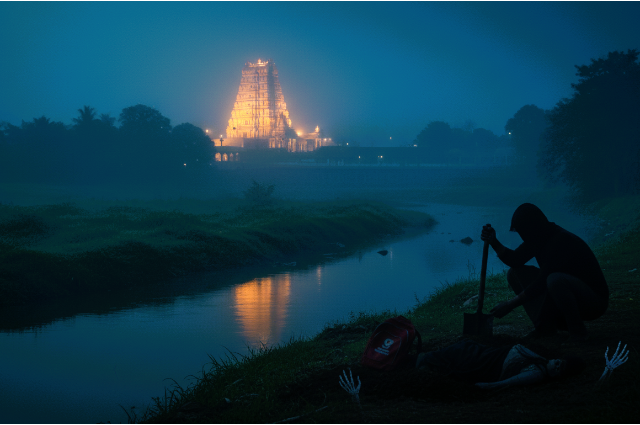
(Disclaimer: This article is based on publicly available information and reports related to ongoing investigations. It contains no defamatory or speculative claims and adheres strictly to a factual, journalistic standard.)
“Mr. D” is a placeholder name. His real identity is intentionally withheld by the Karnataka Police for security and investigative reasons.
Two-Year Retraction: A Mother’s Unsettling Reversal
The disappearance of Ananya Bhatt in 2002 triggered a legal and emotional battle that stretched across more than two decades. At the centre stood her mother, Sujata Devi, whose unwavering conviction shaped the course of the investigation. For twenty-two years, she maintained that her teenage daughter had been murdered by a man referred to as Mr. D, who had allegedly disposed of the body. Her pursuit of justice, born from grief and persistence, became the foundation of the case.
That foundation collapsed abruptly.
In a moment that stunned both the public and the legal system, Sujata Devi appeared before the media and the courts to completely retract her testimony. The anguish and determination that once defined her were replaced by an unsettling calm.
“I have no daughter named Ananya Bhatt,” she stated. “I am asking for forgiveness. Please release me from this controversy. I want to live my life.”
This reversal introduced a disturbing complexity. Why would a mother uphold a narrative for twenty-two years only to dismantle it so suddenly? The motive remains unclear. Investigators are now forced to consider two possibilities: either the original allegation was fabricated, or Sujata Devi was subjected to prolonged intimidation or coercion by powerful forces. The possibility that fear for her own safety ultimately outweighed even a mother’s grief cannot be dismissed, pushing the investigation toward the shadowy realm of influence, pressure, and silence.
The Architect of Silence: Mr. D’s Calculated Confession
Attention soon returned to Mr. D, the man named in the original accusation. In December 2014, he vanished entirely—disappearing with his family and severing all contact. For years, he lived in hiding, haunted by fear, guilt, and recurring nightmares of buried bodies. The psychological toll became unbearable.
Mr. D believed that surrendering to the police was dangerous. According to him, the true masterminds behind the crimes were highly influential individuals—some political, others holding senior official positions. He feared that implicating them openly would result in his elimination. Any move toward confession, therefore, had to be calculated and precise.
In July 2025, Mr. D arrived at the Dharmasthala police station and delivered a detailed, composed confession. This was not an emotional breakdown but a structured account. He provided names, timelines, locations, and methods of disposal. The scale of the confession was staggering: he claimed responsibility for disposing of more than 100 bodies over several years.
The revelation transformed the case into a matter of national urgency, prompting the Karnataka police to mobilise extensive resources.
Conditions for Cooperation and the First Discovery
Mr. D agreed to lead investigators to the burial sites, but only under strict, non-negotiable conditions:
- His identity must remain permanently secret.
- The safety of his family must be fully guaranteed.
- His name and physical appearance must never be revealed publicly.
The police accepted these terms. On July 11, 2025, a specialised team—accompanied by a fully concealed Mr. D and two legal representatives—conducted searches near the Dharmasthala temple. While the full number of alleged burial sites was not immediately uncovered, investigators recovered two to three human skeletons.
Officials emphasised that even a single recovery validated the gravity of the allegations. The focus now shifted sharply: Who were these victims? Who ordered their disposal? And was the sacred geography incidental—or deliberately chosen?
The Hegde Family and the Seat of Power
The investigation inevitably turned toward the Hegde family, custodians of the Dharmasthala temple and one of Karnataka’s most influential lineages. The current Dharmadhikari, Virendra Hegde, is the 21st in succession and a recipient of the Padma Vibhushan. His close ties with the ruling establishment add a sensitive political dimension to any inquiry linked to his domain.
The allegation that over 100 bodies—many believed to be those of teenage girls—were buried in areas under the temple’s jurisdiction raises deeply troubling questions. While no direct accusation has been legally established, the scale and proximity of the alleged crimes demand scrutiny.
This is not the first time the temple authorities have faced public suspicion. The Soujanya rape and murder case remains a haunting precedent. The victim’s parents have long maintained that powerful individuals connected to Dharmasthala were complicit or protected. Protests and public dissent surrounding that case form an essential backdrop to the current investigation.
Responding to renewed scrutiny, temple spokesperson K. Parinath Jay acknowledged past allegations but expressed confidence that the Special Investigation Team would conduct an impartial inquiry and bring the true culprits to justice, irrespective of status or influence.
The Cost of Silence and the Hope for Justice
The unfolding narrative exposes a devastating human cost:
– A man who claims he buried bodies for nearly two decades under coercion.
– A mother who fought for justice for 22 years before denying her daughter’s very existence.
– Families still waiting for answers about deaths now believed to be part of a larger pattern of violence.
Dharmasthala, long synonymous with faith, charity, and spiritual cleansing, now bears an unsettling shadow. The idea that innocent victims may lie buried near the sacred Netravati River has shaken the public conscience.
An Investigation Still Searching for Its End
Those responsible may wield immense power, enough to evade immediate accountability. Yet the belief in divine justice persists—that no authority, however influential, can escape ultimate moral reckoning. The hope remains that a thorough, fearless, and unbiased investigation will prevail, ensuring that silence no longer shields brutality, and that truth, however delayed, is finally unearthed.
Dharmasthala may still echo with prayers, but beneath them lies a silence heavy with names never spoken. As the investigation continues, what lies beneath Dharmasthala now raises questions that silence can no longer contain.