
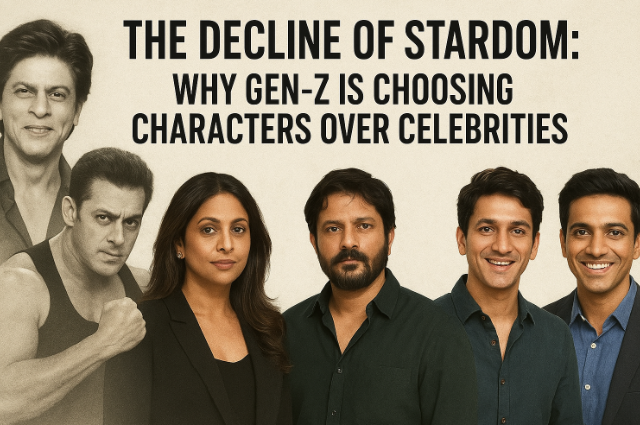
For decades, Indian cinema revolved around one thing: stars. Not stories, not scripts, not craft. Just faces. A movie succeeded simply because Shah Rukh Khan smiled, Salman flexed, or Aishwarya turned her face in slow motion. The industry wasn’t just built on filmmaking; it was built on worship. Actors weren’t seen as performers. They were treated like cultural gods.
But something has shifted, and it’s not subtle. A new audience has quietly changed the rules. Gen-Z doesn’t treat fame the way previous generations did. They don’t care about legacy, lineage, or the idea that an actor deserves respect simply because of their surname or long-standing presence in the industry. They’re not looking for icons to adore. They’re looking for characters they can emotionally invest in.
Earlier, fans didn’t just like actors; they protected them. Criticism was seen as disrespect. Today, criticism is participation. Expression. Accountability. Gen-Z scrolls, reacts, questions and moves forward without apology. Their relationship with cinema is less devotional and more transactional: If the performance is good, they care. If it’s not, they move on.
One major reason behind this shift is access. There was a time when knowing anything about an actor felt like a privilege. Interviews were limited. Appearances were rare. There was a mystique at a distance that made stardom feel untouchable. Now everything is immediate. Interviews, podcasts, livestreams, paparazzi reels, and celebrities exist in the same digital spaces as their audience. The distance shrank, and with it, the aura.
When celebrities are everywhere, they stop feeling extraordinary.
Streaming platforms accelerated the shift. The new Indian audience grew up watching not just big Bollywood films but also Malayalam thrillers, Tamil crime dramas, Korean romances, Turkish family series, and Western miniseries. Storytelling became borderless. Characters became global. Talent became visible beyond heritage and hype. Suddenly, an actor didn’t need a famous last name; they needed range.
That’s why names like Pratik Gandhi, Shefali Shah, Jaideep Ahlawat, Vijay Varma, Rasika Dugal, and even Korean actors like Song Kang or Park Seo-joon trend nationally. They don’t trend because of glamour. They trend because viewers connect to the characters they play, flawed, layered, believable, sometimes painfully real.
There’s another subtle dimension to this shift: relatability. Old stardom thrived on aspiration, an unreachable life that audiences dreamed about. Gen-Z has grown up watching influencers who are accessible, chaotic, imperfect, and unfiltered. When comparison becomes constant, perfection feels artificial. Celebrity lifestyles no longer feel inspiring; sometimes, they feel performative.
Relatability now carries more weight than grandeur.
The audience today wants vulnerability, not polish. Depth, not rehearsed PR lines. Authentic gratitude, not scripted humility. So when actors behave entitled, defensive, or disconnected from their audience’s reality, viewers don’t forgive; they detach.
Another factor reshaping the landscape is narrative complexity. Earlier, movies were vehicles for stars. The plot revolved around them. Today, the story comes first. People now admire writers, directors, cinematographers, and background score composers with the same enthusiasm that once belonged exclusively to actors. Cinema is no longer a personality cult; it’s becoming a collaborative craft.
Even fan culture is evolving. Instead of obsessing over one face for a lifetime, audiences develop temporary emotional loyalty to characters. They fall in love with a role, not the human behind it. And once the story ends, the attachment does too. It’s softer, more fluid loyalty, not devotion, but appreciation.
The shift also reflects something deeper about generational psychology. Gen-Z grew up amid instability, pandemic uncertainty, job insecurity, competitive education systems, mental health struggles, and overstimulation from constant content consumption. This generation values emotional truth more than spectacle. They want art that acknowledges complexity, characters who feel human, and cinema that sees them rather than distracts them.
That’s why a series like Made in Heaven sparks conversation even with no conventional “stars,” and films like Gully Boy, KGF, or Kantara succeed because they belong to worlds, not personalities. Cinema is slowly returning to what it originally was: storytelling.
This doesn’t mean stardom is dead. It’s transforming. The new form of fame is earned, not inherited. It isn’t about distance, it’s about connection. It isn’t about fantasy, it’s about presence. And it doesn’t come from PR, interviews, or curated perfection. It comes from craft.
Maybe the most surprising part is that audiences still want icons, but not the untouchable ones. They want flawed, grounded, self-aware performers who treat acting as work, not entitlement. They want people who disappear into roles, not people who demand loyalty.
The industry now stands at a fascinating intersection: the past ruled by megastars, and the future shaped by characters who live longer in memory than the actors who played them. Stardom isn’t disappearing, it’s being rewritten.
And maybe that’s healthy.
Because cinema should move people, not just markets.
And maybe the next generation of icons will not be worshipped for who they are but respected for how deeply they make us feel.
References:
- https://www.bbc.com
- https://www.weforum.org
- https://variety.com
- https://www.pewresearch.org
- https://hbr.org